

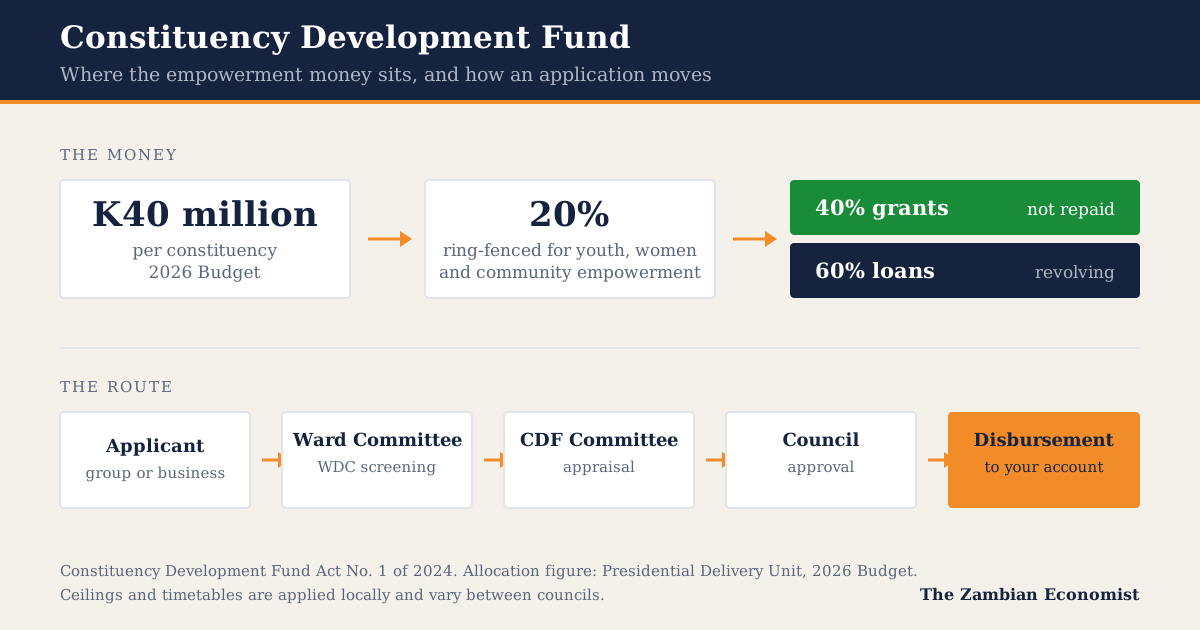
Every constituency in Zambia was allocated K40 million under the Constituency Development Fund in the 2026 Budget, against K1.6 million in 2021. Nationally that comes to K6.245 billion, according to the Presidential Delivery Unit. A fifth of it is set aside for youth, women and community empowerment — grants and loans for ordinary businesses.
Most people who qualify never apply. Not because the money is hidden, but because nobody explains the route clearly: which committee, which form, which documents, and in what order. This is that explanation.

What the CDF actually is
The Fund is established under Article 162 of the Constitution and operationalised by the Constituency Development Fund Act No. 1 of 2024, which replaced the 2018 Act. It is administered by the Ministry of Local Government and Rural Development, and spent locally by your council, working through a Constituency Development Fund Committee (CDFC) and Ward Development Committees (WDCs).
Every one of Zambia’s 156 constituencies receives the same allocation. Your constituency has exactly as much to spend as any other.
The money is divided into components:
- Community projects — classrooms, clinics, boreholes, bridges, roads
- School and skills development bursaries — secondary boarding fees and TEVET or ZNS training
- Youth, women and community empowerment — grants and revolving loans for businesses and groups
- Disaster and emergency — reserved for natural occurrences
The third one is the business money. That is what this guide covers.
Where the empowerment money sits
Twenty per cent of the total constituency allocation is ring-fenced for youth, women and community empowerment. Of that ring-fence, roughly 40 per cent goes out as grants and 60 per cent as loans.
Applied to a K40 million allocation, that puts something in the order of K8 million per constituency into empowerment, split roughly K3.2 million in grants and K4.8 million in loans. Treat those as indicative rather than exact — councils release against actual disbursements received, and the split is applied at council level.
The loans are revolving. Repayments return to the constituency and fund the next round of applicants, which is why councils take repayment seriously even at concessional rates.
For a sense of the real scale: in June 2026 Lumezi Town Council approved K5,077,670 for 91 beneficiaries under the 2025 and 2026 empowerment facility, of which K2,755,000 went to 69 clubs and community groups as grants. That is a workable amount of money reaching a lot of small operations.
Grant or loan — which one are you applying for?
This is the first thing to get right, because the two have different applicants, different forms and different committees looking at them.
Grants
Grants go to organised groups — clubs, cooperatives and community groups — as seed money for livelihood activities. They are not repaid. Councils generally require a minimum of ten members and cap the amount; Namwala Town Council, for example, set a one-off ceiling of K40,000 per group. Caps differ by council, so check yours.
Loans
Loans go to registered businesses — including cooperatives, clubs and small and medium enterprises — whether starting up or expanding. They are repayable on concessional terms. This is the larger pot, and it is the one most individual entrepreneurs should be looking at.
Who qualifies
Requirements are set nationally in the CDF Guidelines and applied locally, so wording varies slightly between councils. The consistent conditions are:
- Zambian citizenship, with a green National Registration Card
- Residence in the constituency — commonly at least six months
- The project must be carried out within that constituency
- For groups: a minimum of ten members and a group bank account or registered mobile wallet
- For loans: a legally registered business, organisation, cooperative or club wholly owned by Zambians
- The proposal should generate income and, where possible, employment
The skills bursary component runs on separate criteria — applicants aged between 16 and 35 with an admission letter from a TEVET institution or the Zambia National Service. School leavers and people already trading who need to re-skill are both eligible.
Documents to assemble before you start
- Certified copies of the NRC for every applicant or group member
- Proof of residence in the constituency
- Registration documents — PACRA certificate, cooperative registration or society registration
- A register of members, for groups
- Proof of a bank account or registered mobile wallet in the group or business name
- A written business proposal
- A recommendation letter, where your council requires one
- A declaration of any loans taken in the last three years and their current balances
Assemble all of it before you collect the form. Incomplete packs are the most common reason an application stalls, and a pack that goes back for missing papers usually misses the appraisal cycle it was aimed at.
The application route, in order
- Watch for the call. Councils advertise an application window, usually with a closing date. Notices go up at the council, at ward offices and increasingly on council websites and Facebook pages.
- Collect the form from the council or your Ward Development Committee, and be clear whether you are taking the grant or the loan form.
- Write the proposal. State the problem you are solving, what you will spend the money on line by line, what you expect to earn, and how many people will work on it.
- Submit at ward level. The Ward Development Committee is the entry point. Hand it to the WDC and keep a stamped copy.
- WDC screening. The ward committee checks eligibility and forwards what qualifies.
- CDFC appraisal. The Constituency Development Fund Committee assesses proposals and recommends them.
- Council approval and disbursement. The council approves and pays into the account you supplied.
Note where the decision actually sits. Under the 2024 Act, approval is decentralised — the CDFC and the council carry it. The committee includes councillors, traditional leadership, civil society, religious and disability representatives, and youth and women’s representatives, with the Member of Parliament sitting ex officio.
How long it takes
Longer than the notice suggests. An application window may run several months, and appraisal happens in batches after it closes. Councils disburse as funds are released to them, not on the day of approval. Plan on the assumption that money approved in one quarter arrives in the next, and do not commit to a supplier before the funds are in the account.
Why applications fail
- Incomplete documents. A missing certified NRC copy or an unregistered group account is enough.
- A proposal with no numbers. “We want to start a poultry business” is not a proposal. Bird numbers, feed costs, expected sale price and a repayment schedule is a proposal.
- The wrong form. Group grant criteria applied to an individual business loan, or the reverse.
- A project outside the constituency. The activity must happen where the fund sits, not where you happen to live.
- Undisclosed existing debt. Councils check. An undeclared balance elsewhere reads as a repayment risk.
- Missing the window entirely. This is the biggest one. Ask your council when the next call opens and diarise it.
The CDF is not the only door
The Citizens Economic Empowerment Commission, established under the Citizens Economic Empowerment Act No. 9 of 2006, runs its own funding rounds through the Citizens Economic Empowerment Fund. The 2026 call for applications closed on 27 February 2026, so the CDF is the live route for most of this year, but CEEC rounds recur and its provincial offices publish product guidelines.
Businesses looking for investment rather than concessional lending should also look at the Zambia Investment Deal Room, which had 202 fund seekers and 187 registered investment projects on it — a different proposition, aimed at equity and structured deals rather than small empowerment finance.
What to do this week
- Call or visit your council and ask two questions: when the next empowerment window opens, and what the current grant ceiling is for your constituency.
- Decide whether you are a group applying for a grant or a registered business applying for a loan. If neither fits yet, fix that first — register the cooperative, or register the business.
- Open the bank account or mobile wallet in the group or business name. Applications are rejected over this routinely.
- Write the proposal with real figures in it. If you cannot show what the money buys and what it earns, the committee cannot approve it.
A note on how we have written this
Requirements, ceilings and timetables are set nationally but applied by 116 local authorities, and details differ between them. Everything above describes the national framework and gives council examples where they are documented. Before you rely on a figure, confirm it with your own council. Where we learn that a detail here has changed, we will update this article and record the change.
Primary sources: Constituency Development Fund Act No. 1 of 2024 · CDF Guidelines, Ministry of Local Government and Rural Development · Presidential Delivery Unit · council application notices
Part of our Doing Business in Zambia series of practical guides.