


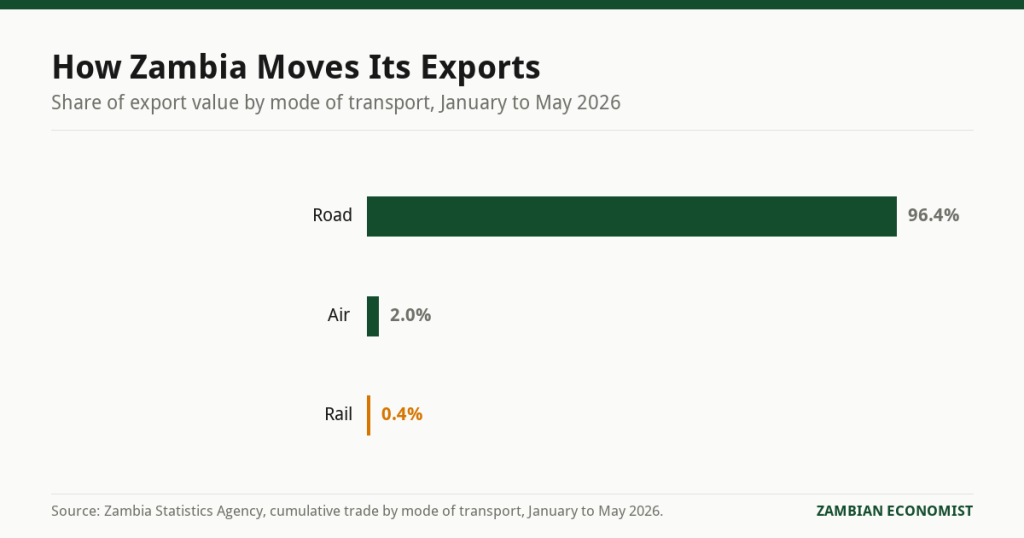
Here is the most under-discussed statistic in Zambian trade policy. Between January and May 2026, Zambia exported goods worth K135.4 billion. Road transport carried K130.5 billion of that — 96.4 percent. Air carried 2.0 percent. Rail carried 0.4 percent.
By volume the picture is no better: of 4.1 million tonnes exported, rail moved 12,800 tonnes, or 0.3 percent.
A landlocked country with a century-old mining industry moves almost nothing by rail. Every tonne of copper leaving Zambia by truck is paying a freight premium, adding a road maintenance liability, and competing for the same border posts as everything else the country trades.
That single fact frames Zambia’s strategic position in the global economy more accurately than any statement of foreign policy. It also explains why corridor diplomacy has become the most consequential external negotiation Zambia is currently conducting.
The repositioning question
Zambia’s place in the world economy has been essentially unchanged for a century: a supplier of unprocessed copper to distant industrial economies, dependent on other countries’ infrastructure to reach them.
What has changed is the environment. Three shifts have occurred more or less simultaneously.
Copper became strategic rather than merely industrial. Electrification, grid expansion, electric vehicles and data centre construction have moved copper from a cyclical industrial input to a material that governments track for national security reasons. London Metal Exchange copper prices rose 10.9 percent in January 2026 to US$13,088.9 per tonne, and structural deficit forecasts have become mainstream.
Supply chain security displaced pure cost minimisation. The United States and European Union now actively finance infrastructure to diversify critical mineral sourcing. Where a mineral is processed, and by whom, is now a policy question rather than a commercial one.
Africa acquired institutional weight. The African Continental Free Trade Area, the African Union’s Agenda 2063 and a more assertive African Development Bank have created continental frameworks that did not previously exist.
Zambia sits at the intersection of all three. That is a position of genuine leverage, and leverage is a wasting asset.
The Lobito Corridor: what it is and what it is not
The Lobito Corridor is a rail-based logistics system anchored in the Benguela Railway, connecting the Atlantic port of Lobito in Angola to the mineral-producing regions of southern DRC and the Zambian Copperbelt. The rail route runs roughly 1,300 kilometres, and the project includes a greenfield line of around 800 kilometres linking Angola and Zambia directly for the first time.
The financing and diplomatic architecture is unusual. The Africa Finance Corporation is lead developer. The African Development Bank committed US$500 million and undertook to help raise substantial additional financing. A memorandum of understanding covering the corridor was signed by the European Union, the United States, Italy and the three host countries alongside the AfDB and AFC. The United States has framed the corridor as a model for commercially-anchored engagement in Africa.
What it genuinely offers Zambia
- An Atlantic outlet. Zambian copper currently reaches world markets primarily through southern and eastern African ports. An Atlantic route materially shortens access to European and American markets.
- Route competition. The value of a second option is not only the second option. It is the pricing discipline it imposes on the first.
- Non-mineral freight. Corridor infrastructure carries agricultural produce, fertiliser and general cargo. For farmers in North-Western Province, that is potentially transformative.
- Diplomatic convening power. The corridor has placed Zambia in a room with the EU, the US, the AfDB and the AFC simultaneously. That access has value beyond the railway.
What it does not solve
Analysts at ECDPM have noted that despite the framing of the corridor as an alternative to Chinese sourcing, there is limited clarity on actual committed investment along the route, and that European and Chinese commercial interests are in practice deeply intertwined. The geopolitical narrative and the commercial reality are not the same document.
More fundamentally, a corridor moves raw material out faster. It does not, by itself, add value inside Zambia. A more efficient route to export unprocessed copper is a better version of the existing model, not a different one.
And corridors carry a specific risk for landlocked states: infrastructure dependency substitutes for market dependency. A country whose exports rely on a single foreign-operated route has exchanged one vulnerability for another. The strategic answer is not one excellent corridor but several functioning ones — Lobito to the Atlantic, Dar es Salaam via TAZARA to the Indian Ocean, Beira, Durban and Walvis Bay to the south.
Playing a contested field without being played
Zambia is being courted. The United States has emphasised commercial engagement and critical minerals. The European Union pursues supply diversification through its Global Gateway framework. China retains deep existing positions across Zambian mining, construction and telecommunications.
Competition among suitors is, in principle, excellent news for a producer country. It is only advantageous, however, if the producer negotiates from a defined position rather than responding to whichever proposal arrives most recently.
Three principles distinguish leverage from drift.
Define the national interest independently of the offer. Zambia’s interests are reasonably clear: higher processed-value retention, reliable and competitively priced power, multiple export routes, technology and skills transfer, and fiscal terms that survive commodity cycles. Any proposal from any partner can be assessed against that list. Without the list, each proposal is assessed against itself.
Refuse exclusivity. Exclusive arrangements convert leverage into dependency at the moment of signature. Non-alignment in economic partnerships is not fence-sitting; it is the mechanism by which a smaller economy retains negotiating room.
Negotiate for capability, not only for capital. Capital builds an asset. Capability builds the ability to build the next one. The distinction shows up in local content provisions, training obligations, technology transfer terms and procurement rules — and Statutory Instrument No. 68 of 2025, which brought local content regulations into effect on 1 January 2026, is an instrument pointed at exactly this.
The value addition question
Every serious Zambian economic strategy for forty years has identified the same problem: the country exports raw and imports finished. Trade data confirms it persists. In January 2026, intermediate goods — principally copper anodes and electrolytic cathodes — accounted for 84.3 percent of total exports, with raw materials a further 9.9 percent. Consumer and capital goods together made up 5.7 percent.
The economics of moving up that chain are genuinely hard, and honesty about the obstacles is more useful than exhortation.
Smelting and refining are power-intensive. Zambia’s electricity deficit is the binding constraint. No processing strategy is credible without firm generation capacity behind it.
Scale requirements are unforgiving. Efficient processing facilities are large. Zambia’s output, at 890,346 tonnes of copper in 2025, supports certain steps in the chain and not others.
Market access for processed goods is harder, not easier. Tariff escalation — where importing countries apply higher duties to processed goods than to raw materials — is a deliberate feature of many trade regimes. This is precisely where economic diplomacy earns its keep, because tariff escalation is negotiated away, not engineered away.
The realistic sequence is therefore selective rather than comprehensive: identify the specific steps where Zambia’s power position, scale and logistics make processing viable, negotiate the market access for those specific products, and build outward from there.
What the numbers say about repositioning progress
| Indicator | Position | What it signals |
|---|---|---|
| Copper share of exports | 64.4% (April 2026), down from 70.1% in March | Movement, but month-to-month rather than structural |
| Non-traditional exports | K9.0bn in April 2026, up 20.9% | Genuine growth from a small base |
| Export destination concentration | Top five markets, 82.7% of earnings | Highly concentrated counterparty risk |
| Rail share of export value | 0.4% | The structural weakness corridors must fix |
| Sovereign rating | CCC+, upgraded from selective default | Re-entry into normal capital markets |
| Cumulative trade, Jan–May | K248.9bn, down 9.5% year on year | Volume contraction despite price strength |
The composite reading is a country whose credibility has improved substantially faster than its structure. Zambia is a better counterparty than it was in 2021. It is not yet a materially different economy.
What businesses should do
- Track corridor progress as an input cost, not a headline. If the Lobito route reaches operational capacity, landed costs and lead times change for exporters well beyond mining.
- Position early on non-mineral corridor freight. Agricultural exporters and logistics firms have a first-mover window that closes once volumes are established.
- Read local content regulations as a market, not a burden. SI 68 of 2025 creates procurement obligations that are, from a supplier’s perspective, a defined demand pipeline.
- Diversify counterparty exposure deliberately. National concentration of 82.7 percent in five markets is usually reproduced at firm level. Check whether yours is.
- Price in route risk. Until multiple corridors function reliably, single-route dependency is a live operational exposure.
What policymakers should consider
Treat corridors as a portfolio. The strategic objective is not the success of any one route but the existence of several, because competition among routes is what disciplines price.
Publish the national interest framework. A short public statement of what Zambia seeks from any major economic partnership would strengthen every subsequent negotiation and reduce the scope for inconsistent commitments across ministries.
Sequence power before processing. Generation capacity is the precondition. Value addition strategies announced ahead of it will not survive contact with a load-shedding schedule.
Negotiate tariff escalation explicitly. Market access for processed Zambian goods is a diplomatic objective that should appear by name in mission mandates.
Risks and opportunities
Risks: corridor financing falling short of announcement; over-dependence on a single route or partner; a copper price correction removing the negotiating leverage that current prices confer; electricity constraints blocking processing; post-election discontinuity in external relationships.
Opportunities: genuine competition among major powers for Zambian minerals; AfCFTA implementation opening regional processed-goods markets; corridor infrastructure benefiting agriculture as much as mining; improved sovereign standing lowering project financing costs.
The corridor portfolio: Zambia’s actual options
Discussion of Zambian export logistics has narrowed to Lobito, which is understandable given the diplomatic weight behind it and misleading as a description of the country’s real position. Zambia has several routes to the sea, in varying states of function.
| Corridor | Ocean | Serves | Principal constraint |
|---|---|---|---|
| Lobito (Angola) | Atlantic | Copperbelt, North-Western Province | New-build sections not yet operational at scale |
| Dar es Salaam / TAZARA (Tanzania) | Indian | Northern Zambia, Copperbelt | Long-standing rehabilitation and capacity issues |
| Beira and Nacala (Mozambique) | Indian | Eastern and central Zambia | Port capacity and inland connection quality |
| Durban (South Africa) | Indian | Southern routing, general cargo | Distance, border congestion, road dependence |
| Walvis Bay (Namibia) | Atlantic | Western and southern routing | Distance and thin freight volumes |
Read as a portfolio rather than a set of competing projects, three conclusions follow.
Rehabilitation is usually cheaper than construction. Restoring an existing route to reliable service typically costs a fraction of building a new one and delivers years earlier. New corridors attract diplomatic attention and summit photographs; existing corridors attract maintenance budgets, which are politically invisible.
Redundancy has measurable commercial value. An exporter who can credibly switch routes negotiates better rates on both. A country with one functioning corridor is a price-taker on freight; a country with three is not.
Rail share is the honest scoreboard. Whatever is announced about any corridor, the test is whether rail’s share of Zambian export value rises meaningfully above its current 0.4 percent. That single number will reveal, within a few years, whether corridor diplomacy delivered infrastructure or communiqués.
For a landlocked economy, transport policy is foreign policy. The countries that control Zambia’s access to the sea are neighbours whose own priorities, port investments and domestic politics determine what Zambian exporters pay. That is not a problem to be solved once but a relationship to be managed permanently — which is precisely what a diplomatic service is for.
Key takeaways
- Rail carries 0.4 percent of Zambian export value; road carries 96.4 percent. This is the structural fact corridor diplomacy exists to address.
- The Lobito Corridor offers an Atlantic outlet and route competition, but moves raw material faster rather than adding value at home.
- Multiple functioning corridors, not one excellent corridor, is the strategic objective for a landlocked state.
- Intermediate and raw goods make up over 94 percent of Zambian exports; tariff escalation is a negotiated obstacle to changing that.
- Zambia’s credibility has improved faster than its economic structure.
Frequently Asked Questions
What is the Lobito Corridor?
The Lobito Corridor is a rail-based logistics route anchored in the Benguela Railway, linking the Atlantic port of Lobito in Angola to mineral-producing regions of southern DRC and the Zambian Copperbelt, including a new line connecting Angola and Zambia directly.
Who is financing the Lobito Corridor?
The Africa Finance Corporation is lead developer. The African Development Bank committed US$500 million and undertook to help raise further financing. A memorandum of understanding was signed by the EU, the United States, Italy, the three host countries, the AfDB and the AFC.
How much of Zambia’s exports move by rail?
Rail accounted for 0.4 percent of export value and 0.3 percent of export volume between January and May 2026. Road transport carried 96.4 percent of value.
Why does a landlocked country need multiple export corridors?
A single route creates dependency on foreign infrastructure and removes pricing competition. Multiple functioning corridors provide redundancy and discipline freight costs.
What is tariff escalation?
Tariff escalation is the practice of applying higher import duties to processed goods than to raw materials, which discourages producing countries from moving up the value chain. It is addressed through trade negotiation.
What share of Zambia’s exports is copper?
Copper and other traditional exports accounted for 64.4 percent of total exports in April 2026, down from 70.1 percent in March, with month-to-month variation driven largely by price.
Why is electricity central to value addition?
Smelting and refining are highly power-intensive. Without firm, reliably priced generation capacity, processing facilities cannot operate competitively regardless of policy support.
Should Zambia align with one major partner?
Exclusive arrangements convert negotiating leverage into dependency. Maintaining multiple partnerships preserves the competition among partners that gives a smaller economy bargaining room.
What are critical minerals?
Critical minerals are materials deemed essential to industrial and security needs, including copper, cobalt, lithium and graphite. Zambia’s National Critical Minerals Strategy has advanced lithium exploration in Mapatizya and Luano and graphite in Petauke.
What is AfCFTA?
The African Continental Free Trade Area is an agreement to reduce trade barriers across African states, creating preferential access to a continental market substantially larger than any single national market.
Has Zambia’s global standing improved?
Yes, in credit terms. S&P Global Ratings upgraded Zambia’s long-term foreign currency rating to CCC+ from selective default following debt restructuring progress. Structural export composition has changed far less.
What is Statutory Instrument No. 68 of 2025?
It introduced local content regulations for mining, effective 1 January 2026, requiring increased Zambian participation in the supply of goods and services along the mineral value chain.
Conclusion
Zambia is being offered something it has rarely had: genuine competition for its resources, at a moment when those resources are strategically valuable and its sovereign credibility is recovering.
That window will not stay open indefinitely. Commodity cycles turn. Great-power attention moves. Infrastructure announcements that are not converted into steel and sleepers within a few years tend to quietly expire.
The test of repositioning is not how many partnerships Zambia signs. It is whether, a decade from now, the country still moves 96 percent of its exports by road, and still ships 94 percent of its value in raw and intermediate form.
Those two numbers are the honest scoreboard. Everything else is prologue.
For the fiscal room available to fund that repositioning, see What the Next Government Inherits.
Should Zambia prioritise the Lobito Corridor or the rehabilitation of existing eastern and southern routes? Zambian Economist welcomes evidence-based responses.
Related: what East Africa learned when it tried to ban used clothing imports.