


By Zambian Economist Analyst
In June 2026, Zambia did something no other country had done: it converted an expensive sovereign bond into an electricity grid.
That sentence is doing a lot of work, so let us take it apart properly — because this transaction will shape Zambia’s fiscal position for fifteen years, and most coverage of it has either celebrated or dismissed it without explaining how it works.
Start with the bond
When Zambia defaulted on its external debt in 2020 — the first African country to do so in the pandemic era — it began a long restructuring under the G20 Common Framework. Official creditors agreed to reschedule around US$6.3 billion, with China restructuring roughly US$4.1 billion of that. Private bondholders were dealt with separately.
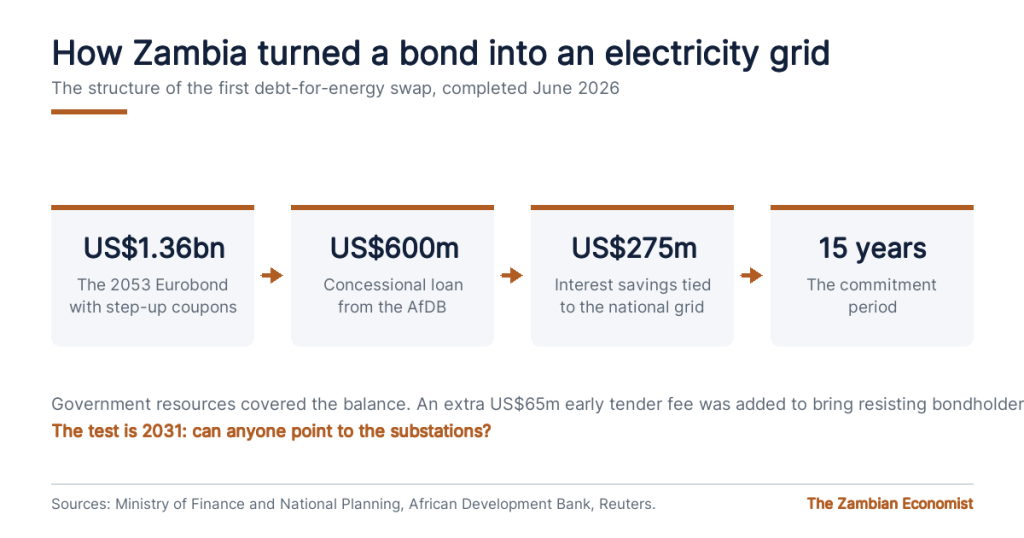
Out of that restructuring came a new instrument: a US$1.36 billion bond maturing in 2053.
The catch was in its structure. The bond carried step-up coupons — interest payments that start low and rise sharply over time. This is a common feature of restructured debt. It gives the borrower breathing room immediately and pushes the pain into the future, on the assumption that the future will be more affordable.
By 2026, that future was approaching. And Zambia, with copper high and the kwacha strong, was in a position to deal with it early.
What Zambia did
In May 2026, the Ministry of Finance and National Planning launched a cash tender offer — an invitation to bondholders to sell their bonds back to the government for cash.
The funding came from two places:
- A US$600 million concessional loan from the African Development Bank
- Government’s own resources
“Concessional” is the operative word. An AfDB development loan carries a lower interest rate and longer tenor than a market bond with rising coupons. The trade is straightforward: swap expensive private debt for cheaper multilateral debt.
That part is ordinary liability management. Many countries do it.
What made it a world first
The unusual element is the condition attached.
In exchange for the relief, Zambia committed up to US$275 million of the resulting interest savings to strengthening and modernising the national electricity grid over fifteen years.
Debt swaps with development conditions are not new in themselves. Seychelles did the first debt-for-nature swap in 2015 to fund marine conservation. Ecuador executed the largest in 2023 to protect the Galápagos. Kenya entered a US$1 billion debt-for-food arrangement in 2024.
But those were largely environmental or social. A debt-for-energy swap — where the savings are ring-fenced for productive infrastructure that directly raises the country’s output capacity — had not been done before.
That distinction matters. Most debt-for-development deals fund things that are worth doing but do not raise GDP. This one funds the binding constraint on Zambian industry. If the grid investment lands, it should pay for itself in ways a coral reef, however valuable, cannot.
It was not smooth
Two things are worth recording honestly.
Bondholders pushed back. An ad hoc group of holders of the 2053 notes publicly objected in June, arguing through their lawyers that the tender terms were materially adverse to noteholders and had been set without negotiation. The government eventually offered an additional US$65 million as an early tender fee, described as its best and final offer, and extended the early participation deadline. The deal was structured to proceed only if at least 75% of the outstanding notes were tendered.
By 10 June, government announced near-unanimous acceptance.
Critics made a structural point. Campaigners noted that the complexity of the arrangement is itself evidence that the original Common Framework restructuring did not deliver sufficient relief. On this reading, Zambia should not have needed a first-of-its-kind swap in 2026 — it should have received adequate debt relief in 2023.
That criticism is not a reason to dismiss the transaction. It is a reason to be sober about what it proves: it demonstrates Zambian financial creativity, not the adequacy of the international debt architecture.
What it means in practice
For the fiscal position. Zambia has removed a rising future interest burden and replaced it with cheaper, longer-dated debt. That smooths the debt-service profile, which matters more than the headline debt stock for a country trying to fund a budget. It also, as government noted, paves the way for a possible eventual return to international capital markets.
For the power sector. A ring-fenced fifteen-year funding stream for transmission and distribution is unusual and valuable. Zambian energy investment has historically concentrated on generation, because generation projects are visible, financeable and easy to announce. Grids are none of those things, and they are where much of the loss happens.
For business. This is the most directly commercial item in Zambia’s 2026 economic news. Power reliability is the constraint that shows up in spoiled stock, idle shifts, generator diesel and orders that cannot be quoted. We look at those costs in detail in Zambia’s power deficit and the real cost to business.
For accountability. A fifteen-year commitment spans at least three parliaments. The commitment is only as good as the reporting against it. This is precisely the kind of undertaking that quietly dissolves unless somebody tracks it annually — which is a job for parliament, for the Auditor General, and for the press.
Frequently asked questions
What is a debt-for-energy swap?
An arrangement where a country reduces or refinances debt and commits the resulting savings to energy infrastructure. Zambia’s is described as the first of its kind globally.
How much did Zambia buy back?
The tender covered its US$1.36 billion Eurobond maturing in 2053, created during the post-default restructuring.
Who funded the buyback?
A US$600 million concessional loan from the African Development Bank, plus Zambian government resources.
What did Zambia commit to spend the savings on?
Up to US$275 million on strengthening and modernising the national electricity grid over fifteen years.
Did all bondholders agree?
An ad hoc creditor group objected that the terms were adverse to noteholders. Government added US$65 million as an early tender fee and, in June 2026, reported near-unanimous acceptance.
Does this mean Zambia’s debt problem is solved?
No. It improves the maturity and cost profile of one instrument. Zambia’s overall debt burden remains substantial, and the transaction is liability management rather than debt cancellation.
Is Zambia’s debt restructuring finished?
Most of the external restructuring under the G20 Common Framework has been concluded following the 2020 default. This buyback sat on top of that process.
Why did critics object to the deal?
Some argued the terms were unfavourable to bondholders; others argued that the need for such a complex transaction shows the original restructuring gave Zambia too little relief.
The bottom line
Zambia took an expensive bond, replaced it with a cheaper loan, and legally tied the difference to the electricity network. It is genuinely innovative, and it was genuinely contested.
The measure of it will not be the announcement. It will be whether, in 2031, somebody can point to specific substations, transmission lines and reduced losses and say: that was paid for by this.
Ask that question every year.
Figures current as at 28 July 2026. Nothing in this article constitutes investment advice. Part of our Zambia Economy 2026 series.
Primary sources: Bank of Zambia