By Zambian Economist Analyst
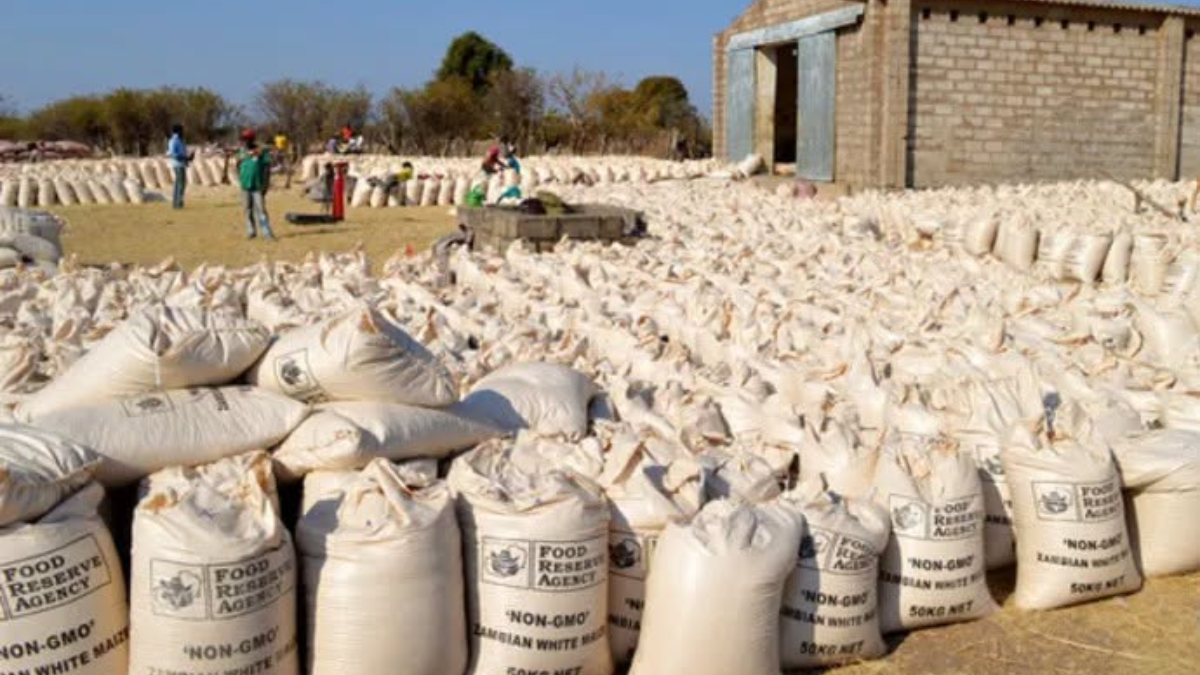
The Food Reserve Agency opened 1,749 satellite buying depots across the country today, 29 July, beginning the 2026 crop marketing season. For farmers the question is no longer what the price is — it is whether they can actually get paid, and how fast.
Here is what week one looks like in practice, and the three things worth watching.
The terms, in one table
| Item | 2026 season |
|---|---|
| Grade A non-GMO white maize | K6.94/kg — K347 per 50kg bag |
| Paddy rice | K7.50/kg — K300 per 40kg bag |
| Depots open | 1,749, from 29 July 2026 |
| Staffing | 3,498 trained clerks, with matching security |
| Purchase target | At least 500,000 tonnes maize; 10,000 tonnes paddy rice |
| Payment commitment | Within three days of delivery |
Why the season opened late
The Agency attributed the delayed opening to high moisture content in the crop, which it says has since come down to acceptable levels across most of the country. That matters at the depot gate: moisture is the most common reason a delivery is rejected or down-graded, and a rejected load is a wasted trip.
If your maize has been stored under plastic, in a sealed crib, or was harvested late, test before you transport rather than after.
What to bring to the depot
Requirements vary by district, but deliveries generally move fastest when the seller arrives with proof of identity, evidence of the farming enterprise, and grain that is clean, dry and properly bagged. Cooperative members should confirm in advance whether they are delivering individually or through the cooperative, because that determines which account the payment lands in.
Two practical points that cause most of the friction:
- Bagging. Grain arriving in mixed or damaged bags slows grading and invites disputes over weight.
- Account details. The three-day payment clock is meaningless if the receiving account details are wrong or the mobile wallet is unregistered. Verify before delivery, not after.
The gap that will shape this season
Smallholder representatives have put the maximum open-market offer at around K220 per 50kg bag. The FRA is paying K347. That is roughly 58% above the market.
A gap that size does three things at once. It genuinely raises farmer income, which is the point. It makes the FRA the buyer of first resort rather than the buyer of last resort, which is not how a strategic reserve is designed to work. And it creates an arbitrage for anyone who can buy at K220 and deliver at K347 — which is a trader’s incentive, not a farmer’s, and is why depot-level verification matters more this season than the price itself.
We set out the fiscal arithmetic of that spread in the FRA floor price and what it costs.
Three things to watch in week one
- Actual payment lag, not the pledge. Farmer unions have welcomed the three-day commitment while noting that timeliness, rather than the headline rate, has historically been the weak point. The first fortnight is the test.
- Whether private buyers stay in the market. The FRA’s 500,000-tonne target is roughly 10% of a 5.1 million tonne crop. The other 90% has to clear through millers, traders and cross-border sales. If private buyers step back because they cannot match K347, farmers hold grain they cannot sell.
- Depot congestion. With a price well above market and a purchase ceiling, the binding constraint becomes depot access and storage capacity, not demand.
A note on holding stock
The Agency has advised farmers to retain adequate maize for household consumption and sell only surplus, citing anticipated El Niño conditions that could affect future seasons. Given that Zambia has now had two consecutive strong harvests — 5.1 million tonnes this year against 3.6 million last — the temptation to sell everything at K347 is real. It is also the decision most likely to be regretted if the next season disappoints.
The wider picture
This is the year agriculture, not copper, carried national growth: Q1 2026 GDP rose 7.7% year on year on the back of the harvest, while copper output fell 4.27%. What happens at 1,749 depots over the next few weeks is therefore a macroeconomic event, not just an agricultural one.
Marketing, machinery and agribusiness finance are all in one place this week at the 98th Zambia Agricultural and Commercial Show, which opened the same day as the depots and runs to 3 August.
Figures current as at 29 July 2026. Requirements vary by district — confirm with your local FRA depot before travelling.
Part of our Zambia agriculture and mining coverage.