
By Zambian Economist Analyst
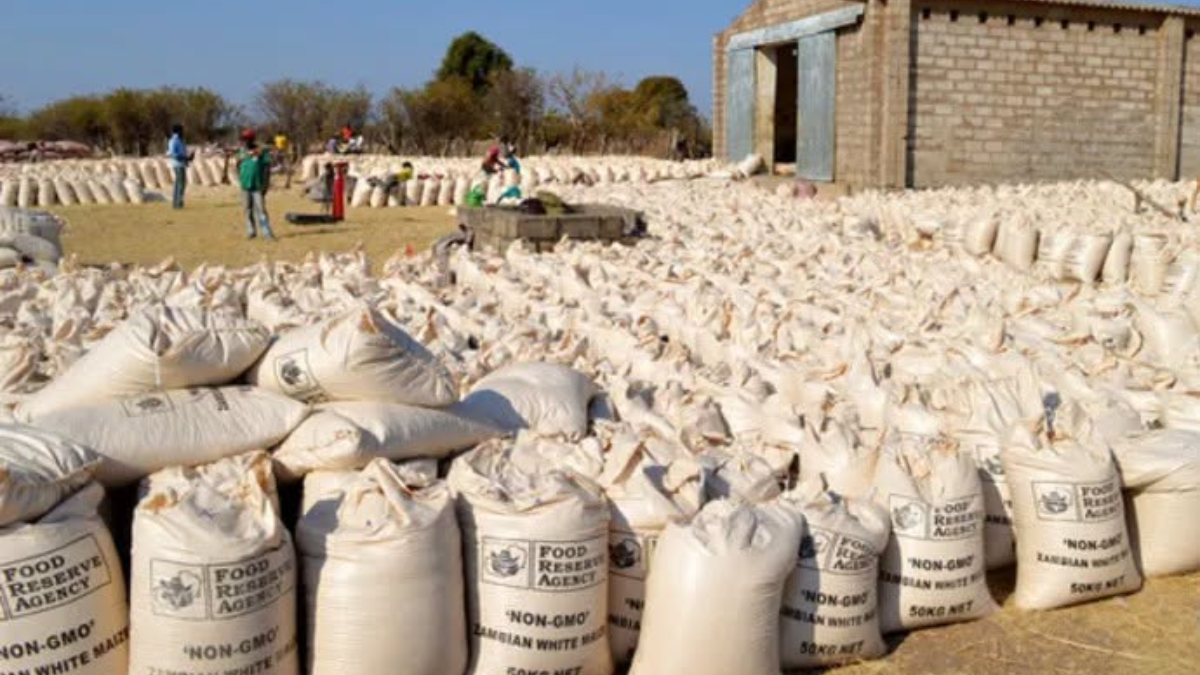
The Food Reserve Agency has set the 2026 maize floor price at K347 per 50kg bag, up from K340 last season. The headline is a 2% increase. The number that actually matters is the one nobody led with: the gap between what the FRA will pay and what the open market is paying.
Update, 29 July: buying has now opened. See FRA depots open: what to watch in week one.
What was announced
| Item | 2026 crop marketing season |
|---|---|
| Grade A non-GMO white maize | K6.94/kg, K347 per 50kg bag (from K340) |
| Paddy rice | K7.50/kg, K300 per 40kg bag |
| Maize purchase target | At least 500,000 tonnes |
| Paddy rice target | 10,000 tonnes |
| Satellite depots | 1,749, opening 29 July 2026 |
| Depot staffing | 3,498 clerks trained, with matching security personnel |
| Payment commitment | Within three days of delivery |
FRA Board Chairperson Suresh Desai announced the prices at a briefing in Lusaka on Friday 24 July, following consultations with farmer organisations, grain traders, consumer associations and financial institutions. The Agency attributed the late opening of the season to high moisture content in the crop, which it said has since improved.
The gap, not the increase, is the story
The National Association for Smallholder Farmers put the maximum open-market offer at around K220 per 50kg bag. The FRA will pay K347.
That is roughly 58% above the market, K6.94 a kilogramme against about K4.40. A gap that size does four things at once, and only the first is intended.
- It raises smallholder income, which is the policy purpose and it will work.
- It makes the FRA the buyer of first resort rather than the buyer of last resort, which is the opposite of how a strategic reserve is meant to function.
- It creates an arbitrage. Anyone who can buy at K220 and deliver at K347 has a 58% margin before costs. That is a trader’s incentive, not a farmer’s, and it is why depot-level verification matters more than the price itself.
- It rations by queue. With a purchase ceiling and a price well above market, the constraint becomes depot access and storage, not demand.
What 500,000 tonnes actually costs
At K6.94 a kilogramme, 500,000 tonnes costs approximately K3.47 billion before storage, transport, handling and losses. Against a 2026 national budget of K253.1 billion, that is roughly 1.4% of total spending committed through a single agency announcement.
Valued at the open-market price instead, the same volume would cost about K2.2 billion. The difference, on the order of K1.27 billion, is the implicit transfer from the Treasury to maize sellers. That is a defensible policy choice. It is not a free one, and it is precisely the kind of exposure that sits outside the headline deficit until it is settled. We flagged unquantified FRA liability as one of the open items in what the next government inherits.
A record harvest changes the arithmetic
Zambia harvested about 5.1 million tonnes of maize in 2026, against 3.6 million tonnes in 2025, an increase of roughly 42%, and the second consecutive strong season after the 2024 drought.
The FRA’s 500,000-tonne target is therefore about 10% of the crop. The other 90% clears through private buyers, millers and cross-border trade. The floor price only functions as a floor if those private buyers stay active; if they step back because they cannot match K347, the FRA ends up absorbing volume it did not budget for, or farmers hold grain they cannot sell.
This is also the year agriculture, not copper, carried national growth, Q1 2026 GDP rose 7.7% year on year on the back of the harvest, while copper production fell 4.27%.
The three-day payment pledge is the real test
A floor price a farmer cannot collect is a notional price. The FRA has committed to paying within three days of delivery, and farmer unions have welcomed the commitment while noting that timeliness, not the headline rate, has historically been the weak point.
Depots open on 29 July. The general election is on 13 August. The first fortnight of buying therefore runs directly into the campaign, which makes payment performance both highly visible and easily measured. Whatever view one takes of the timing, the test is verifiable: farmers either receive funds within three days or they do not.
- Actual payment lag in the first three weeks, not the pledge.
- Whether purchases stop at 500,000 tonnes. The Agency has said volumes may rise subject to storage and market conditions, which is where the fiscal number moves.
- Private-sector participation. If millers and traders compete near the floor, the policy works cheaply. If they withdraw, it gets expensive.
- Mealie meal prices. The FRA cited affordability as a pricing consideration; the pass-through to retail shows up in the monthly inflation print. See the Zambia inflation tracker.
- El Nino. The Agency advised farmers to retain household stocks against anticipated conditions affecting future seasons.
Maize marketing, machinery pricing and agribusiness finance are all in one place this week at the 98th Zambia Agricultural and Commercial Show, which opens the same day as the depots. Scheduled data releases are in the Zambia economic calendar 2026.
On agriculture as an export and diversification opportunity, see Beyond Copper: how economic diplomacy can drive Zambian diversification.
Figures current as at 29 July 2026. Budget and GDP figures from our own reporting; crop and pricing figures as announced by the FRA and reported in the Zambian press.
Part of our Zambia agriculture and mining coverage.
Related: FRA’s Slow Depots and Storage Shortfall Are Turning Zambia’s Bumper Harvest Into a Logistics Problem
Related: Zambia’s Maize Export Opportunity Faces Food-Security and Climate Risk


