


By Zambian Economist Analyst
If you understand one relationship in the Zambian economy, make it this one.
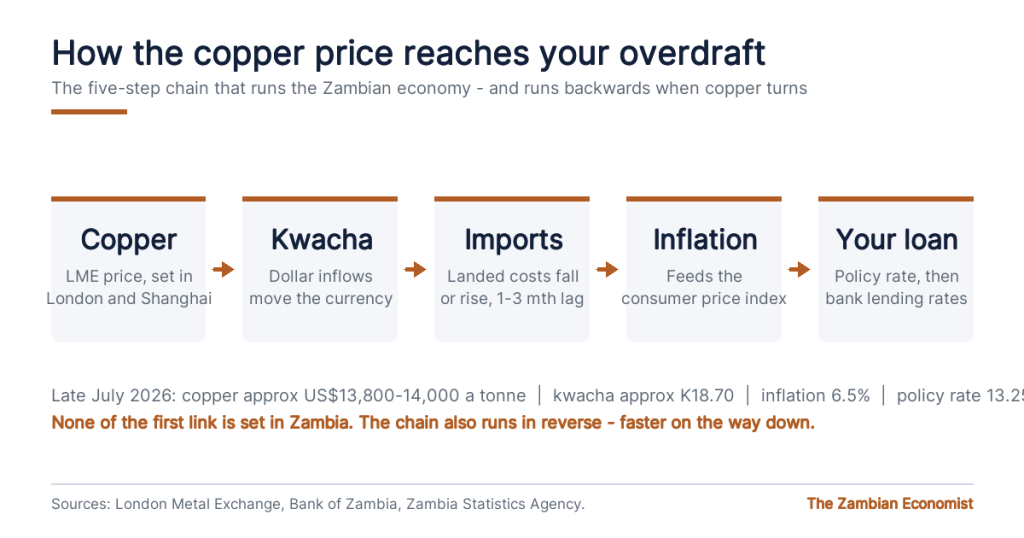
Copper sets the kwacha. The kwacha sets import costs. Import costs set a large part of inflation. Inflation sets the policy rate. The policy rate sets the cost of your overdraft.
Which means that a decision taken by a construction firm in Guangdong or a tariff office in Washington ends up in the monthly repayment of a hardware business in Kitwe — through a chain of five steps that almost nobody spells out.
Here is the chain, step by step.
Step 1: Copper is what Zambia sells to the world
Zambia is Africa’s second-largest copper producer, behind the Democratic Republic of Congo. Copper and copper products dominate export earnings — the country’s other exports matter, but none of them is in the same order of magnitude.
That means the supply of dollars entering Zambia is, to a first approximation, a function of two numbers: how much copper the country produces, and what price it fetches.
Zambia controls the first, slowly and with difficulty. It controls none of the second.
Step 2: The price is set somewhere else entirely
Copper trades on the London Metal Exchange and on Comex in New York. In late July 2026, LME three-month copper was trading around US$13,800–14,000 a tonne, close to the record set in early June.
What is driving that price has almost nothing to do with Zambia:
- Chinese demand and physical tightness. Falling stockpiles and rising premiums inside China have signalled a tight physical market.
- United States trade policy. The US confirmed in 2025 that refined copper imports would be temporarily exempt from tariffs, with a phased duty starting at 15% from 1 January 2027. That timeline alone has moved prices and widened the gap between New York and London.
- Speculative positioning. Analysts at Macquarie raised their 2026 average copper forecast to around US$13,165 a tonne while simultaneously noting the market is not physically short — projecting a surplus in 2026 and larger surpluses in 2027 and 2028. A good part of the current price is momentum running ahead of fundamentals.
- The US Federal Reserve. Copper slipped in late July as traders waited on a Fed decision, because interest rates move the dollar, and the dollar moves every commodity priced in it.
None of that is a Zambian variable. Zambia is a price-taker in the most literal sense.
Step 3: Dollars arrive, and the kwacha responds
When copper is high, mining companies and traders convert more dollars into kwacha to meet local costs — wages, suppliers, electricity, taxes. Foreign reserves build. Sentiment improves and portfolio money follows.
More dollars chasing the same kwacha means the kwacha appreciates.
The evidence is unusually clean. The kwacha touched about K29 to the dollar in March 2025. It has since strengthened to around K18.70, appreciating roughly 20% in 2026 alone and more than 30% year on year. Over the same period copper went from strong to near-record.
The correlation is not perfect — debt restructuring progress and a Bank of Zambia directive requiring domestic transactions to be settled in kwacha both helped — but copper is the dominant term.
Step 4: The kwacha moves inflation
Zambia imports fuel, fertiliser, medicines, machinery, vehicles and a large share of consumer goods. All of it is priced in dollars.
When the kwacha strengthens from K27 to K18.70, the landed kwacha cost of every one of those items falls — with a lag of one to three months while existing stock clears.
That is a large part of why inflation fell to 6.5% in June 2026 from 11.2% in December 2025. The other large part was a bumper maize harvest, which is a rainfall story rather than a copper story.
Step 5: Inflation moves the policy rate, and the policy rate moves your loan
Falling inflation gave the Bank of Zambia room to cut. The Monetary Policy Rate came down from 14.25% to 13.5% in February and to 13.25% in May 2026. In its statement, the Committee explicitly cited exchange-rate stability and the expected maize harvest.
That feeds into what businesses actually pay. We cover the transmission — and why the average commercial lending rate is nearer 28% than 13% — in what the policy rate means for your loan.
The chain runs backwards too
This is the part that gets forgotten during good years.
If copper falls sharply — because Chinese construction weakens, because the projected surpluses materialise, because the dollar strengthens — the same chain runs in reverse, and it runs faster on the way down than on the way up:
- Dollar inflows fall
- The kwacha depreciates
- Import costs rise, and fuel and fertiliser lead
- Inflation rises
- The Bank of Zambia is forced to raise rates into a slowing economy
- Businesses face higher input costs and higher borrowing costs simultaneously
Zambia lived through exactly this between 2022 and 2024. It is not a hypothetical. It is recent memory, and it took two years to unwind.
The fiscal twist
There is a complication that makes copper dependence more awkward than it first appears.
Mineral royalties are calculated on the dollar value of copper but spent in kwacha. So government revenue in kwacha depends on production times dollar price times exchange rate times collection effectiveness.
When the kwacha appreciates, the exchange rate term works against the Treasury. The same tonne, at the same dollar price, delivers fewer kwacha to the budget.
This is why a strong kwacha and a strong fiscal position are not the same thing — a point we develop in why a strong kwacha is not always good news.
What breaks the dependence
Only two things, and neither is fast.
More copper. Higher production means more dollars at any given price, and it dilutes the effect of price swings on national income. That requires investment, and investment requires reliable power — which is why the power deficit is a mining story as much as a manufacturing one.
Something other than copper. Agriculture and agro-processing, tourism, manufacturing, tradable services. Every Zambian economic strategy for thirty years has said this. The obstacle has never been the diagnosis.
Note the cruel timing problem: diversification is hardest to fund when copper is weak and easiest to ignore when copper is strong. Right now copper is strong.
What a business owner should take from this
Treat the exchange rate as a copper forecast. When you are asked to commit to a rate for a two-year lease or a long contract, you are implicitly forecasting copper. Assume a weaker kwacha than today’s spot in any long-dated commitment.
Watch the LME, not just the local news. Copper price moves reach Zambian costs with a lag of weeks to months. That lag is your planning window, and most businesses waste it.
Understand which side of the chain you sit on. Importers benefit from strength. Exporters and import-competing manufacturers suffer from it. The same headline is good news and bad news depending on your business model.
Do not confuse a good cycle with a structural change. The 2026 numbers are genuinely good. They are also cyclical. Build the business that survives K27, not just the one that thrives at K18.70.
Frequently asked questions
Why does the copper price affect the kwacha?
Copper dominates Zambia’s exports. High prices bring more dollars into the country, which increases dollar supply relative to kwacha demand and strengthens the currency.
What is the copper price now?
LME three-month copper has been trading around US$13,800–14,000 a tonne in late July 2026, close to the record set in early June.
Is Zambia the biggest copper producer in Africa?
Zambia is the second largest, behind the Democratic Republic of Congo.
What happens to Zambia if copper prices fall?
The kwacha typically weakens, import costs and inflation rise, government revenue from royalties falls, and the Bank of Zambia comes under pressure to raise interest rates.
Why does the US tariff on copper matter to Zambia?
Tariff policy shifts where refined copper flows and distorts the price gap between New York and London, which affects the global price Zambia’s exports are benchmarked against.
How can Zambia reduce its dependence on copper?
By raising and diversifying production within mining, and by developing tradable sectors such as agro-processing, manufacturing and tourism. Both require reliable power, predictable policy and long-term investment.
The bottom line
Almost every good economic number Zambia has printed in 2026 — the strong kwacha, low inflation, falling interest rates, improved reserves — traces back through this chain to a single commodity whose price is set on the other side of the world.
That is not a criticism of anyone’s economic management. It is the structure of the economy as it currently exists.
The task, for whoever governs and for every business planning past next year, is to make the good numbers survive the next turn of the cycle. Because there is always a next turn.
Figures current as at 28 July 2026. Nothing in this article constitutes investment advice. Part of our Zambia Economy 2026 series.
Primary sources: Bank of Zambia · Zambia Statistics Agency