


By Zambian Economist Analyst
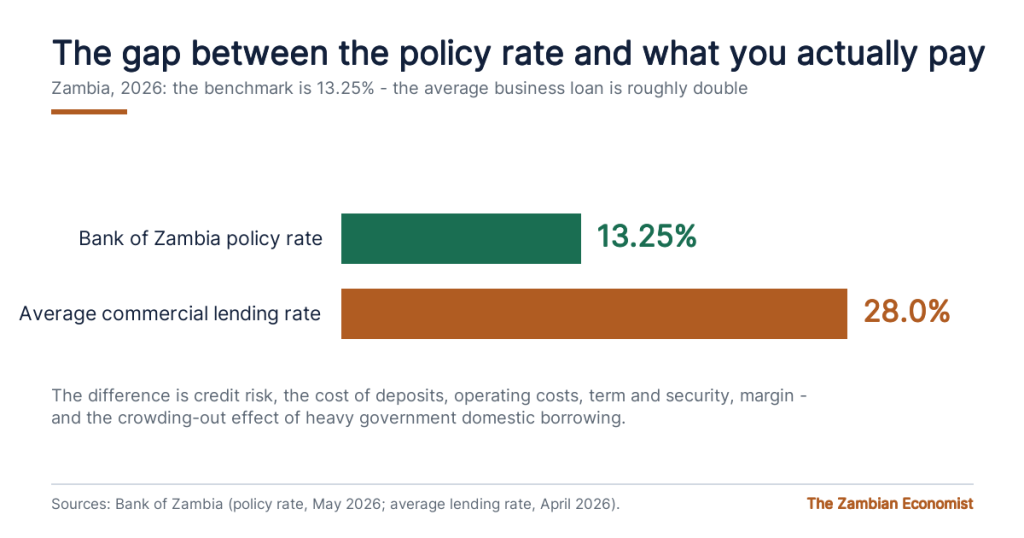
The Bank of Zambia cut its Monetary Policy Rate to 13.25% in May 2026. It was the third consecutive cut, following reductions to 14.25% and then 13.5%.
Somewhere in Zambia, a business owner read that headline, walked into their bank expecting cheaper credit, and was quoted something close to 28%.
That gap is not a mistake, and it is not necessarily your bank overcharging you. But almost nobody explains it, so let us.
What the policy rate actually is
The Monetary Policy Rate is the benchmark rate at which the Bank of Zambia lends short-term funds to commercial banks. It is the price of money at the very top of the system.
It is not the rate you pay. It is the starting point from which the rate you pay is built.
The Monetary Policy Committee meets quarterly and moves the rate up when it wants to slow inflation and down when inflation is under control and the economy needs support. It has been cutting because inflation has fallen sharply — to 6.5% in June 2026, inside the 6–8% target band.
Why your loan costs roughly twice that
Bank of Zambia data put the average commercial bank lending rate at around 28% in April 2026, down from about 28.6% in March.
The difference between 13.25% and 28% is roughly fifteen percentage points. It is made up of:
Credit risk. The bank’s expectation of how many borrowers will not repay. Zambia’s non-performing loan ratios have been a persistent supervisory concern — the Bank of Zambia has issued public notices on elevated NPLs, including those associated with public sector workers. High default rates in a portfolio are paid for by the borrowers who do repay. That is arithmetic, not injustice.
The cost of funds. A bank does not fund your loan at the policy rate. It funds it largely from deposits, on which it pays interest, and from the interbank and securities markets. When government pays attractive yields on Treasury bills, banks have a risk-free alternative to lending you money — and your loan has to beat it.
Operating costs. Branches, staff, systems, regulation, capital requirements.
Term and security. Longer tenors and weaker collateral cost more. Always.
Margin. Banks are businesses.
The crowding-out problem. When government borrows heavily domestically, it absorbs bank liquidity and sets a high risk-free benchmark. Private sector credit becomes both scarcer and dearer. This is one of the least-discussed reasons Zambian business borrowing is expensive, and it is a fiscal problem rather than a banking one.
Why the cut still matters to you
Three reasons, even though your rate did not halve.
If your facility is variable-rate, it should move. Many Zambian business facilities are priced as a reference rate plus a margin. When the reference falls, your rate should fall. Check your last three statements. If the policy rate has come down 125 basis points since November and your rate has not moved at all, that is a conversation to have with your relationship manager — armed with the dates.
It changes the negotiating environment. In an easing cycle with inflation inside target, banks are competing for good credit. Your leverage is higher now than it was in 2024.
It signals direction. The MPC projects inflation averaging 6.8% in 2026 and around 6.1% in 2027. If those forecasts hold, the direction of travel is further easing, and a shorter fix or a variable rate may serve you better than locking in for five years today.
The transmission problem
Here is the honest part.
Policy rate changes reach borrowers slowly and incompletely in Zambia — faster on the way up than on the way down. Banks reprice loans quickly when rates rise and reluctantly when they fall.
That is a real feature of the market, and it means the practical effect of a 25 basis point cut on a small business overdraft in Kabwe is close to zero in the short run. What matters more is the cumulative direction — 14.5% down to 13.25% over a year, alongside inflation halving — because that is the environment in which banks eventually reprice and credit appetite eventually returns.
What to actually do
1. Audit your existing facilities this month. For every loan and overdraft, write down: the current rate, whether it is fixed or variable, the reference rate it is priced off, the margin, and the date it last changed. Most business owners cannot answer all five questions, which is precisely why they overpay.
2. Ask your bank three specific questions.
- What reference rate is my facility priced against?
- What has that reference done in the last twelve months?
- What margin am I paying, and what would move it?
Specific questions get specific answers. “Can you reduce my rate?” gets a polite no.
3. Understand the election timing. The next MPC meeting is 28–29 September, six weeks after the 13 August election. Nothing moves before then. Banks are also unlikely to approve significant new facilities in the interim — a point we cover in election period planning. If you need credit in the fourth quarter, start the application in August.
4. Compare fixed against variable deliberately. With inflation projected to stay in or near the target band and the policy rate on a downward path, locking a long fixed rate today means betting against the central bank’s own forecast. That can be the right call if certainty matters more to you than cost — but make it a decision rather than a default.
5. Look past the rate to the total cost. Arrangement fees, insurance requirements, valuation costs and early settlement penalties can add more to the true cost of a facility than a percentage point on the headline. Ask for the total cost of credit in kwacha over the life of the loan, not the annual percentage.
A warning worth repeating. A strong kwacha makes dollar borrowing look cheap. It is the same trade that destroyed Zambian balance sheets between 2022 and 2024. Unless you earn dollars, borrowing in dollars means taking a currency position you are not equipped to manage. See why a strong kwacha is not always good news.
Frequently asked questions
What is the Bank of Zambia policy rate now?
13.25%, set on 13 May 2026. It was the third consecutive cut, from 14.25% in late 2025 and 13.5% in February 2026.
When is the next MPC meeting?
28–29 September 2026.
Why is my loan rate so much higher than the policy rate?
The policy rate is what banks pay the central bank for short-term funds. Your rate adds credit risk, the bank’s cost of deposits, operating costs, term and security considerations, and margin. The average commercial lending rate was around 28% in April 2026.
Will interest rates fall further in Zambia?
The Committee projects inflation averaging 6.8% in 2026 and about 6.1% in 2027, which is consistent with further easing if those forecasts hold. Decisions are data-driven and no outcome is guaranteed.
Should I take a fixed or variable rate loan?
Variable rates benefit from further cuts; fixed rates give certainty. With the policy rate falling, a long fixed rate is a bet against the central bank’s own projections.
Does the policy rate affect my savings?
Yes, indirectly. Deposit rates tend to follow the policy rate, usually more slowly and by less than lending rates.
Should I borrow in dollars while the kwacha is strong?
Borrowing in a currency you do not earn creates exchange rate risk. Many Zambian businesses were badly affected by this between 2022 and 2024. Match the currency of your borrowing to the currency of your income.
How can I get a lower rate?
Improve your security position, shorten the tenor, maintain a clean repayment record, formalise your accounts, and negotiate on the margin rather than the reference rate — the margin is the part your bank actually controls.
The bottom line
The policy rate at 13.25% will not appear in your loan agreement. What it tells you is the direction of the environment: inflation contained, policy easing, and a banking system that will eventually pass some of that through.
Your job is to make sure you are positioned to receive it. Know what your facility is priced against. Ask the specific questions. Start any fourth-quarter application in August. And do not solve an expensive kwacha loan by taking a cheap-looking dollar one.
Figures current as at 28 July 2026. This article is general information, not financial advice. Speak to your bank or a licensed adviser about your specific position. Part of our Zambia Economy 2026 series.
Primary sources: Bank of Zambia
If commercial lending is out of reach, concessional finance may not be: see CDF empowerment grants and loans.