


By Zambian Economist Analyst
Zambia votes on Thursday 13 August 2026, with polls open from 06:00 to 18:00.
Most businesses treat an election as a political event. It is also an operating condition — a predictable six-to-ten week period in which government spends differently, banks lend differently, customers behave differently and your staff are somewhere other than work.
The businesses that come through it well are not the ones with the best political predictions. They are the ones that treated the calendar as a planning input.
This is a practical checklist. It takes no view on the outcome and requires none.
What reliably changes around an election
These patterns are structural rather than political. They hold regardless of who is contesting or who wins.
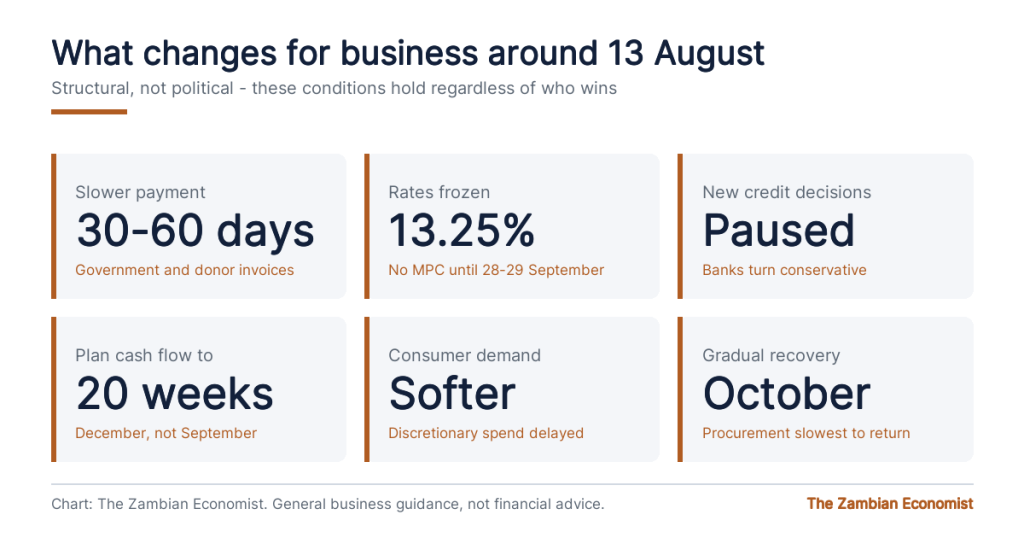
Government procurement slows. Approvals sit longer. New tenders are deferred. Invoices already in the system take longer to clear.
Credit decisions pause. Banks and lenders become more conservative on new facilities in the weeks either side of a transition. The Bank of Zambia’s next Monetary Policy Committee meeting is 28–29 September, six weeks after the vote, so the policy rate is fixed at 13.25% through the entire period. See what the policy rate means for your loan.
Capital investment stops. Corporates and foreign investors run the standard playbook of waiting. Your customers are doing this too, which is why your pipeline may look softer than your relationships suggest.
Working days are lost. Polling day itself, travel by staff registered elsewhere, and campaign-period disruption around rallies and road closures.
Logistics get unpredictable. Road movements, fuel demand and transport availability all shift during campaign season.
Cash behaviour changes. Households and businesses tend to hold more cash and delay discretionary purchases when uncertain about the near term.
The checklist
Cash flow: plan to December, not to September
The single most common failure is a business that has budgeted to the end of the quarter when the disruption runs to the end of the year.
- Build a 20-week cash flow, not a 12-week one
- Assume receivables from government or donor-funded clients arrive 30–60 days later than normal
- Assume no new bank facility approves between now and October unless it is already at final stage
- Identify your minimum operating cash and the date you would hit it in a slow scenario
Collections: chase now, not in September
Every week of delay compounds. Call your top twenty debtors this week and next. Where a customer is government or donor-funded, get the invoice into the system before the pre-election slowdown rather than after.
Offer a modest settlement discount for early payment if your margin allows it. Cash in August is worth more than a slightly better margin in November.
Stock: hold, but do not over-hold
Two competing pressures. Import costs are unusually favourable with the kwacha near K18.70, which argues for buying. Demand may soften and cash is king, which argues against.
The resolution is category by category:
- Fast-moving, non-perishable, imported: buy ahead. The currency advantage is real and today’s landed cost may not repeat.
- Slow-moving or perishable: do not. Tying cash up in stock that sits is exactly the wrong risk this quarter.
- Anything with a long lead time: order now so arrival is not caught in a disrupted logistics window.
Staffing: plan the days you will lose
- Confirm which staff are registered to vote outside your operating town and will need travel time
- Publish your polling-day arrangements in writing, in advance
- Agree cover for essential functions — security, cold chain, customer support
- Decide now, and communicate, whether the day is paid
Writing it down beforehand prevents the argument on the day.
Contracts and pricing
- Check whether any contract you are signing this quarter carries currency or fuel exposure you cannot hedge
- Where you can, build in review clauses rather than fixed prices on multi-year commitments
- Get supplier commitments in writing, including delivery windows
Security and premises
Prudent, not alarmist:
- Review insurance cover and confirm it is current
- Know the location of your nearest polling station and any planned rally routes near your premises
- Have a simple decision rule for closing early, and tell staff what it is
- Back up your data off-site
Communications: stay out of it
Your business is not a political actor. A clear internal rule saves a great deal of trouble:
- No party branding on company premises, vehicles or uniforms
- No political content from corporate social media accounts
- Staff are free to hold and express their own views on their own time and accounts
- Managers do not campaign in the workplace
This is not timidity. It is protecting a customer base that is politically mixed and will still be your customer base on 14 August.
What to actually do with the quiet
Here is the argument this article is really making.
A pre-election slowdown feels like a business problem. It is also six weeks of unusually low external demand on your attention — which is the scarcest input in any small business.
The firms that emerged strongest from the 2021 transition were not the ones that stopped. They were the ones that used the pause on the work that never gets done when things are busy:
- Renegotiating supplier terms
- Rebuilding a stale price list at current exchange rates (here is why that matters now)
- Cleaning the debtors ledger
- Fixing the website, the catalogue, the quotation template
- Training staff
- Documenting the processes that currently live in one person’s head
Capital expenditure can reasonably wait for clarity. Operations cannot, and should not.
Expert tip: Write your reopening plan now — the specific list of decisions you will make in the week after results are confirmed. Businesses that pre-commit act in September. Businesses that wait to think about it act in November, by which time the good suppliers, sites and staff are taken.
After the vote
Two things to watch, whatever the result:
- The Bank of Zambia MPC on 28–29 September. The first substantive policy signal after the election.
- The national budget, traditionally presented to the National Assembly on the last Friday of September. The 2026 budget was K253.1 billion, or 27.4% of GDP. Tax measures announced there will shape your 2027 costs.
Both dates and everything else worth diarising are in our Zambia economic calendar 2026.
Frequently asked questions
When is the Zambian general election?
Thursday 13 August 2026. Polls are open from 06:00 to 18:00 according to the Electoral Commission of Zambia.
Is election day a public holiday in Zambia?
Polling day is typically declared a public holiday. Confirm the official declaration and plan staff arrangements in writing in advance.
How do elections affect business in Zambia?
Government procurement slows, credit and investment decisions pause, working days are lost around polling, and consumer spending typically softens on uncertainty.
Should I delay investment until after the election?
Deferring major capital commitments until the picture is clear is defensible. Deferring operational improvements is not — that is when the pause becomes a cost rather than a break.
Will interest rates change before the election?
The policy rate is 13.25% and the next Monetary Policy Committee meeting is scheduled for 28–29 September 2026, after the vote.
How long does the disruption usually last?
Plan for normal conditions to resume gradually from October, with government procurement often the slowest to recover.
Should my business take a political position?
Businesses serve politically mixed customers and employ politically mixed staff. A clear neutrality policy protects both relationships and premises.
The bottom line
You cannot forecast the result and you do not need to. You can forecast the conditions: slower payment, paused credit, lost days, softer demand, then a gradual return from October.
Plan to December. Collect now. Buy imported stock selectively while the kwacha is favourable. Write down your staffing and security arrangements before you need them. Stay out of the politics.
And use the quiet weeks on the work you have been postponing since January.
Figures current as at 28 July 2026. This article is general business guidance, not legal or financial advice. Part of our Zambia Economy 2026 series.
Practical guidance for the months ahead: Doing Business in Zambia, including company registration and CDF finance.