By Zambian Economist Analyst
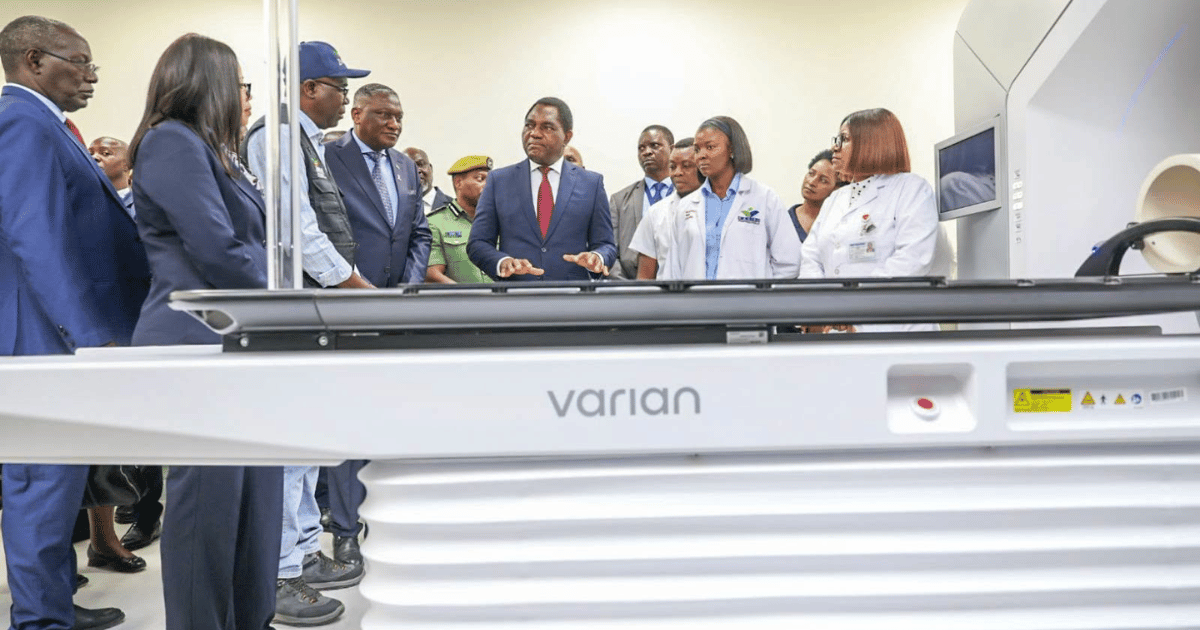
For five years, a Zambian cancer diagnosis carried an extra sentence beyond the medical one: a plane ticket. On Saturday, President Hakainde Hichilema commissioned the refurbished radiotherapy and imaging section of the Cancer Diseases Hospital (CDH) at the University Teaching Hospital in Lusaka, a facility that had sat closed since 2020, forcing patients needing radiation treatment to be flown abroad or to simply wait.
The commissioning matters for reasons that go beyond ribbon-cutting. It reopens the only public radiotherapy service in a country of roughly 20 million people, at a moment when Zambia’s health budget has been quietly absorbing the cost of sending patients overseas, money that could otherwise have gone into building capacity at home.
What was closed, and what has reopened
The Cancer Diseases Hospital has been Zambia’s national cancer referral centre since it was established in the mid-2000s with support from the International Atomic Energy Agency, and for years it was the only centre in the country offering radiotherapy, serving the entire population of Zambia as well as some neighbouring countries including Malawi, the Democratic Republic of Congo and Zimbabwe. In the decade after it opened, the hospital diagnosed and treated more than 17,000 cancer cases, with cervical cancer consistently the most common diagnosis among the women it served.
That track record is precisely why the 2020 closure of the radiotherapy and imaging section landed so hard. A cancer centre without a working linear accelerator can still diagnose disease: it cannot treat it with radiation, which is often the difference between a curable and an incurable case, particularly for cervical cancer, breast cancer and other tumours where radiotherapy is standard of care.
The re-establishment work has been under way for some time. As recently as 31 July 2026, the day before the President’s visit, Zambia’s Radiation Protection Authority (RPA) carried out a formal inspection of the rebuilt facility’s Linear Accelerator and CT scan equipment, confirming compliance with the country’s radiation-safety legislation before the unit could resume operations. RPA Senior Inspector Ian Mukabe said the inspection was completed in line with the Ionizing Radiation Protection Act No. 16 of 2005 and its Amendment Act No. 19 of 2011, while CDH’s Senior Medical Physicist, Mulape Kanduza, said the successful completion of the inspection would pave the way for the hospital to begin offering radiotherapy services again and expand access to cancer treatment. That regulatory sign-off is the reason the commissioning could go ahead this weekend rather than being a purely symbolic event.
The numbers the President put on the table
Speaking at the commissioning, President Hichilema set out the cost of the closure in blunt terms. Government had spent millions of kwacha sending roughly 600 patients abroad for radiotherapy during the years the local facility was out of service, while thousands more Zambians who could not access an overseas referral simply waited, some, inevitably, for longer than their disease allowed.
With the wing now operational, the President said the hospital is expected to treat up to 60 patients a day locally. He framed the shift as a straightforward reallocation of spending: money that used to buy airfares and pay foreign hospital bills will now go toward Zambian doctors, Zambian nurses, and equipment inside the country. He also described the facility as one of only three of its kind on the continent, alongside centres in South Africa and Egypt, a claim that speaks to the scale of the investment but one Zambian Economist has not been able to independently verify against a continent-wide equipment registry, and readers should treat it as the President’s own characterisation rather than a confirmed ranking.
The first patient treated under the reopened service was Madam Mauleya Zimba, 62, who is living with cervical cancer, the same disease that has historically accounted for the largest share of cases at CDH. The President described her as carrying, in that first treatment session, the story of the thousands of Zambians who have waited behind her.
Why this is an economic story, not just a health one
It is tempting to file hospital reopenings under health news and move on. But the mechanics here are worth spelling out, because they touch fiscal policy, foreign exchange, and household economics all at once.
Foreign exchange leakage. Every patient referred abroad for radiotherapy is, in balance-of-payments terms, an import of a health service, paid for in hard currency, typically US dollars or South African rand, at a time when the kwacha’s stability already depends heavily on managing outflows. A functioning domestic radiotherapy unit converts a recurring foreign-currency cost into a domestic-currency one: staff salaries, local consumables, and equipment maintenance contracts that, where possible, are priced and paid in kwacha.
Fiscal reallocation, not new spending. The most useful way to read the President’s framing is as a reallocation argument rather than a claim of new money. If medical evacuation costs were previously drawn from the Ministry of Health’s budget line for external referrals, closing that line (or shrinking it) frees the same envelope for domestic capacity: staffing, maintenance, and eventually expansion to a second centre outside Lusaka. This is analogous to the debt-service-versus-development-spending trade-off that has dominated Zambia’s fiscal debate since the 2020 default: money not going to one obligation is money that can go somewhere else, but only if the reallocation is disciplined and tracked.
Household-level cost avoidance. For an ordinary Zambian family, an overseas referral is rarely fully government-funded in practice: patients and families often bear travel, accommodation and incidental costs that a government stipend does not cover, even when the treatment itself is subsidised. A commentary published earlier this year by the Zambian Observer captured the frustration behind this pattern bluntly, arguing that families still sell property, borrow from relatives and run fundraising appeals while diseases progress during the wait for treatment abroad. A working domestic radiotherapy unit does not eliminate that burden for every cancer, but it removes it for the cases CDH can now treat locally.
Regional service exports. Because CDH has historically also served patients referred from Malawi, the DRC and Zimbabwe, a fully operational radiotherapy wing is not purely a domestic public good: it is a small, tangible entry in Zambia’s services trade with its neighbours, however modest in scale next to copper or agricultural exports.
What this doesn’t fix
None of this resolves the underlying capacity constraint that has driven Zambia’s medical-evacuation bill for specialist care more broadly. Commentary this year has pointed out that Zambians with heart disease, kidney disease and complex neurosurgical needs are still routinely referred abroad, and that a single reopened radiotherapy wing, however welcome, does not by itself constitute the “National Specialist Treatment Programme” that critics of the status quo have called for. Zambia also has a well-documented shortage of oncology specialists relative to patient need, a workforce constraint that new equipment alone does not solve; training and retaining radiation oncologists, medical physicists and specialist nurses is a multi-year undertaking, not a one-day commissioning.
There is also a maintenance question that Zambia’s health infrastructure history makes impossible to ignore. The five-year closure of this same unit is itself the case study: a linear accelerator is a precision instrument that requires calibration, spare parts, and trained technicians to keep running, and previous investment in medical equipment across Southern Africa has not always been matched by a durable maintenance budget. Whether this reopening becomes a permanent fixture or another cycle of build-use-break will depend on decisions made in future budget cycles, not on Saturday’s ceremony.
Zambian Economist will be tracking three things in the months ahead: whether the Ministry of Health publishes updated referral-abroad figures showing a real decline in cancer-related medical evacuations; whether the 2027 budget allocates a dedicated maintenance and consumables line for CDH’s equipment, rather than folding it into general hospital operations; and whether government follows through on any plan to build oncology capacity outside Lusaka, given how much of the country still has to travel to the capital for a cancer diagnosis, let alone treatment.
If you want to follow how this story develops, alongside our ongoing coverage of Zambia’s 2026 fiscal position, Zambian Economist will keep tracking it with the same independent, data-first approach. Follow or subscribe for the next update.