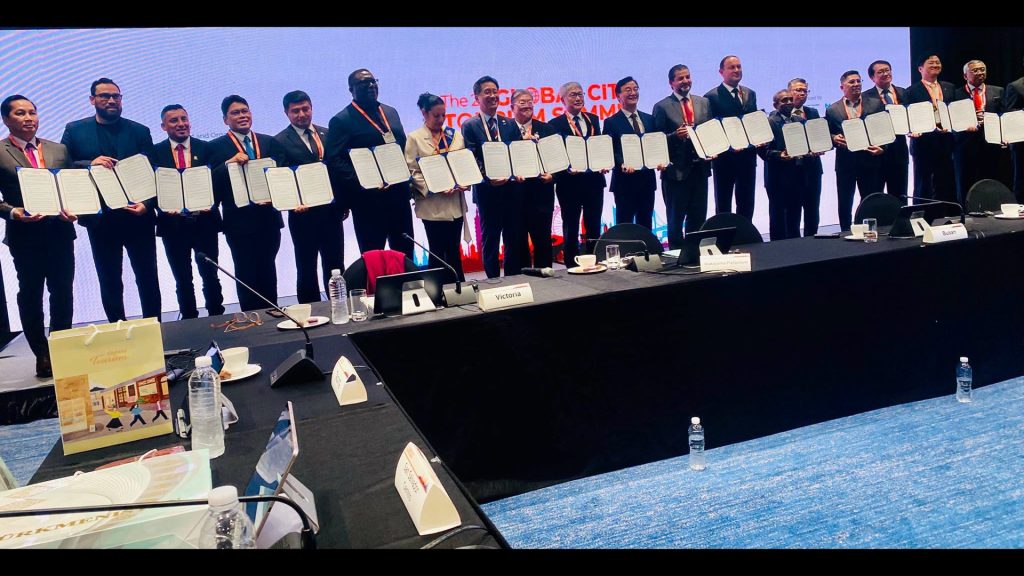

In February 2026, Zambia’s Minister of Foreign Affairs and International Cooperation addressed an audience in Washington. In December 2025, the Zambia Development Agency signed three memoranda of understanding in the same city. The President has described himself, more than once, as the country’s chief marketing officer.
All of this is economic diplomacy. Whether it is working is a harder question, and it is not answered by counting trips.
This article sets out what economic diplomacy actually is, what machinery Zambia has to conduct it, where that machinery underperforms, and what a serious reform agenda would look like. It is the first in a Zambian Economist series on Zambia’s external economic engagement.
What economic diplomacy is, and what it is not
Economic diplomacy is the use of a state’s diplomatic apparatus to pursue commercial objectives: expanding exports, attracting investment, securing market access, shaping the rules of international trade, and defending national economic interests in multilateral settings.
It is not the same as foreign policy, though it operates inside it. It is not the same as trade policy, which sets tariffs and negotiates agreements. And it is emphatically not the same as investment promotion, though the two are routinely conflated in Zambian public debate.
The distinction matters practically. Investment promotion is a marketing function: it tells a story to an audience that has already decided to consider you. Economic diplomacy is a state function: it changes the conditions under which those decisions are made, by opening a market that was closed, resolving a regulatory dispute that was blocking a shipment, or securing a rule in a multilateral forum that favours your producers.
A country can be excellent at the first and poor at the second. Zambia, on the evidence, is closer to that position than is comfortable.
The starting point: an economy that is externally exposed and narrowly connected
Zambia is landlocked, commodity-concentrated and trade-dependent. That combination makes external economic relations more consequential here than in a large, diversified, coastal economy.
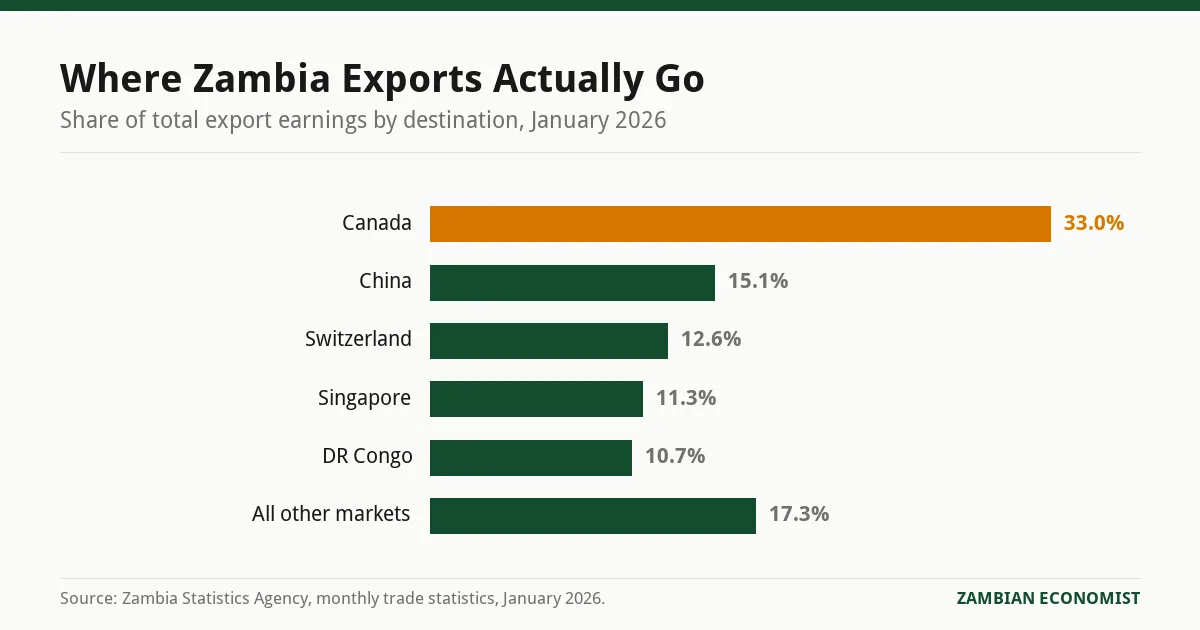
The concentration is stark. According to Zambia Statistics Agency data for January 2026, the top five export destinations accounted for 82.7 percent of total export earnings: Canada at 33 percent, China at 15.1 percent, Switzerland at 12.6 percent, Singapore at 11.3 percent and the Democratic Republic of Congo at 10.7 percent.
Read that list again. Three of those five, Switzerland, Singapore and to a degree Canada, reflect where copper is traded and booked rather than where it is ultimately consumed. Zambia’s export statistics describe a commodity moving through a financial and logistical system as much as they describe a trading relationship.
Meanwhile the country runs merchandise trade deficits with the regions closest to it. In April 2026 Zambia recorded deficits with Asia of K2.7 billion, with SADC-exclusive markets of K4.8 billion, and with the European Union of K1.1 billion, even while posting an overall monthly trade surplus of K3.5 billion on the strength of copper.
That is the diagnostic picture in a sentence: Zambia sells one product to a handful of counterparties and buys a great many products from its neighbours. Economic diplomacy is the instrument most directly suited to changing both halves of that sentence.
Zambia’s economic diplomacy machinery
Four institutions carry most of the load.
The Ministry of Foreign Affairs and International Cooperation coordinates Zambia’s diplomatic and consular missions abroad, manages treaty signature, and handles membership of international and regional organisations. It also runs foreign service training, which is where the professional standard of Zambian economic diplomacy is ultimately set.
The Zambia Development Agency is the investment promotion and facilitation body, increasingly active in signing agreements directly with foreign counterparties.
The Ministry of Commerce, Trade and Industry handles trade negotiation and market access, including obligations under COMESA, SADC and the African Continental Free Trade Area.
Sector ministries, Mines, Tourism, Agriculture, increasingly conduct their own external engagement, which is both a strength and the source of the central problem described below.
The coordination problem
When four sets of institutions engage externally without a single accountable owner, three predictable failures follow.
The first is message inconsistency. An investor hearing one set of assurances from a mission, another from an agency and a third from a line ministry does not conclude that Zambia is enthusiastic. They conclude that Zambia is unpredictable, which, as this publication has argued elsewhere, is the single most expensive signal a country can send.
The second is follow-through failure. Memoranda of understanding are signed at a high tempo. Conversion of an MoU into a financed, permitted, operating project requires sustained casework over months, usually by somebody junior, usually unglamorous, and usually unresourced.
The third is the missing feedback loop. A mission that identifies a barrier, a phytosanitary rule blocking Zambian honey, a certification requirement excluding Zambian gemstones, needs a channel through which that intelligence reaches the ministry able to fix it. Where the channel is informal, the intelligence dies with the officer who gathered it.
What good looks like: four comparators
None of these countries is a template. Each isolates one mechanism worth studying.
| Country | Mechanism | Transferable lesson |
|---|---|---|
| Rwanda | Missions carry explicit, measured commercial targets | Diplomats are appraised on trade and investment outcomes, not activity |
| Morocco | Sustained continental commercial strategy with banking and logistics arms | Diplomacy paired with actual delivery capability rather than promises |
| Ireland | Single agency owns export promotion end to end | Clear accountability beats distributed enthusiasm |
| Botswana | Long-horizon positioning around a single resource | Consistency across administrations compounds; reinvention resets the clock |
The common thread is unglamorous: specificity and continuity. Countries that succeed at economic diplomacy set narrow objectives, assign them to named officers, measure them, and then leave the strategy alone long enough for relationships to mature.
Opportunities Zambia is positioned to capture
Critical minerals. Global demand for copper, cobalt, lithium and graphite is being driven by electrification, and Zambia’s National Critical Minerals Strategy has advanced exploration of lithium in Mapatizya and Luano districts and graphite in Petauke. Critical minerals are unusual in that they are simultaneously a commercial and a strategic conversation, which gives a producer country diplomatic leverage it does not have when selling an ordinary commodity.
Regional market access. Zambia borders eight countries. AfCFTA, COMESA and SADC give preferential access to a combined market vastly larger than the domestic one. The current trade deficits with SADC markets represent an opportunity as much as a weakness, those are trade relationships that already exist and currently run the wrong way.
Agricultural exports. Non-traditional exports rose 20.9 percent between March and April 2026, from K7.5 billion to K9.0 billion, with maize and tobacco contributing significantly. Agricultural market access is won or lost almost entirely through diplomacy: phytosanitary recognition, standards equivalence and quota negotiation.
Tourism. International arrivals reached 2.3 million in 2025, up from just over one million in 2022. Visa waivers have been extended to 167 nations. Aviation route negotiation and visa reciprocity are diplomatic instruments, not marketing ones.
Challenges that will not resolve themselves
Resourcing. Economic diplomacy is staff-intensive and its returns arrive over years. It competes for budget against needs that are immediate and visible. This is the same asymmetry that afflicts every long-horizon investment in a democracy.
Skills. Commercial diplomacy requires officers who can read a term sheet, understand a rules-of-origin certificate and hold a credible conversation about tariff schedules. That is a different skill set from traditional political reporting, and it has to be deliberately built.
Attribution. When an investment lands, many actors claim it. When it fails to land, nobody owns it. Without honest attribution, learning is impossible.
Continuity risk. Zambia holds a general election on 13 August 2026. Economic diplomacy is a relationship business, and relationships reset when personnel change wholesale. The countries that do this well insulate the function from political turnover.
The way forward: five practical reforms
1. Give every mission a commercial mandate with numbers. Not aspiration, a defined set of target sectors, named counterparties and reportable outcomes, reviewed annually.
2. Appoint a single accountable owner. One office, with authority across ministries, responsible for converting external engagement into completed transactions. Without this, coordination remains a meeting rather than a function.
3. Build the feedback channel formally. A structured, routine mechanism through which missions report market access barriers to the ministries that can remove them, with published response times.
4. Publish an annual economic diplomacy report. MoUs signed, projects converted, barriers removed, value realised. Publication is what converts activity into accountability, and it is cheap.
5. Professionalise commercial attaché training. Trade finance, standards, contract law, sector economics. The Ministry already carries a foreign service training mandate; the content is the variable.
What businesses should do
- Use the missions. They are an underused public asset. Approach them with a specific request, a named buyer, a named barrier, rather than a general introduction.
- Report barriers formally and in writing. An informally mentioned obstacle rarely reaches the desk that can fix it. A documented one sometimes does.
- Join the trade delegations, but prepare differently. Delegations produce value in proportion to the specificity of what participants bring. Arrive with a defined ask.
- Watch standards, not just tariffs. For most Zambian non-traditional exports, the binding constraint is a certification requirement rather than a duty rate.
Measuring what matters: a proposed mission scorecard
The recurring objection to reforming economic diplomacy is that its results are unmeasurable. They are not. They are simply unmeasured.
Activity metrics, meetings held, delegations hosted, agreements signed, are easy to collect and nearly useless, because they rise when a mission is busy rather than when it is effective. Outcome metrics are harder to collect and considerably more honest.
| Metric | What it captures | Why activity measures fail here |
|---|---|---|
| Barriers removed | Specific market access obstacles resolved for named Zambian products | Counting meetings rewards raising an issue, not closing it |
| MoU conversion rate | Share of signed agreements reaching financial close or operation | Counting signatures rewards ceremony over casework |
| Export value in target sectors | Realised earnings in the sectors the mission was mandated to grow | Total trade moves with copper prices regardless of effort |
| Investment disbursed | Capital actually deployed, not pledged | Pledges are announcements; disbursement is commitment |
| Response time on exporter queries | Service quality to the businesses the mission exists to serve | Invisible in every activity report ever written |
Two design points make such a scorecard workable rather than punitive.
First, metrics must be sector-specific and mission-specific. A mission in a major capital serving a large consumer market should not be assessed against the same targets as one whose primary value is multilateral negotiation. Uniform targets produce uniform gaming.
Second, the time horizon must match the work. Market access negotiations frequently run three to five years. Annual assessment against annual outcomes will push officers toward whatever can be closed quickly, which is rarely what matters most. A rolling multi-year review with annual progress reporting is the more honest instrument.
None of this requires new legislation or significant expenditure. It requires a decision to publish, and the institutional confidence to be measured on something harder than travel.
A note on what economic diplomacy cannot do
It is worth stating the limits plainly, because inflated expectations are how good functions get discredited.
Economic diplomacy cannot make an uncompetitive product competitive. It cannot substitute for reliable electricity, functioning logistics or a predictable tax regime. It cannot manufacture demand that does not exist, and it cannot compensate for a domestic business environment that deters the investors it attracts.
What it can do is ensure that a competitive Zambian product is not excluded from a market by a rule that nobody negotiated away, and that an investor who wants to commit capital is not defeated by a process nobody owned. Those are narrower claims than the ones usually made for it, and they are achievable.
Conclusion
Zambia does not have an access problem. Its President is received in capitals that matter, its ministers travel, its agencies sign agreements, and global interest in its minerals is at a generational high.
What Zambia has is a conversion problem. The distance between a signed memorandum and an operating plant is measured in unglamorous casework: certification files, permit sequencing, offtake negotiation and the patient removal of small obstacles by officials nobody photographs.
That work is cheap relative to its returns. It requires mandates, ownership, measurement and publication rather than money. And it is the difference between a country that is visited and a country that is invested in.
The next two articles in this series examine where that conversion capacity would be applied: Zambia’s strategic repositioning in a contested global economy, and the diversification agenda beyond copper.
The domestic fiscal and macroeconomic base this machinery has to work from is assessed in What the Next Government Inherits.
What should a Zambian mission abroad be measured on? Zambian Economist welcomes contributions from diplomats, exporters and researchers.
Series hub: Economic Diplomacy and Zambia in the Global Economy.