
Zambia’s national uniform pump prices will remain unchanged throughout September 2026, giving households and businesses another month of fuel-cost stability despite pressure from international oil prices and the exchange rate.
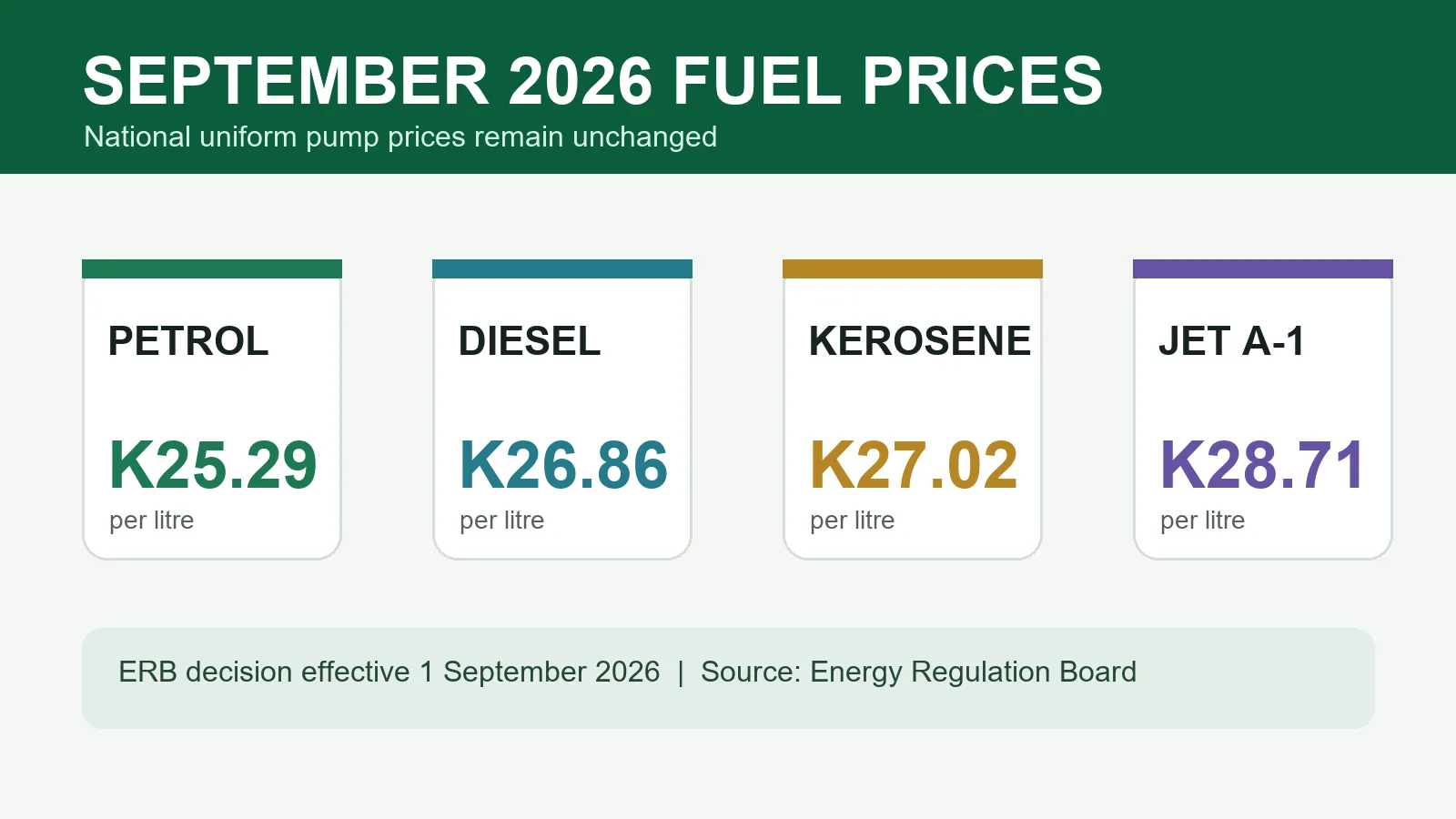
The Energy Regulation Board said petrol will continue to sell at K25.29 per litre, diesel at K26.86, kerosene at K27.02 and Jet A-1 at K28.71. The prices took effect on 1 September and will remain in force until the next monthly review.
September 2026 fuel prices
| Product | National uniform price | Change |
|---|---|---|
| Petrol | K25.29 per litre | Unchanged |
| Diesel | K26.86 per litre | Unchanged |
| Kerosene | K27.02 per litre | Unchanged |
| Jet A-1 | K28.71 per litre | Unchanged |
The decision follows the price reductions introduced for August 2026.
Why prices were held
ERB Board Chairperson James Banda said international prices for petrol, diesel, kerosene and Jet A-1 faced upward pressure during the review period because of geopolitical tensions in the Middle East. Exchange-rate movements also affected the cost of importing fuel.
Zambia’s fuel pricing system is particularly sensitive to those two variables because petroleum products are imported and paid for in foreign currency. A weaker kwacha raises the local-currency cost of a dollar-priced shipment, while higher global oil and refined-product prices increase the starting cost.
The regulator said the effect was mitigated by continued policy interventions, including the suspension of excise duty, the zero-rating of value-added tax and the application of the regulatory price-smoothing mechanism.
What stability means for the economy
Keeping diesel and petrol prices unchanged provides immediate predictability for public transport operators, farmers, mines, manufacturers and distributors. Fuel is embedded in the cost of moving food, construction materials, workers and finished goods across the country.
The decision may also help prevent a fresh round of transport and distribution increases while annual inflation is easing. Zambia’s inflation rate fell to 6.2% in August, bringing it within the Bank of Zambia’s target range of 6% to 8%.
Stable pump prices do not mean the external pressures have disappeared. Instead, part of their effect has been absorbed through tax treatment and price smoothing. The durability of the September position will therefore depend on global petroleum costs, the kwacha and the extent to which the interventions remain in place.
The policy trade-off
Tax relief can shield consumers and reduce short-term inflation pressure, but it also means the Treasury collects less revenue from each litre than it would under the full tax structure. ERB’s September notice does not quantify the revenue forgone or any balance carried by the smoothing mechanism.
That makes transparency in future price build-ups important. Businesses need to know whether today’s stability is likely to persist, while taxpayers need to understand the cost and financing of measures used to hold prices.
For September, the practical result is clear: motorists and businesses will pay the same regulated pump prices as they did in August. The next review will show whether external cost pressure has eased or merely been postponed.
Sources and editorial note
Source: Energy Regulation Board, September 2026 Petroleum Pump Prices press statement and published price build-ups, dated 31 August 2026.
The featured graphic was created by The Zambian Economist using official ERB price data.
WARNING! All rights reserved. This material and all other digital content on this website may not be reproduced, published, broadcast, rewritten, or redistributed, in whole or in part, without the prior express permission of The Zambian Economist. Where permission is granted, the content must be clearly credited to “The Zambian Economist,” with “www.zambianeconomist.com” prominently displayed.
WhatsApp: +260775574228 | Email: info@zambianeconomist.com
© 2026 The Zambian Economist.
Work With The Zambian Economist: Advertise With Us · Directory · Submit an Article
Related: Zambia Raises Petrol to K31.46 and Diesel to K33.27 as Excise Duty Returns.
Analysis: Fuel Price Shock Hits Zambia’s Pump Stations, Carrying Multi-Layer Effects by Kelvin Chisanga.