

Key takeaways
- Since Anna Chifungula retired in December 2015, the Office of the Auditor General has had a substantive, properly confirmed head for barely three and a half years, and none at all since July 2023.
- The only substantive appointee since 2015, Dick Sichembe, was arrested by the Anti-Corruption Commission in March 2023 over alleged graft exceeding K1 million and resigned four months later.
- Ron Mwambwa, who held the office in an acting capacity under two presidents a decade apart, was removed by the Constitutional Court on 21 August 2026. He was 64 at appointment; the Constitution retires the post at 60, and Parliament never ratified him.
- The root cause predates both administrations: the State Audit Commission Act of 2016, which creates the body that must recommend every candidate, has never been brought into force. One commencement order has stood between Zambia and a lawful appointment for ten years.
- Government has accepted the ruling. The lawful route back runs through a statutory instrument, a constituted commission, a transparent recruitment and ratification by a National Assembly elected on 13 August 2026.
The order was unambiguous; the failure it closed took a decade to build. On 21 August 2026 the Constitutional Court declared Dr Ron Mwambwa’s appointment as Auditor-General unconstitutional and ordered him to vacate the office at once. He was 64 when State House announced him in September 2023, the Constitution retires the holder of that office at 60, and the National Assembly never ratified him. The court refused an order that he refund his emoluments, because the Law Association of Zambia (LAZ), which brought the petition, filed no evidence of what he had been paid. Each party will bear its own costs. Our report on the ruling explains what the court decided; this analysis traces how the office reached the point where a court had to decide.
The deeper story does not begin in 2023. It begins in December 2015, when Anna Chifungula, the first woman to hold the post, retired on turning 60 after more than a decade of annual reports that ministers dreaded and donors dissected. What followed her orderly exit is a case study in how not to manage an institution whose only real asset is its credibility: four years of acting cover, one substantive appointment that ended in an arrest, and a second spell of improvisation so irregular that the courts have now shut it down.
The court has settled who cannot hold the office. The record since 2015 shows the state has never worked out, in any sustained way, who should. What the office does, and why lenders price its independence, is set out in our Auditor General Explained series.
The standard Chifungula set
Chifungula was appointed in 2003 and built the job into something governments had to reckon with. Her special audits arrived between annual reports and did not wait for polite timing; an interim report on the Tomorrow Investments contract, delivered to President Levy Mwanawasa, made her name as an auditor willing to hand power an unwelcome finding before the year was out. By 2011 she was complaining in public that officers cited in her reports were almost never prosecuted, a frustration every one of her successors has inherited.
She left the way the rulebook says office holders should: at the age of 60, in December 2015, with her reports tabled. A year later, a new Constitution fixed that same age in Article 252 as the retirement ceiling for her successors, and a new appointment route in Article 249: the President appoints an Auditor-General on the recommendation of a State Audit Commission, subject to ratification by the National Assembly. Zambia then spent a decade not using that route, and the bill has now arrived in court.
Four years without a substantive head
The vacancy outlasted a presidency’s patience. For most of the period from December 2015 the office was held in an acting capacity by Ron Mwambwa, a long-serving deputy. He resigned on 28 June 2018, officially to pursue personal interests; reports at the time spoke of pressure from above over the office’s work. Further caretaker arrangements followed, and by March 2019 commentators were noting that the country had gone more than three years without a substantive Auditor-General.
The scandal calendar filled the vacuum. In 2017 the government bought 42 fire trucks for US$42 million, a purchase the Anti-Corruption Commission opened an investigation into that December after public fury over the price. In September 2018 Britain froze budget support after US$4.3 million meant for social cash transfer households went missing; donors withheld roughly US$34 million, and President Edgar Lungu fired his community development minister. The institution best placed to trace such money was, through all of it, running on caretakers.
The Lungu administration acted at the eleventh hour. Parliament ratified Dr Dick Sichembe, a former Accountant General with more than twenty years in public financial management, in December 2019, and he was sworn in as Zambia’s fourth Auditor-General in January 2020. Even that appointment skipped half the constitutional route: there was no State Audit Commission recommendation, for the plain reason that no commission existed.
Ratified in weeks, arrested in three years
Sichembe’s tenure produced reports through the pandemic years, and then undid itself. On 9 March 2023 the Anti-Corruption Commission arrested him on charges including corrupt practices involving more than K1 million, obtaining goods by false pretences, conspiracy to defraud the government and theft. He stepped aside on leave, then resigned on 12 July 2023 under Article 252(4) of the Constitution.
For the office, the damage was reputational in the crudest sense: the official hired to catch misuse of public money was now answering allegations of it. For the appointment pipeline, the damage was structural. The vacancy reopened, and the government of President Hakainde Hichilema, in office since 2021, filled it the same way its predecessor had, with an acting arrangement.
Mwambwa, again, and the crash
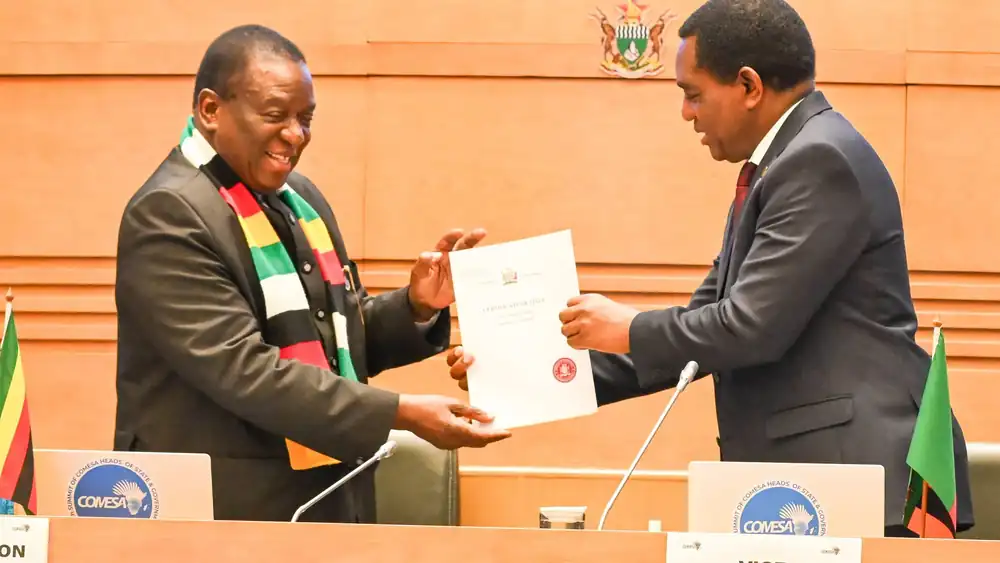
Court records place Dr Mwambwa in the chair from about May 2023, in the unsettled months after Sichembe’s arrest. A State House press release of 25 September 2023 announced him as Auditor-General, pending ratification by the National Assembly. The ratification never came. In later proceedings he said he held a separate acting appointment dated 26 October 2023; he described the letter as classified and never produced it. He was 64 at the time of the announcement. He is 67 now.
LAZ petitioned the Constitutional Court in March 2025, then withdrew the case on 30 May 2025 after the government undertook to operationalise the two 2016 audit laws and make a substantive appointment. Neither happened. The association refiled on 23 March 2026. In May 2026 the Attorney General, Mulilo Kabesha, told the court that a substantive Auditor-General would be appointed once the State Audit Commission was constituted, and asked for the petition to be dismissed. The full bench heard it on 21 July and ruled on 21 August.
The judgment ran short and hit hard. The appointment was ultra vires Articles 249(1), 259(1)(a) and 252(1); continued occupation of the office was null and void; Mwambwa was to cease performing its functions and vacate immediately. On acting arrangements the court added a warning that future governments should pin to the wall: Article 251 covers genuine contingency such as absence or illness, must be for a short period, and the acting appointee must be qualified for the office, age ceiling included. Within a day, Kabesha said the government accepted the ruling and Mwambwa would vacate.
Who has held the office since Chifungula:
| Period | Office-holder | Status | How it ended |
|---|---|---|---|
| 2003 to Dec 2015 | Anna Chifungula | Substantive; first woman in the post | Retired at 60 |
| Dec 2015 to Jun 2018 | Ron Mwambwa | Acting | Resigned, citing personal interests |
| Jun 2018 to Dec 2019 | Caretaker arrangements | Acting | Sichembe ratified by Parliament |
| Jan 2020 to Jul 2023 | Dick Sichembe | Substantive; no commission recommendation | ACC arrest in Mar 2023; resigned 12 Jul 2023 |
| May 2023 to Aug 2026 | Ron Mwambwa | Acting; announced as AG, never ratified | ConCourt order of 21 Aug 2026 |
| Aug 2026 to date | Vacant | No lawful acting cover available | Awaiting commission route |
Why has Zambia gone so long without a lawful Auditor-General?
Because the body that must recommend every candidate has never existed. Parliament passed the State Audit Commission Act (No. 27 of 2016) and the Public Audit Act (No. 29 of 2016) on 7 June 2016. Both await commencement orders from the Minister of Finance, ten years on. Without the commission there can be no recommendation; without a recommendation there can be no constitutionally valid appointment; and every improvisation used to bridge the gap has now failed, in court or in office.
The Public Audit Act even defines the candidate pool with care: a qualified accountant, a member of the Zambia Institute of Chartered Accountants, at least ten years of audit work including five at senior management level, and at least 45 years old on appointment. Read with the constitutional retirement age of 60, that gives Zambia a fifteen-year eligibility window, wide enough for any serious recruitment. What has been missing is not talent. It is the signature that switches the process on, and the will to run it.
The failure is bipartisan, which is precisely why it has lasted. The Lungu administration left the office vacant for four years and skipped the commission route when it finally appointed. The Hichilema administration defended an acting appointment made four years past the age limit, and let the undertaking it gave LAZ in May 2025 lapse into this month’s judgment. Dr Mwambwa’s own record spans both: acting head under one president, removed by court order under another, a decade apart.
What the drift has cost
The professional cadre kept the machine running, and that deserves saying plainly. The 2023 report went to Parliament and flagged, among other things, K1.2 million paid to officers while they were on leave and K3.3 million paid to people not entitled to it. The 2024 main report is published and sits before the Public Accounts Committee. Auditors who spent three years working under a legal cloud over their own chief executive still delivered the product.
But a supreme audit institution is more than a publication schedule, and the erosion has happened where it is hardest to see. Civil society reviewers, including Transparency International Zambia, note that the same findings recur year after year with thin follow-through on Public Accounts Committee recommendations (our plain-language guide explains how to read one). Chifungula’s 2011 complaint about missing prosecutions has aged into a structural condition. The office can name the missing money; the state has yet to show consistent interest in recovering it.
The outside world prices this. Zambia’s IMF programme, an Extended Credit Facility arrangement of about US$1.3 billion approved in August 2022, last reached a staff-level agreement on a review in June 2025, and public financial management credibility runs through every such review. The European Union funds peer-to-peer institutional support to the National Audit Office; Norway and other partners have backed the office through AFROSAI-E. The INTOSAI framework that anchors audit independence worldwide counts appointment by due constitutional process among its principles. Zambia’s partners do not need perfection; they need predictability, and for ten years the one office that certifies the state’s books has been an exercise in improvisation.
The public reaction has followed a gentler arc than the courtroom drama. On social media, sympathy for Dr Mwambwa has outweighed triumph: many commenters noted that he did not pick himself for the job, only to be undone by rules others ignored. Few dispute that the age limit settles the matter. The sharpest posts have been reserved for the state itself, and for a habit of punishing honest advice that long predates this ruling.
The way back
The repair sequence is short, and every step sits within powers the executive already holds. Issue the commencement order for the two 2016 Acts by statutory instrument. Constitute and swear in the State Audit Commission. Run an open recruitment against the published qualifications, with a shortlist the profession can inspect. Appoint on the commission’s recommendation and transmit the name to the National Assembly for ratification. Done at that pace, the exercise fits inside ninety days, and nothing in it requires new legislation or money.
The timing is awkward but workable. The order landed days after the Electoral Commission declared the result of the 13 August general election, a result the opposition is contesting, and the new National Assembly that must ratify any appointment has yet to convene. That is an argument for starting the commission work now, not for waiting. Every month of vacancy pushes the audit calendar, and the findings that recur in each report, one year further from consequence.
The constitutional route against the record:
| Step | What the law requires | Status |
|---|---|---|
| Commencement | Minister of Finance issues orders bringing the two 2016 Acts into force | Never done; ten years on |
| Commission | State Audit Commission constituted and sworn in | Never constituted |
| Recommendation | Commission recommends a qualified candidate | Never happened |
| Appointment | President appoints on that recommendation | Attempted by press release in 2023; voided by the court |
| Ratification | National Assembly confirms the appointment | Last done for Sichembe in Dec 2019 |
What it means
The vacancy is not an abstract constitutional problem. It lands on three constituencies The Zambian Economist writes for.
For business: Auditor-General reports are the public record of whether suppliers, contractors and councils delivered what the state paid for, and the Public Accounts Committee builds its hearings on them. A headless office does not stop audits, but it slows the reckoning: findings recur, files age, and firms holding government contracts wait longer to know where they stand. Businesses named in recent reports should assume the backlog of follow-through will take years to clear.
For investors: Governance risk is part of the price of Zambian money, and the IMF review calendar reads the same files investors do. A court order obeyed within a day, a statutory instrument, a ratified appointee: that sequence would cost nothing and buy credibility at the exact moment an election petition is testing it. Drift would do the opposite, just as programme reviews and budget-support decisions fall due.
For policy: The fix is administrative, not legislative, and it should be paired with the harder reforms the episode exposes: a published timetable for the appointment, parliamentary tracking of the May 2025 undertaking, and a Public Accounts Committee process with teeth for ignored recommendations. The wider pattern of appointments that bypass constitutional checks is examined in Beyond the Ballot Box. The next Auditor-General will also eventually turn 60. If the pipeline is switched on now, that succession can be routine. If not, the next transition will look like this one.
Conclusion
Chifungula’s retirement was the last orderly transition the office has had. Since then, two administrations have treated the constitution’s appointment route as optional, and each shortcut has failed more expensively than the one before it. The staff kept auditing; the state kept fumbling the paperwork. There is no legal obstacle left to a proper appointment, only an administrative one, and it is a single signature old. The court has emptied the chair. Filling it lawfully would take ninety days. A decade of drift has run out of excuses.
Related reading:
- ConCourt Removes Mwambwa as Auditor-General Over Age Limit
- What’s Actually in an Auditor General’s Report? A Plain-Language Guide
- OAG Reports Simplified: How Zambia Audits the Constituency Development Fund
- Auditor General Links Accountability to Investment at the Show
WARNING! All rights reserved. This material and all other digital content on this website may not be reproduced, published, broadcast, rewritten, or redistributed, in whole or in part, without the prior express permission of The Zambian Economist. Where permission is granted, the content must be clearly credited to “The Zambian Economist,” with “www.zambianeconomist.com” prominently displayed.
WhatsApp: +260775574228 | Email: info@zambianeconomist.com
© 2026 The Zambian Economist.
Work With The Zambian Economist
Related: Acting Auditor General Malaila Calls for Prudent Budgeting to Protect Core Audit Work.