By Zambian Economist Analyst
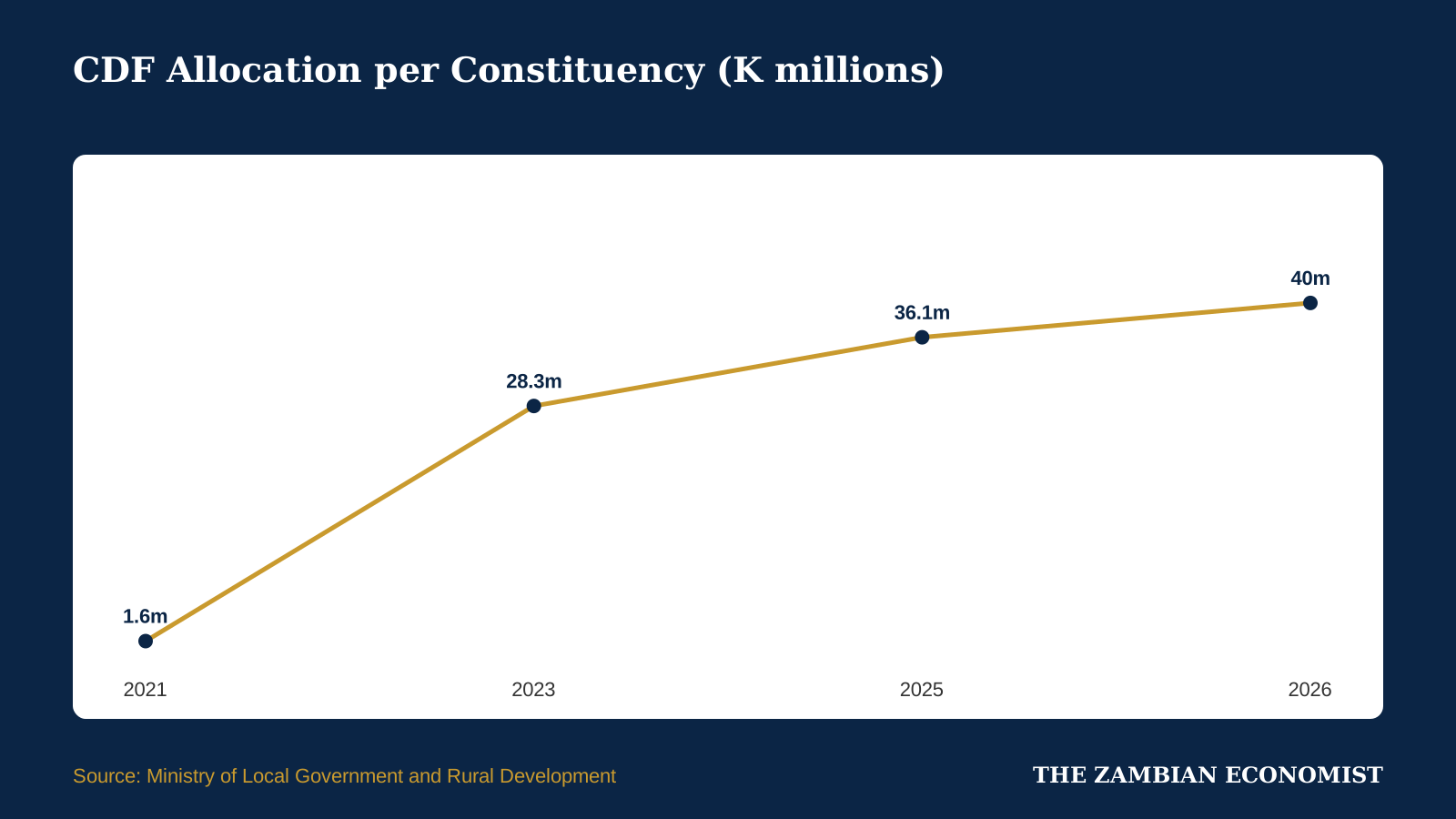
CDF has grown from K1.6 million to K40 million per constituency since 2021, making it Zambia’s fastest-growing public fund and its most closely audited. Here is how the Auditor General actually checks it.
Zambia’s Fastest-Growing Public Fund
The Constituency Development Fund has grown from K1.6 million per constituency in 2021 to K40 million in 2026, a national total of K6.245 billion spread across 156 constituencies. No other public spending line in Zambia has grown this quickly in percentage terms, which is exactly why it draws the most sustained audit attention of any single fund in the Auditor General’s annual reports.
What the CDF Actually Pays For
The fund is split into three components: community infrastructure projects, youth, women and community empowerment grants, and secondary school bursaries and skills development. It is administered by the Ministry of Local Government and Rural Development, but implemented locally through district and municipal councils and elected Constituency Development Fund Committees, which decide which local projects get funded.
Why the Auditor General Keeps Coming Back to It
Decentralised spending is harder to audit than centralised spending precisely because it happens in 156 separate places at once, each with its own committee, procurement process and paperwork trail. The Office of the Auditor General checks CDF spending against three basic questions: was the money released as budgeted, was it spent on an approved project, and is there a paper trail, invoices, completion certificates, minutes, connecting the disbursement to the outcome on the ground. Value-for-money findings, not just missing-money findings, are the more common outcome: a school block completed at a higher cost than budgeted, or a road graded to a lower standard than specified.
How to Read an Audit Finding on CDF
A finding that a constituency “failed to account for” a sum does not automatically mean the money was stolen. It often means the underlying documentation was incomplete or was not submitted in time for the audit, which is itself a governance weakness worth fixing, but a different problem from outright loss of funds. Distinguishing between the two is part of what the OAG Explained series exists to help readers do.
| Year | CDF per constituency |
|---|---|
| 2021 | K1.6 million |
| 2022 | K25.7 million |
| 2023 | K28.3 million |
| 2024 | K30.6 million |
| 2025 | K36.1 million |
| 2026 | K40 million |
Why This Matters for Voters and Businesses
For citizens, understanding how CDF is audited is the difference between reading an Auditor General headline as a scandal and reading it as a management issue with a specific fix. For local contractors and suppliers, the fund’s scale, K6.245 billion in 2026 alone, makes CDF-funded projects one of the largest sources of local government contracting opportunity in the country, with compliance and documentation increasingly a condition of getting paid on time.
Key Takeaways
- CDF has grown 25-fold since 2021, from K1.6 million to K40 million per constituency in 2026.
- The fund is split between infrastructure, youth and women empowerment, and education bursaries.
- Most Auditor General findings on CDF concern documentation and value for money, not simple theft.
Related reading: What’s Actually in an Auditor General’s Report? A Plain-Language Guide
See also: Ethics as Infrastructure: The Economic Case for Integrity in Zambia’s Engineering Sector, Eng. Willings Sichalwe’s analysis of why integrity systems are now a fiscal question for infrastructure delivery.
Related: Sunday Chanda Concedes Kanchibiya Seat, Defends His Bill 7 Vote in Farewell Statement
Related: The Constitutional Court has removed Auditor-General Dr. Ron Mwambwa from office over his age and the lack of parliamentary ratification. Read: ConCourt Removes Mwambwa as Auditor-General Over Age Limit.
Related: CDF Must Not Become a Blank Cheque for Infrastructure, Kelvin Chisanga’s case for national cost benchmarks on CDF-funded builds.
Related: How International Standards Are Closing the Net on Procurement Fraud