A ten-minute bus wait in Seoul raises a practical question for public investment: how should we measure an asset’s value after construction is complete?
Key takeaways
- A project’s construction price does not show the full cost of keeping it useful over time.
- Passenger comfort, access and reliable information matter, but each benefit should be assessed separately and with evidence.
- Maintenance plans and repair records should be part of the investment decision from the start.
- Small public facilities should be judged by how well they serve a complete journey, not only by whether they were built.
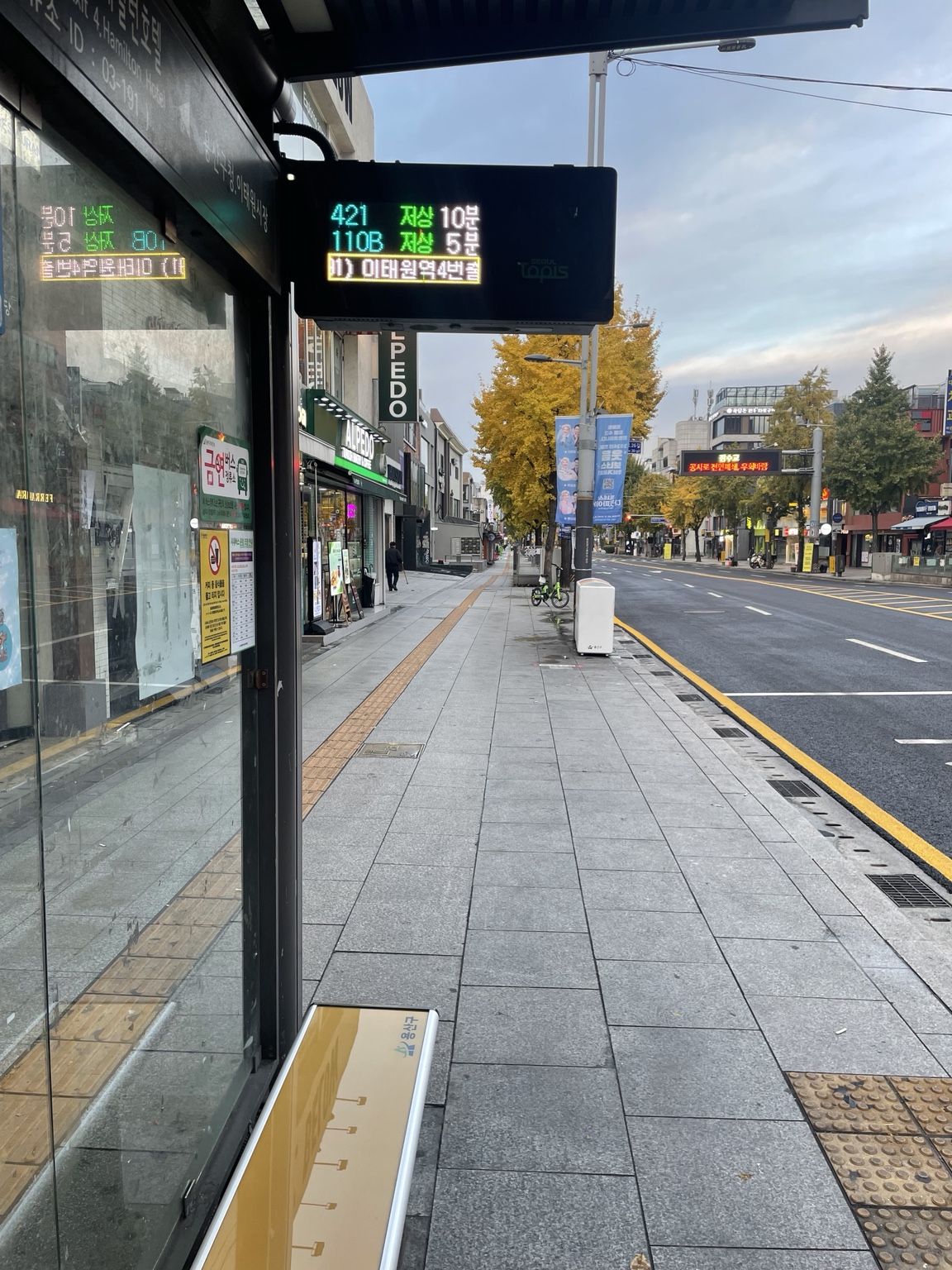
One cold morning in Seoul, the screen at my bus stop told me route 421 would arrive in ten minutes. Normally, ten minutes feels longer when I am thinking about work. That morning, I sat on a heated bench and watched yellow leaves across the street. I was not visiting a landmark or buying a service. I was simply waiting for an ordinary bus.
The scene brought to mind a question from construction and project work: after a public facility is completed, what should count as its value?
A contractor can report its cost, materials, installation date and inspection result. A government can count how many shelters it built in a financial year. Those facts matter. The public experiences a facility through the time, effort, uncertainty and discomfort involved in using it.
My observations come from daily journeys in Seoul. They are not an economic evaluation of Korea’s transport system, and they cannot establish what would suit a city in Zambia. They are a practical starting point for asking better questions about modest public investments.

The first cost is not always on the invoice
There is a difference between a project’s construction price and the cost of the service it provides over time. A low-priced facility that often fails, is uncomfortable or expensive to repair may not be the economical choice. A more durable option may cost more at first but need fewer repairs. Neither conclusion is automatic; both need evidence.
A bus stop’s construction budget might cover a shelter, lighting, a bench and a display. Operating it can require electricity, cleaning, replacement parts, inspections and repairs. If recurring costs were never realistically budgeted, the project may look successful at opening and disappoint users later.
An elaborate shelter may be unnecessary at a stop with few passengers, while a modest roof could make a real difference where many people wait. The right design depends on who uses the stop, when and under what conditions. I would begin with users and operations staff, not a catalogue of equipment.
The value of a wait
A comfortable waiting place can make a small difference to a morning. It may protect a passenger from rain or sun. A legible arrival display can show whether there is time for a phone call or whether the next bus is still far away. At a busy stop, an accessible route to the platform may matter more than decorative finishes.
These are real experiences. But observing them does not prove that a heated bench creates a particular amount of economic value. A researcher would need credible information about use, costs, preferences and alternatives.
The same caution applies to time savings. A real-time display may reduce uncertainty even if the bus itself arrives no sooner. Counting all waiting minutes as time saved would overstate the benefit. Clearer information and faster transport should be assessed separately.
There are distributional questions too. Seating or weather protection may matter more to someone who finds standing difficult than to someone who can easily wait on their feet. One average user can hide those differences.
The second budget: maintenance
In Yeoksam, I have seen a glass-walled waiting shelter with seating and a digital information screen. I have also seen a compact climate-controlled booth intended for a smaller stop. They are different responses to the same broad need; neither proves that every stop requires the more elaborate version.
As a construction professional, I notice that each added feature creates an obligation. Glass needs cleaning. Doors need adjusting. Displays need support. Electrical equipment needs inspection. Components eventually need replacement.

A sound proposal should show two budgets: the capital needed to create the asset and the recurring resources needed to keep it working. Without the second, the first figure can mislead.
A government does not need a complex technology platform to begin tracking performance. A reliable inventory, a simple inspection schedule, a clear contact for reporting faults and a record of repair times can improve accountability.
When records show recurring failures, decision-makers can ask whether the design, materials, installation or maintenance arrangements need to change. Sometimes the answer is to improve one component or repair a repeated defect more effectively, not replace everything.

Measure service, not just delivery
Construction completion is a milestone. Public value continues afterwards.
For a modest transport facility, an operational scorecard could ask five questions: How many people use it at different times and seasons? Can people approach and use it safely, including those with mobility difficulties? Are its main features working reliably? How long do reported problems take to fix? What has it cost to operate and repair compared with the forecast?
These questions are not a universal formula or a substitute for engineering assessment. They connect spending with observed service and make trade-offs easier to discuss.
If a new shelter’s lighting fails repeatedly, counting it as a permanent success is premature. If an existing one can be improved cheaply and safely, rehabilitation may make better use of funds than replacement. A remote location may need a simpler, more robust option than a technologically elaborate one.
Most importantly, the scorecard must lead to decisions. Recording defects without assigning responsibility or funding repairs does little for users.

The experience should follow the whole journey
In Seoul, bus platforms in the middle of major roads connect to central bus-only lanes. Their design differs from the quiet neighbourhood stop near my home, but passengers experience them as parts of one journey.
A well-equipped waiting area does not compensate for an unsafe route to reach it. A comfortable seat is less useful if the pavement beside it is difficult to navigate. On a steep road near my home, dark lines in the asphalt appear to mark work associated with winter road heating, although I cannot confirm their operation by sight alone. The observation is a reminder that safe access to public transport begins before a passenger reaches the shelter.
Infrastructure planning often separates roads, bus facilities, drainage and maintenance into different projects and budgets. From a resident’s perspective, the connections among them may matter most. An evaluation should ask whether an investment improves a complete journey or just one object.

Questions worth asking in any city
I have not undertaken field research in Zambia, and I would not presume that a heated bench in Seoul is a model for Zambian public spending. Different climates, travel patterns, electricity costs, fiscal constraints and maintenance capabilities lead to different priorities.
The transferable point is more modest. Before approving a small public amenity, decision-makers could ask who will use it, what problem it solves, what less costly alternatives exist, how it will be maintained and how people will know whether it worked.
Some communities may place the highest value on shade, safe crossings, drainage, accessible paths or dependable information. Others may need basic shelters before more sophisticated equipment. Priorities should be established locally.
Consultation should be more than asking residents whether they like a drawing. People who use a place can explain how it behaves in rain, rush hour, after dark and when an installation stops working. Engineers can then test feasible remedies against safety, cost and technical standards.

What a ten-minute wait can teach
When my bus arrived, I left the heated seat and joined the other passengers. The stop had done something small for me: it made an ordinary winter wait more comfortable.
It would be easy to romanticise that moment or turn it into an unsupported claim about economic returns. I prefer a practical conclusion. For a public asset, value is not simply the amount spent to build it. It is the service that survives the opening ceremony: usefulness, reliability, accessibility and maintenance over time.
The most important question may come after construction: is this facility still doing what the public needed it to do? The answer should shape the next repair, design and budget.
About the author
Tristan Kim is a South Korean construction and project-quality professional. He holds a Bachelor of Engineering in Architectural Engineering from Konkuk University and an LL.M. in Economic Law from Yonsei University. He completed doctoral coursework in Law at Konkuk University; no doctoral degree was awarded. He holds South Korea’s Professional Engineer qualification in Architectural Construction and is a Professional Member of the Royal Institution of Chartered Surveyors (MRICS). He documents everyday buildings and public spaces in Seoul through PG Global Insight.