
By Meamui Mwendaweli | For The Zambian Economist
Education can widen opportunity in Zambia, but its ability to narrow inequality depends on whether employers create jobs that use what people have learned and whether graduates can afford to pursue those jobs. Families commit scarce resources to fees, transport and living costs because they expect a qualification to open a route to financial independence. The wait for a first job can put that promise out of reach.
What the unemployment rate leaves unanswered
The Zambia Statistics Agency released its 2025 Labour Force Survey results on 16 October 2026. It estimated that 4.76 million people were employed in 2025, lifting the employment-to-population ratio to 37.1% from 33.1% a year earlier. Among people aged 15 to 24 in the labour force, 23.9% were unemployed. Across that age group, roughly 2.09 million were outside employment, education and training.
The rise in employment matters to households, but job quality varies widely. ZamStats counted about 3.02 million people in informal employment in 2025. A graduate earning money in work unrelated to their training counts as employed. That classification tells us little about whether their skills are being used or whether their income can support a household.
The 2024 Labour Force Survey also shows how outcomes vary among people with similar qualifications. Among certificate and diploma holders in the labour force, 15.4% of women were unemployed, compared with 8.5% of men. The survey gives us a picture by qualification and sex. Following graduates from the point they leave school would help explain where the gaps emerge.
Who can afford to wait for a first job?
Consider two graduates with comparable qualifications. One can draw on professional contacts, pay for transport to interviews and accept a placement while family covers living costs. The other depends on advertised vacancies and needs an income immediately. An unpaid internship may offer experience to the first graduate while putting the same opportunity out of reach for the second.
In a 2025 release, Afrobarometer reported that 63% of Zambians surveyed aged 18 to 35 had secondary or post-secondary education and 54% said they were looking for work. The responses describe young adults’ experiences. ZamStats uses its own labour-force definitions and reports separate rates for different age groups.
Where can Zambia put graduates’ skills to work?
In its analysis of Zambia’s growth and jobs, the World Bank found that wage employment was scarce and the public sector absorbed a large share of workers with tertiary education. Expanding the number of pharmacy, engineering or information technology graduates will bring greater returns if firms can grow and hire people in those fields. In pharmaceuticals, for example, building a competitive manufacturing industry would create places to apply skills that a degree alone cannot provide.
Mining shows how shortages of jobs and shortages of specific skills can coexist. A 2025 World Bank analysis estimated that direct mining employment could rise from about 56,000 to 200,000 if Zambia meets its copper production targets. The same analysis identified limits in the supply of technicians and artisans. Employers and training institutions can address those gaps by planning apprenticeships and work placements around the roles firms expect to fill.
Measure what happens after graduation
Universities and technical colleges should publish graduate outcomes by programme. How long does it take graduates to find their first paid job? What do they earn, and how often does their work use the skills they trained for? Following graduates at six and twelve months would give students better information before they enrol and help institutions decide where employers should have a greater role in training.
Government should judge investment and industrial policy in part by the jobs they create and the wages those jobs pay. Employers can widen access by advertising entry-level roles openly and paying interns enough to participate. Training institutions can use evidence from graduates and employers to decide which programmes need more practical instruction.
Education remains a valuable investment. It becomes an equaliser when a graduate’s prospects depend less on family resources and more on what they can do. Zambia can move closer to that goal by making the first step into paid work more accessible and expanding the industries where graduates can build a career.
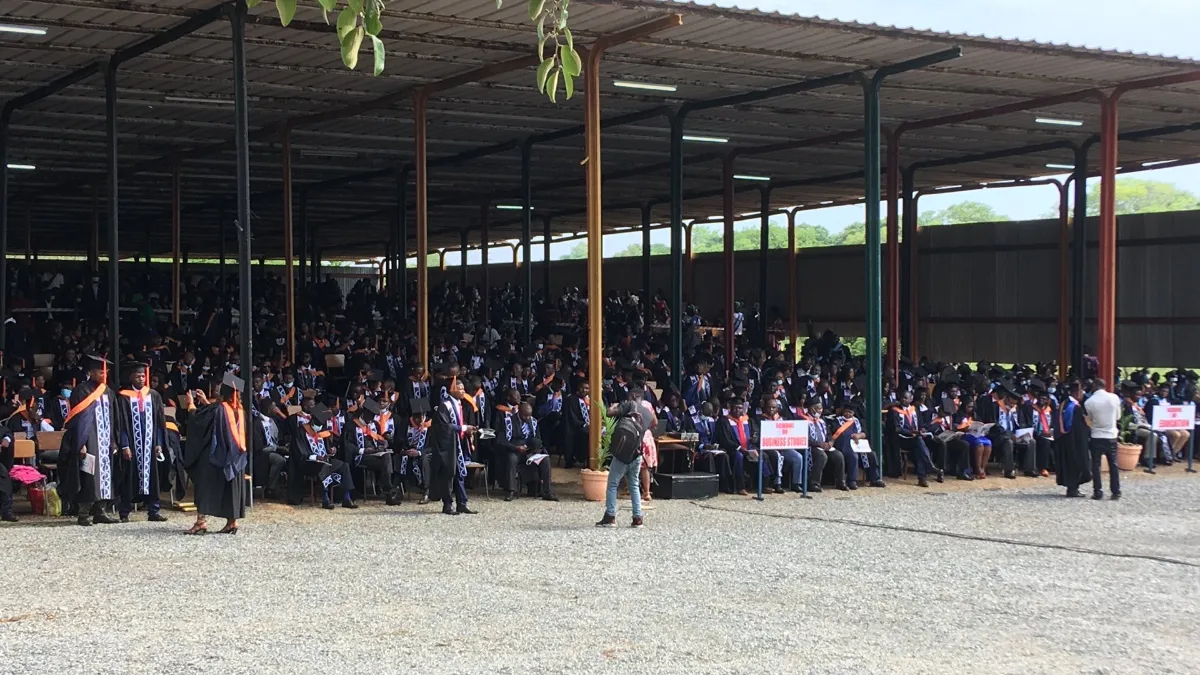
Mulungushi University’s graduation ceremony, November 2021. Photo by Mac H. Alford via Wikimedia Commons, CC BY-SA 4.0. Cropped to 16:9.

About the author
Meamui Mwendaweli
Student Contributor Writer · Lusaka, Zambia
Meamui Mwendaweli is a Bachelor of Pharmacy student at Levy Mwanawasa Medical University. She writes about public policy, economic development, governance and public health, with a focus on how policy affects everyday life and access to opportunity.
Related coverage Labour & Employment
WARNING! All rights reserved. This material and all other digital content on this website may not be reproduced, published, broadcast, rewritten, or redistributed, in whole or in part, without the prior express permission of The Zambian Economist. Where permission is granted, the content must be clearly credited to “The Zambian Economist,” with “www.zambianeconomist.com” prominently displayed.
WhatsApp: +260775574228 | Email: info@zambianeconomist.com
© 2026 The Zambian Economist. The graduation photograph is available under the Creative Commons licence credited above.