
Ask a mining executive in Solwezi what keeps a multi-billion-dollar expansion decision awake at night, and the answer is rarely the copper price. Copper prices can be hedged. What cannot be hedged is the possibility that the tax regime, the licensing rules, or the mineral royalty structure will look different in eighteen months.
That single insight explains more about Zambia’s investment performance over three decades than any other variable. Capital does not primarily fear bad policy. It fears changing policy, and it prices that fear into every decision about whether to build a smelter in Chingola or a solar farm in Chisamba.
This article examines what policy certainty actually means in practice, what the evidence shows about its effect on Zambian investment and employment, and what it would take to institutionalise it beyond any single administration.
What policy certainty means, and what it does not
Policy certainty is frequently confused with two other things it is not.
It is not the same as political stability. Zambia has enjoyed remarkable political stability by regional standards, with peaceful transfers of power between parties in 1991, 2011 and 2021. That record is a genuine national asset and rarely credited as one. Yet Zambia has simultaneously experienced significant policy volatility, particularly in mining taxation, which changed materially on numerous occasions between 2008 and 2020.
It is also not the same as policy quality. A consistently poor policy is certain, and certainty of that kind does not attract capital. What investors actually price is the variance of expected policy, weighted by how long their capital is locked in.
The correct formulation is this: policy certainty is the credible expectation that the rules governing a specific investment will not change arbitrarily within that investment’s payback period.
That definition has a practical corollary. The longer the payback period, the higher the certainty premium required. A retail shop in Kabwe with an eighteen-month payback needs relatively little. A greenfield mine with a fifteen-year payback needs a great deal. A transmission line or a rail concession needs more still.
This is precisely why Zambia’s investment profile has historically skewed toward extraction and trading rather than manufacturing. It is not a failure of Zambian entrepreneurship. It is a rational response to a certainty environment that has favoured short-payback activity.
The evidence: what changed between 2021 and 2026
The past four years offer an unusually clean natural experiment, because several policy variables moved in the same direction at once.
Mining investment. Sector estimates place mining investment attracted over the 2022-2026 period in the region of US$10 billion, a figure widely cited in industry analysis, though readers should note it is a sector estimate rather than an official statistic. What is not in dispute is the direction. The variable that changed was not geology, the Copperbelt and North-Western Province orebodies were exactly where they had always been. What changed was the resolution of disputes and the direction of tax policy.
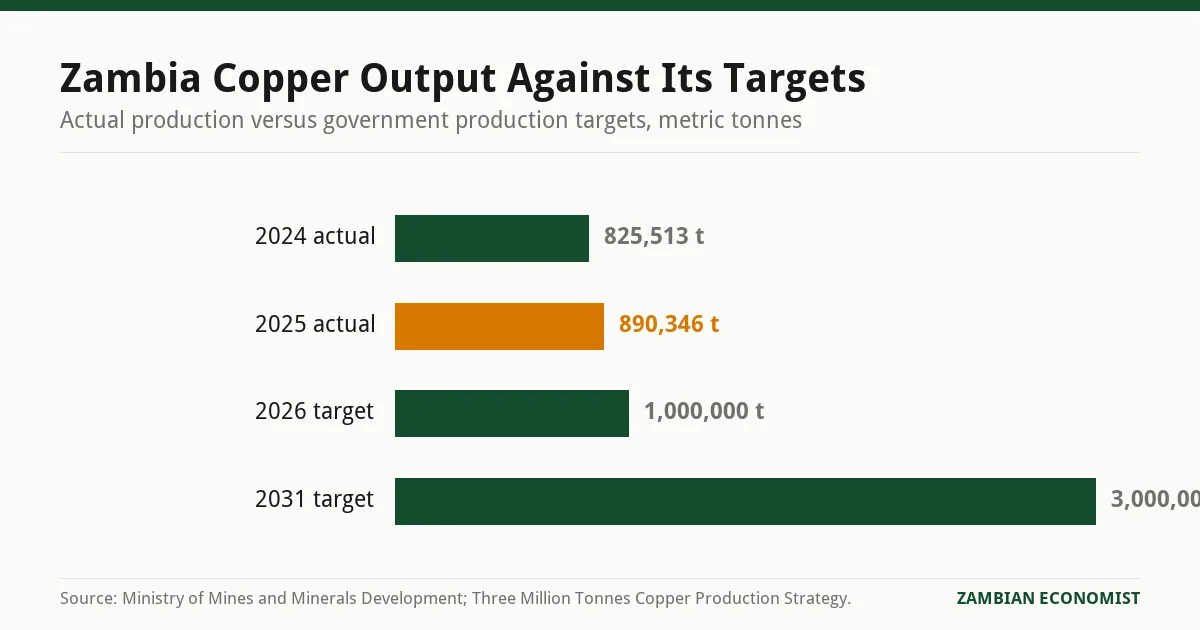
Production response. According to the Ministry of Mines and Minerals Development, copper output reached 890,346 tonnes in 2025, an 8 percent rise from 825,513 tonnes in 2024 and the second consecutive year of growth. Konkola Copper Mines, following resolution of the long-running dispute with Vedanta Resources, increased output sharply to just over 80,000 tonnes. Mopani Copper Mines increased output by around 40 percent. Both are recovery stories from operations that had been effectively paralysed by ownership uncertainty.
That is a direct, measurable illustration of the mechanism. Two assets sat underperforming for years not because the ore had disappeared, but because nobody knew who would own the cash flows.
Sovereign risk pricing. S&P Global Ratings upgraded Zambia’s long-term foreign currency rating to CCC+ from selective default. Sovereign ratings are, at root, a formal opinion on policy predictability. Every corporate borrower in the country prices off that sovereign anchor, whether or not they ever read a rating report.
Macroeconomic anchor. Inflation fell from 11.2 percent in December 2025 to 6.5 percent by June 2026, inside the Bank of Zambia’s 6-8 percent target band. The Policy Rate has been reduced three consecutive times to 13.25 percent as of May 2026. Gross international reserves reached about US$6.4 billion, or 4.4 months of import cover.
None of this establishes that any particular administration deserves credit, copper prices, a strong 2025 maize harvest and improved electricity generation all contributed independently. What it does establish is the direction of the relationship: as uncertainty fell, capital commitment rose, and it rose fastest in the assets where uncertainty had been highest.
The transmission channels: how certainty becomes jobs
Policy certainty does not create employment directly. It works through four channels, each with a different lag.
| Channel | Mechanism | Typical lag | Zambian example |
|---|---|---|---|
| Cost of capital | Lower perceived risk lowers required returns | 6-18 months | Sovereign upgrade feeding into corporate borrowing costs |
| Investment horizon | Firms shift from trading to building | 2-5 years | Brownfield mine expansions |
| Formalisation | Firms register when rules are predictable | 1-3 years | PACRA registrations, local content compliance |
| Skills investment | Firms train when they expect to stay | 3-10 years | Mining and agro-processing apprenticeships |
The employment implications follow from the lags. Certainty established in 2026 shows up in the cost of capital almost immediately, in construction jobs within two to three years, and in the deep skills base only after a decade.
This has an uncomfortable political consequence: the electoral cycle is shorter than the employment response to good policy. A government that establishes genuine certainty will very likely not be in office when the employment benefits arrive. A government that abandons certainty for short-term stimulus will very likely not be in office when the costs arrive either.
That asymmetry is the central governance problem in Zambian economic policy, and no manifesto solves it.
The uncomfortable arithmetic of jobs
Formal employment in Zambia is commonly put at roughly 1.18 million people, a figure cited in current manifesto debate and broadly consistent with labour force survey findings, though definitions of formality vary between sources. Against a population well above 20 million and a labour force expanding by hundreds of thousands each year, that order of magnitude is the country’s defining economic statistic, more revealing than GDP growth, inflation or the exchange rate.
It also puts campaign pledges in perspective. Proposals to lift formal employment to 2.5 million, or to create two million jobs, would require more than doubling the formal economy within a single term. Zambia’s Q1 2026 GDP growth of 7.7 percent, reported by the Zambia Statistics Agency, is genuinely strong, and the IMF projects growth in the region of 5.5 percent for 2026 as a whole. But growth of that order, sustained, historically produces formal job growth in the tens of thousands per year, not the hundreds of thousands.
The gap is not a failure of ambition. It is a structural feature of an economy where the largest growth sectors, mining and, to a degree, agriculture at commercial scale, are capital-intensive rather than labour-intensive. Mining contributes a substantial share of GDP and the large majority of export earnings while employing a small fraction of the workforce.
Closing that gap requires labour-intensive sectors to grow: agro-processing, construction, tourism, light manufacturing, and tradeable services. Every one of those has a payback period long enough to be certainty-sensitive. Which returns the argument to where it started.
Regulatory reform: what has moved and what has not
Several reforms bear directly on the certainty environment.
Local content regulations (Statutory Instrument No. 68 of 2025) took effect on 1 January 2026, aimed at increasing Zambian participation in mining supply chains. Local content rules are a genuine two-sided instrument: they can build durable domestic supplier capability, as Nigeria’s oil and gas sector has demonstrated in parts, or they can raise costs and create rent-seeking if compliance thresholds outrun actual local capacity. The determining factor is almost always whether the rules are phased predictably and enforced consistently.
The National Critical Minerals Strategy has advanced exploration of lithium in Mapatizya and Luano districts and graphite in Petauke. Critical minerals are where Zambia’s certainty premium will be tested most sharply over the next decade, because the global capital chasing them is highly mobile and highly attentive to regulatory risk.
Digitisation of government services appears across the political spectrum as a commitment, and deservedly so. Predictability is partly a function of discretion: every manual approval is a point where the rule can be applied differently to different applicants. Rwanda and Kenya have both demonstrated measurable improvements in business registration and permitting through digitisation.
What has not moved sufficiently: electricity. Zambia’s power deficit remains the most frequently cited constraint by firms across every sector, and no amount of regulatory predictability compensates for an unreliable supply. Load shedding is, functionally, a form of policy uncertainty, a firm cannot plan production against an unpredictable input.
The election-cycle effect
There is a well-documented pattern across emerging markets: private investment decisions cluster after elections rather than before them. Boards defer irreversible commitments through periods of political uncertainty, then release them once the direction is known. Economists call this the option value of waiting, when a decision is irreversible and information is arriving, delay itself has value.
Zambia is unlikely to be an exception, and the effect is visible in ordinary commercial behaviour: equipment orders deferred, expansion approvals scheduled for the following board cycle, hiring frozen pending clarity.
For business planning, three observations follow.
First, the pre-election lull is normal and temporary; it is not a signal about the underlying economy. Second, the post-election release creates a genuine window, firms positioned to move in the first quarter after a result typically secure better terms on labour, equipment and premises than those that wait for confirmation. Third, and most importantly, what matters for the release is not who wins but how quickly the policy direction is clarified. A government of any complexion that publishes a credible, costed fiscal and regulatory roadmap within ninety days of taking office will unlock more investment than one that spends six months signalling.
What businesses should do
- Distinguish political risk from policy risk. Political risk is about who governs. Policy risk is about what the rules will be. The second is more manageable and more consequential for most firms.
- Contract for certainty where you cannot legislate it. Development agreements, stability clauses, long-term offtake contracts and power purchase agreements all substitute private certainty for public certainty. They cost something. They are frequently worth it.
- Match payback to certainty. If your project’s payback exceeds five years, build a scenario in which the tax or tariff regime changes once. If it exceeds ten, build in two changes.
- Engage the consultation process seriously. Statutory Instruments and budget submissions are the points at which rules are actually made. Industry associations have more influence at drafting stage than at implementation stage.
- Track leading indicators, not headlines. Bond auction subscription rates, arrears to suppliers, and the pace of statutory instrument issuance tell you more about the near-term environment than campaign rhetoric.
What policymakers should consider
Institutionalise, do not personalise. Certainty embedded in a person is not certainty. Certainty embedded in a statute, a published fiscal rule, an independent regulator, or a binding medium-term expenditure framework survives transitions.
Publish a policy calendar. One of the cheapest reforms available: a rolling twelve-month schedule of anticipated regulatory changes, consultations and statutory instruments. It costs almost nothing and materially reduces variance for every firm in the country.
Protect the mining fiscal regime from annual revision. Zambia’s most damaging historical pattern has been repeated mid-cycle changes to mineral royalty and tax structures. A binding commitment to a fixed review cycle, with published methodology, would be worth more to investment than any incentive package.
Treat electricity as an investment-climate variable, not merely an energy problem. Every gigawatt of firm capacity added reduces the certainty premium across the entire economy.
Risks and opportunities
Risks: a post-election fiscal loosening that reverses macroeconomic gains; renewed uncertainty over mining tax; a slower-than-expected successor IMF arrangement; drought recurrence affecting both agriculture and hydropower; global copper price correction.
Opportunities: the post-election investment release window; critical minerals demand driven by the energy transition; the Lobito Corridor and improved export logistics; regional market access through AfCFTA, COMESA and SADC; a demonstrated track record of debt restructuring that, if maintained, moves Zambia meaningfully up the sovereign credit ladder.
Conclusion
Zambia’s economic debate tends to treat politics and economics as separate arenas, one for rallies, one for spreadsheets. The evidence of the last four years suggests they are the same arena.
Two mines that had been effectively idle returned to production not because of new geology or higher prices, but because ownership questions were settled. Inflation returned to target not solely through interest rates but because the fiscal and external position became legible again. Billions of dollars committed to Zambian mining were, in substantial part, a bet on predictability.
The lesson is not that any particular set of policies is correct. It is that the durability of policy is itself an economic input, as real as electricity, roads, or skilled labour, and considerably cheaper to supply.
Whoever forms the next government inherits a rare position: a country whose macroeconomic credibility has been rebuilt but not yet tested across a political transition. How that test is handled between August and December 2026 will shape Zambian investment for a decade.
Do you think Zambia’s investment climate is better served by incentives or by predictability? Share your view, Zambian Economist welcomes contributions from business leaders and researchers.
Related coverage: institutional credibility is part of the policy-certainty picture, see ACC Rejects Claims It Failed to Protect Ministry of Finance Whistleblower. On investor-facing infrastructure, see the Zambia Investment Deal Room pipeline.
An independent judiciary is part of that certainty: read how Chief Justice Malila is preparing the High Court to resolve 2026 election disputes without fear or favour.