
In May 2026, three things happened in Zambian public finance within a few weeks of each other.
Market reporting indicated that a government bond offering in late April drew weaker-than-expected demand from the domestic market. On 10 May, the Minister of Finance tabled Supplementary Estimates of K26.3 billion. On 13 May, the Bank of Zambia’s Monetary Policy Committee cut the Policy Rate by 25 basis points to 13.25 percent, a smaller cut than February’s 75 basis points.
Read individually, each is routine. Read together, they describe a familiar sequence: spending pressure rises, the domestic market pushes back on price, and monetary policy accommodates a fiscal position it does not control.
This is not an accusation against any government. It is a description of what happens to nearly every democracy in an election year, and Zambia is in one. The useful question is what the pattern costs, and what institutional design reduces it.
Defining populism precisely, and neutrally
Populism is used in Zambian political debate as an insult. That makes it analytically useless.
For the purposes of fiscal analysis, a more precise and non-partisan definition works better:
A populist fiscal measure is one whose benefits are immediate, concentrated and visible, and whose costs are deferred, diffuse and difficult to attribute.
Note what this definition does not say. It does not say the policy is wrong. It does not say the beneficiaries are undeserving. It says nothing about ideology, and it applies with equal force to incumbents and oppositions, to left and right.
Under this definition, several measures qualify regardless of who introduces them: fuel subsidies, across-the-board wage increases granted outside a productivity framework, debt write-offs, price controls, and untargeted input support programmes.
Equally, several things that sound generous do not qualify: targeted social cash transfers to the poorest households, school feeding, childhood immunisation, and rural road maintenance. These have well-documented long-run returns and their costs are visible and budgeted. Social spending is not populism. Untargeted, unbudgeted, irreversible spending is.
Distinguishing these two categories properly is the entire skill of fiscal policy, and it is routinely collapsed in campaign season by all sides.
The measurable cost: Zambia’s 2026 fiscal swing
Zambia offers an unusually well-documented case study, because the IMF’s May 2026 assessment attributed the deterioration explicitly.
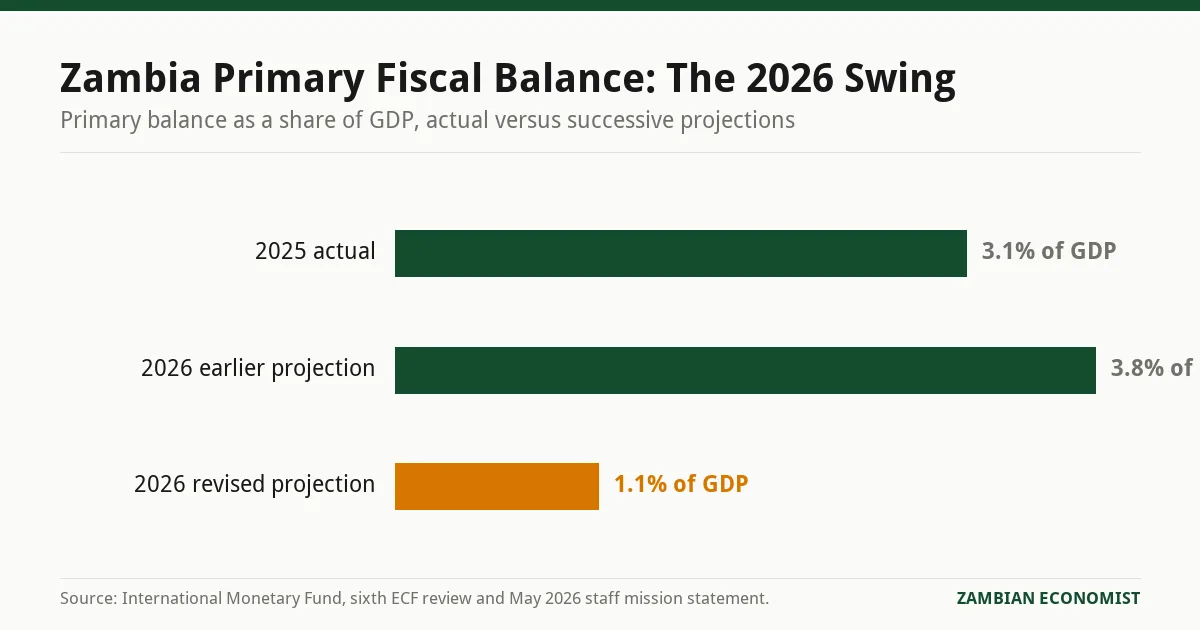
The primary fiscal surplus, revenue minus spending, before interest, is projected to fall to 1.1 percent of GDP in 2026, down from 3.1 percent achieved in 2025, and against 3.8 percent projected at the time of the sixth Extended Credit Facility review. Four causes were named: weaker tax revenues, the suspension of fuel VAT and excise duties, pre-election spending pressures, and a civil service wage adjustment.
Two of those four are direct policy choices.
The fuel tax relief
Government suspended excise duty and zero-rated VAT on petroleum products for three months. The effect on households was real and immediate: pump prices held, transport costs contained, and, as the Bank of Zambia’s own MPC statement acknowledged, fuel prices lower than they would otherwise have been. This contributed to inflation falling to 6.5 percent by June 2026, comfortably inside the 6-8 percent target band.
That is a genuine benefit to every Zambian who buys transport, which is every Zambian.
The cost is entirely fiscal, entirely deferred, and entirely invisible at the pump. It appears months later as revenue that did not arrive, financed by borrowing that must be repaid, and, in the interim, as an inflation figure that flatters the underlying position. An inflation rate suppressed by subsidy is not the same economic signal as an inflation rate suppressed by supply and monetary policy, even though they look identical in the data series.
The wage adjustment
Government and public service unions concluded negotiations on a K700 across-the-board increase in monthly basic salaries, effective in early 2026, alongside an increase in the daily meal allowance from K150 to K175.
Public servants have absorbed years of real income erosion, and the case for restoring purchasing power is substantial. But the fiscal characteristics are worth stating plainly: the increase is recurrent, it is permanent, it compounds through allowances and pension obligations, and it establishes a new baseline for every subsequent negotiation.
The IMF’s long-standing benchmark for Zambia has been a wage bill within roughly 35 percent of domestic revenue and under 8 percent of GDP. Across-the-board increases, as distinct from targeted increases tied to skills shortages or performance, make that ceiling progressively harder to hold as headcount grows through the recruitment of teachers and health workers that every party supports.
Why the ratchet is the real problem
The core difficulty with populist fiscal measures is not their initial cost. It is their asymmetry.
Introducing a fuel subsidy is politically cheap and administratively simple. Removing one is politically expensive and administratively fraught. Nigeria spent the better part of two decades attempting to remove petrol subsidies, with repeated reversals under public pressure. Zambia’s own history with maize and fuel subsidies follows the same pattern.
Economists call this the ratchet effect: spending moves upward easily and downward with great difficulty. Each cycle sets a higher floor.
The arithmetic consequence is that a country can lose fiscal space permanently through a sequence of individually defensible decisions. No single measure looks reckless. The accumulation is what does the damage, which is precisely why it is so difficult to resist, and why institutional constraints work better than individual restraint.
The case for the other side
Intellectual honesty requires setting out the strongest argument against everything above, because it is a serious one.
Austerity has costs too, and they are also deferred. A child who leaves school because fees rose does not appear in this year’s fiscal accounts. Neither does the untreated illness, the road that degraded past the point of economical repair, or the graduate who emigrated. These are real losses to national income, they compound, and they are systematically under-measured because no line item records them.
Fiscal consolidation that ignores distribution is not sustainable either. The Tonse Alliance manifesto’s central political observation, that macroeconomic improvement has not translated into felt prosperity for large sections of the population, is empirically defensible. Inflation at 6.5 percent nationally coexists with 8.4 percent in Lusaka Province, where a high concentration of wage earners live. A stabilisation that most citizens do not experience is politically fragile, and politically fragile stabilisations get reversed.
Some populist spending is genuinely high-return. Free education, whatever its fiscal cost, raises human capital. Input support that reaches genuine smallholders raises output. The problem is rarely the category; it is targeting, costing and exit design.
The honest position is therefore not that discipline is good and spending is bad. It is that the quality of spending matters more than its quantity, and that irreversibility is the variable to watch.
What long-term planning actually looks like
Three international examples are directly relevant to a copper-dependent economy.
Chile: the structural balance rule
Chile, the world’s largest copper producer, budgets not against actual copper prices but against a long-run reference price set by an independent panel of experts. When copper trades above the reference price, the surplus is saved. When it trades below, the accumulated fund is drawn down.
The effect is that Chilean fiscal policy became counter-cyclical rather than pro-cyclical. Governments cannot spend a boom, because the boom revenue is not in the budget in the first place.
For Zambia, where copper generates the large majority of export earnings, and where the government targets more than 1 million tonnes in 2026 and 3 million tonnes by 2031 against 890,346 tonnes produced in 2025, the relevance is direct. A production expansion of that scale, at favourable prices, would generate a revenue surge. Whether that surge becomes a permanent spending baseline or a buffer is a design decision that must be made before the money arrives.
Botswana: the fiscal rule and the Pula Fund
Botswana channelled diamond revenue through an explicit rule limiting government consumption spending and directing resource revenues toward investment and savings. The results were imperfect and Botswana faces its own diversification challenge today, but the country converted a mineral windfall into decades of investment-grade credit standing, an outcome Zambia has not yet achieved from a comparable resource base.
Independent fiscal institutions
The Netherlands has costed party manifestos through its Bureau for Economic Policy Analysis since the 1980s. Australia’s Parliamentary Budget Office performs a similar function. The mechanism is simple: parties submit proposals, an independent body publishes the cost, and voters see comparable numbers.
The effect is not that parties stop making promises. It is that promises become comparable, and that the most implausible ones are filtered before rather than after an election. Zambia has strong institutional foundations for this, a functioning National Assembly committee system, ZIPAR, the Economics Association of Zambia and the Office of the Auditor General all produce credible analytical work. What is missing is a body with a statutory mandate and pre-election timing.
A practical framework for Zambia
Six reforms, ranked by feasibility rather than ambition.
| Reform | Difficulty | Impact | Timeframe |
|---|---|---|---|
| Publish a rolling policy and SI calendar | Low | Medium | Immediate |
| Mandatory costing note on every new spending measure | Low | High | One budget cycle |
| Statutory wage bill ceiling as share of domestic revenue | Medium | High | 1-2 years |
| Independent parliamentary budget office | Medium | High | 2-3 years |
| Legislated primary balance rule with escape clauses | High | Very high | 3-5 years |
| Copper stabilisation fund with reference-price budgeting | High | Very high | 3-5 years |
The first two require no legislation and no new institution. They require a decision.
What businesses should do
- Assume fiscal slippage is priced into your borrowing costs. When the Treasury borrows heavily domestically, commercial lending rates follow regardless of the Policy Rate. Fix rates where you can.
- Manage public sector receivables aggressively. Arrears to suppliers are the standard shock absorber when revenue disappoints. Shorten terms, demand milestone payments, and do not extend informal credit to government entities on the assumption of eventual payment.
- Watch subsidy expiry dates, not subsidy announcements. A three-month fuel tax suspension implies a decision point. Model your input costs for both outcomes.
- Distinguish the inflation you see from the inflation you would face without support measures. Pricing decisions made on subsidised input costs become losses when the subsidy lapses.
What policymakers should consider
Cost every promise before it is made, not after. The discipline of publishing a number changes the promise itself.
Prefer targeted to universal wherever administration allows. Zambia’s social protection architecture is more capable than it was a decade ago. Targeting is now a realistic option, not an aspiration.
Build the exit into the entry. Any subsidy or relief measure should be introduced with a published sunset date and a stated trigger for review. Removing a measure that always had an end date is politically survivable. Removing one that never did is not.
Protect the primary balance, not the headline deficit. The primary balance is the honest measure of whether a government is living within its means before inherited obligations.
Risks and opportunities
Risks: a post-election spending surge locking in a higher permanent baseline; wage bill growth outpacing revenue; deferred subsidy withdrawal colliding with a copper price correction; delayed successor IMF arrangement raising financing costs; renewed domestic market resistance to government paper.
Opportunities: a genuine window to legislate fiscal rules while the memory of the 2020 default remains politically salient; a projected copper revenue expansion that could seed a stabilisation fund if designed now; broad cross-party agreement on diagnosis, which lowers the political cost of institutional reform.
Conclusion
Zambia has, at considerable social cost, rebuilt something valuable between 2021 and 2026: inflation inside target, a restructured debt profile, restored reserves, and a sovereign rating out of default. That achievement belongs to public servants, taxpayers and households who absorbed the adjustment as much as to any political actor.
The question the 2026 election settles is not whether that gain will be spent, some of it certainly will be, and there is a legitimate democratic argument that citizens who bore the adjustment are entitled to feel the recovery. The question is whether it is spent on things that are reversible or things that are not, and whether the spending is captured in a rule or left to discretion.
Countries rarely fail because of one bad budget. They fail because of a decade of individually defensible decisions that nobody costed together.
The most valuable reform available to Zambia costs almost nothing: requiring that every new spending commitment arrive with a published price tag and an end date. Whether any administration adopts it will say more about the country’s next decade than any manifesto.
What that decade actually starts from is set out in What the Next Government Inherits.
Should Zambia legislate a fiscal rule, or does that constrain democratic choice too tightly? Zambian Economist welcomes opinion submissions on both sides.