By Zambian Economist Analyst
The campaign is over. Whoever forms a government now meets a calendar that does not care who won.
Between the declaration and the end of September sit a series of decisions with fixed dates and real fiscal consequences. This is that list. It applies identically to a continuing administration and a new one.
The fixed dates
| When | What | Why it matters |
|---|---|---|
| Late August | Monthly ZamStats inflation release | First reading of whether post-election conditions moved prices |
| Through September | FRA marketing season winds down | Final purchase volume and, critically, payment performance |
| 28–29 September | Bank of Zambia MPC meeting | First monetary policy signal of the new term |
| Late September | 2027 National Budget address | The first real statement of intent, and where promises meet arithmetic |
The budget address is the one to watch. Campaign commitments are costless until they appear as a line item with a financing source beside them.
Five decisions that cannot be deferred
1. The CDF arithmetic. With roughly 226 constituencies after delimitation, the fund faces a binary choice: hold the per-constituency amount near K36.1 million and the total rises to roughly K8.2 billion a year, or hold the total near K5.63 billion and each constituency drops to about K24.9 million. There is no third option. Whichever way it goes, it is permanent: the full arithmetic is in what the election costs.
2. FRA payments. The Agency committed to paying farmers within three days of delivery against a target of at least 500,000 tonnes at K347 per 50kg bag. If that commitment held through the season, it is a genuine administrative achievement. If arrears accumulated, they become an early and visible liability. See the depot opening and the floor price arithmetic.
3. The mining licence backlog. No licences were issued in Q1 2026 because the Minerals Regulation Commission board was not constituted; roughly 444 rights cleared in July against a backlog of more than 1,672. Exploration approved now becomes production in the early 2030s, precisely when the three-million-tonne target falls due. See copper production 2026.
4. Pharmaceutical arrears. Supplier debt has been a direct driver of medicine shortages in public facilities. It is unglamorous, it is measurable, and it is one of the fastest available improvements to service delivery. See medicine prices and the kwacha.
5. Whether the tax reforms hold. Smart Invoice, the mobile money levy and mandatory tax clearance are the machinery behind a budget that is 81.6% domestically financed. Reversing or diluting them is politically easy and fiscally expensive: the full picture is in Zambia Tax 2026.
Four tests for anything announced
The framework we applied to manifestos applies with more force now, because announcements become commitments:
- Recurrent or capital? A road is paid for once. A wage increase is paid every year, indefinitely.
- What is the financing source? New revenue, reallocated spending, or borrowing, and if borrowing, against what.
- Is there absorption capacity? Money allocated is not money spent. Delivery, not funding, is often the binding constraint.
- Is it reversible? Spending that cannot be withdrawn without political cost becomes permanent regardless of what the Treasury can afford later.
What the numbers looked like on handover
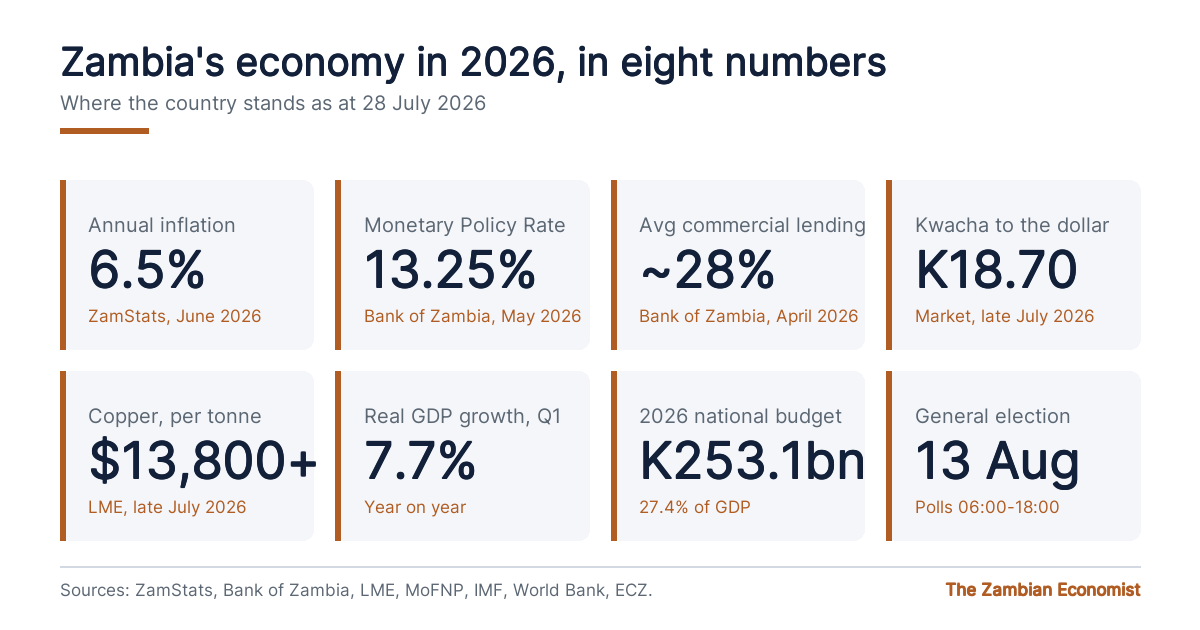
For the record, the position at the point of transition: inflation had fallen from 11.2% in December 2025 to 6.5% by June 2026; Q1 GDP grew 7.7% year on year, driven by agriculture rather than mining; copper output fell 4.27% in Q1 to 208,992 tonnes against a 2025 total near 890,346 tonnes; the policy rate stood at 13.25% while average lending rates sat near 28%; and maize production reached roughly 5.1 million tonnes against 3.6 million the previous year.
A fuller inventory of assets and liabilities is in what the next government inherits.
The honest framing
Governments are judged on the first hundred days largely because it is a convenient number. Very little that matters can be delivered in that window.
What the period does reveal is sequencing: what gets paid first, what gets deferred, and whether the 2027 budget is written against the arithmetic or against the campaign. Those choices are visible almost immediately, and they are the best available predictor of the four years that follow.
We will hold the same tests to whoever governs. The full series is at the economics of Zambia’s 2026 election.
Written ahead of the 13 August 2026 general election and published the following day. Figures are as at the end of July 2026 and describe the position at handover, not the outcome of the vote. This piece assesses fiscal arithmetic, not parties.
Related: Beyond the Ballot, Zambia Turns the Page to Economic Delivery