
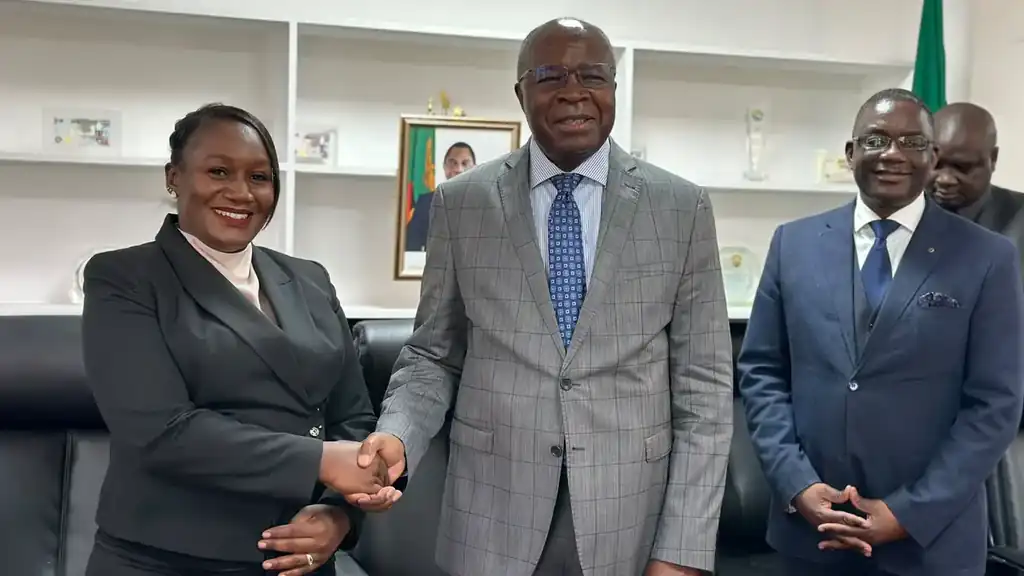
The Economics Association of Zambia has asked the Ministry of Finance and National Planning for a formal partnership. Dr Situmbeko Musokotwane said yes in principle, then set the terms: bring ideas that work.
KEY TAKEAWAYS
- EAZ President Dr Edna Kabala-Litana, Vice President Mr Laban Simbeye and members of the National Executive Committee paid a courtesy call on Finance and National Planning Minister Dr Situmbeko Musokotwane and Permanent Secretary Mr Mulele M. Mulele.
- The two sides discussed cooperation on economic policy research, professional development, public policy dialogue and support for Zambia’s economic transformation agenda.
- The Association proposed a Memorandum of Understanding (MoU) to formalise the partnership.
- Dr Musokotwane committed to supporting the Association and challenged it to produce innovative, practical policy recommendations drawn from countries that transformed their economies through strategic reform.
- For a leadership elected by seven votes less than a month ago, a working agreement with the Treasury is an early test of whether the new executive can turn access into influence.
A first formal visit for the new executive
The Economics Association of Zambia (EAZ) has taken its new leadership team to the Ministry of Finance and National Planning. EAZ President Dr Edna Kabala-Litana led the delegation, joined by Vice President Mr Laban Simbeye and other members of the National Executive Committee, in a courtesy call on the Minister, Dr Situmbeko Musokotwane, MP, and Permanent Secretary Mr Mulele M. Mulele, who holds the ministry’s economic management portfolio.
The meeting covered four areas where the two institutions could work together: economic policy research, professional development for economists, public policy dialogue, and support for the government’s economic transformation agenda. EAZ went further and proposed a Memorandum of Understanding to put that cooperation on a formal footing.
The visit comes weeks after Dr Kabala-Litana won the EAZ presidency at the Association’s elective Annual General Meeting in Livingstone, beating Mr Yenda Shamabobo by 142 votes to 135. Mr Simbeye took the vice presidency with 78.5% of the vote.
The Minister’s challenge
Dr Musokotwane commended the previous EAZ Executive Committee for its contribution to economic debate and said he was committed to supporting the Association’s work. He then set a bar. He challenged EAZ to bring forward innovative and practical policy recommendations that can help strengthen the economy, and to draw those lessons from countries that have changed their economic fortunes through strategic reform.
The request fits where the Treasury now says it is heading. In a ZNBC interview on 20 September, the Minister described the next phase of policy as a shift from stabilisation to production and exports, organised around the Grow Zambia Agenda’s production targets. That pivot raises harder questions than the debt restructuring did: which sectors to back first, how to sequence power, land and finance, and how to attract private capital without giving away the fiscal room that was rebuilt at some cost. Those are questions where independent economists should have something useful to say.
Comparative lessons are plentiful. Mauritius moved from a sugar monoculture to textiles, tourism and financial services through export processing zones and a steady investment regime. Botswana turned diamond revenue into decades of growth by saving part of it in the Pula Fund and holding to fiscal rules. Vietnam’s Doi Moi reforms opened the economy to trade and foreign investment, and Rwanda paired investment promotion with public service reform. None of these templates transfers neatly to a landlocked copper economy, which is precisely why the Minister asked for practical adaptation rather than imported blueprints.
Why an MoU matters
Courtesy calls are common. Signed agreements that change how an association and a ministry actually work together are less so. An MoU gives EAZ a defined channel into the policy cycle, whether through pre-budget consultation, joint research on specific questions, or structured access to data that researchers otherwise request one letter at a time.
The Zambian Economist has previously argued that EAZ should offer government a five-year economic advisory compact. The proposed MoU is a narrower version of the same idea. Its value will depend on what the text commits each side to do, and on whether the ministry treats it as a working tool or as a ceremonial document.
There is a balance to strike. EAZ’s credibility with the public rests on its independence. A partnership with the Treasury can sharpen its analysis by bringing it closer to the numbers, but members and the public will watch whether the Association keeps its freedom to disagree with the government when the evidence calls for it. A well drafted MoU can protect that by stating plainly that cooperation on research does not bind either side to the other’s conclusions.
What EAZ brings, and what it has to prove
The Association has real assets. Its membership includes academics, central bank and ministry staff, private sector analysts and students. It can convene, it can train, and it can explain policy in plain language when official releases leave the public guessing.
It also has ground to make up. Fewer than 300 members voted in the Livingstone election, and the Association’s public commentary has been uneven in recent years. Dr Kabala-Litana campaigned on member value, policy leadership and a permanent EAZ House. A partnership with the Ministry is a chance to show progress on the second of those promises early in her term.
The timing is useful. The Ministry is preparing the 2027 national budget, the first of the new administration’s term, and is consulting on its medium-term revenue strategy. A quick, well evidenced EAZ submission on either would demonstrate the kind of practical input the Minister asked for.
What it means
For policymakers: A structured link to the economics profession gives the Ministry a place to test proposals before they are announced, and a source of analysis that is not tied to lenders or bank research desks.
For business and investors: A more active EAZ adds a local, independent voice to policy debate. Firms looking for early reads on budget and tax direction will have another credible source to follow.
For EAZ members: Professional development and research partnerships with the Ministry could open training, data access and practical policy work that the Association has struggled to offer on its own.
What to watch
Three things will show whether this visit leads anywhere. First, whether an MoU is drafted and signed, and how soon. Second, what it contains: specific commitments on research, data sharing and consultation, or general statements of goodwill. Third, what EAZ produces in the months that follow. The Minister has set the test in his own words. Practical recommendations, grounded in the experience of countries that got transformation right, are what he asked for, and they are what the Association will be judged on.
More on the EAZ: Dr Edna Kabala Litana Elected EAZ President After Tight Livingstone Vote | EAZ Should Offer Hichilema a Five-Year Economic Advisory Compact | EAZ 2026: The Continuity Question Facing Zambia’s Economists | Zambia’s Economists Gather in Livingstone to Elect New Leadership
On the Treasury’s agenda: Musokotwane Pivots Zambia Toward Export-Led Growth | Musokotwane Named Finance Minister of the Year 2026 | Budget 2027 Should Put Jobs and Productive Investment First | Zambia Needs a Bold Economic Blueprint to Trigger Industrial Transformation
WARNING! All rights reserved. This material and all other digital content on this website may not be reproduced, published, broadcast, rewritten, or redistributed, in whole or in part, without the prior express permission of The Zambian Economist. Where permission is granted, the content must be clearly credited to “The Zambian Economist,” with “www.zambianeconomist.com” prominently displayed.
WhatsApp: +260775574228 | Email: info@zambianeconomist.com
© 2026 The Zambian Economist.