Airtel Zambia’s K5.76 dividend is more than a shareholder payout. It is evidence of the growing commercial value of Zambia’s digital economy.
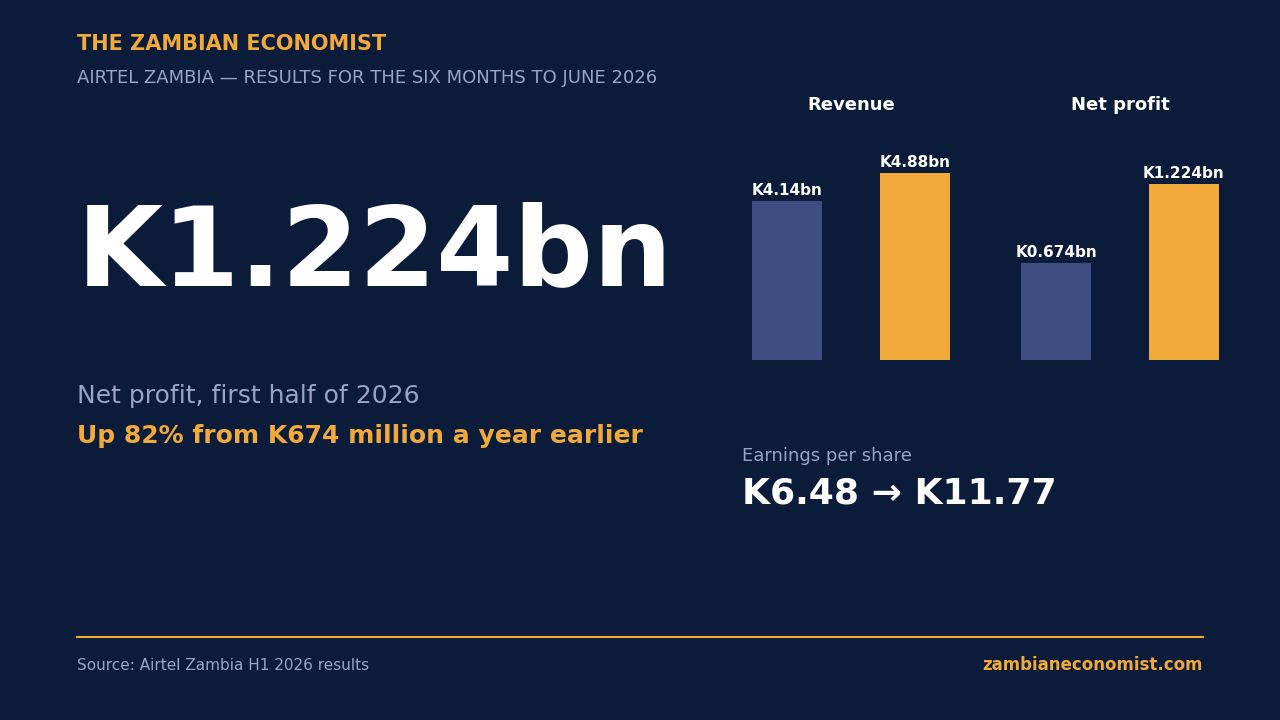
For the six months to June 2026, Airtel’s revenue increased from K4.14 billion to K4.88 billion, while net profit rose from K674 million to K1.224 billion, an increase of about 82%. Earnings per share also increased, from K6.48 to K11.77.
The key issue is that profit grew substantially faster than revenue, pointing to stronger operating efficiency and monetisation rather than growth for its own sake.
The drivers include a growing customer base, rising data consumption, Airtel Money, digital financial services and continued network investment, including a reported US$107 million nationwide network expansion.
From an economic perspective, Airtel demonstrates how investment in digital infrastructure can generate scale, productivity, profits and shareholder wealth.
The broader lesson for Zambia is clear. Stabilisation must translate into productive private-sector investment, stronger companies, employment, tax revenues and, ultimately, higher household incomes.
Reporting and analysis by Kelvin Chisanga for The Zambian Economist.
About the author: Kelvin Chisanga is a Zambian economist and public policy analyst with over 15 years of multidisciplinary experience spanning ICT, mining, insurance, hospitality and media. He writes and comments regularly on monetary policy, macroeconomic stability and Zambia’s development agenda, with a particular focus on translating economic stabilisation into production, investment and improved household incomes.