From India’s weak monsoon to Spain’s burnt pastures and Zambia’s rivers, El Niño is arriving in a world already running hot. The question is whether food, water and energy systems can adapt in time.
23 September 2026
KEY TAKEAWAYS
- El Niño is developing in a warmer world, and UK Met Office scientists expect it to be unprecedented in modern climate records, with extremes magnified beyond those of 2015/2016.
- The effects are already global: India’s southwest monsoon is about 15% below normal, more than 12.5 million people in Indonesia have been exposed to wildfire haze, and Spain has recorded its largest wildfire.
- For Southern Africa, including Zambia, the risk is drought that cuts river flows, hydropower, irrigation, fisheries and pastoral incomes.
- FAO argues that agrifood systems are part of the solution: restoring degraded land, expanding agroforestry and making livestock and aquaculture more sustainable build resilience and cut emissions.
In a world already struggling with conflict and food insecurity, El Niño is a threat multiplier, and its effects are already visible (Fletcher, 2026). The world today is hotter and El Niño is expected to be stronger. El Niño years tend to bring below-average monsoon rainfall in India (Rich and King, 2026), and by 22 September the southwest monsoon had delivered about 15% less rain than normal (India Meteorological Department, 2026). That has direct implications for global food supply and prices (Quiñones, 2026).
A familiar pattern for Africa’s rivers
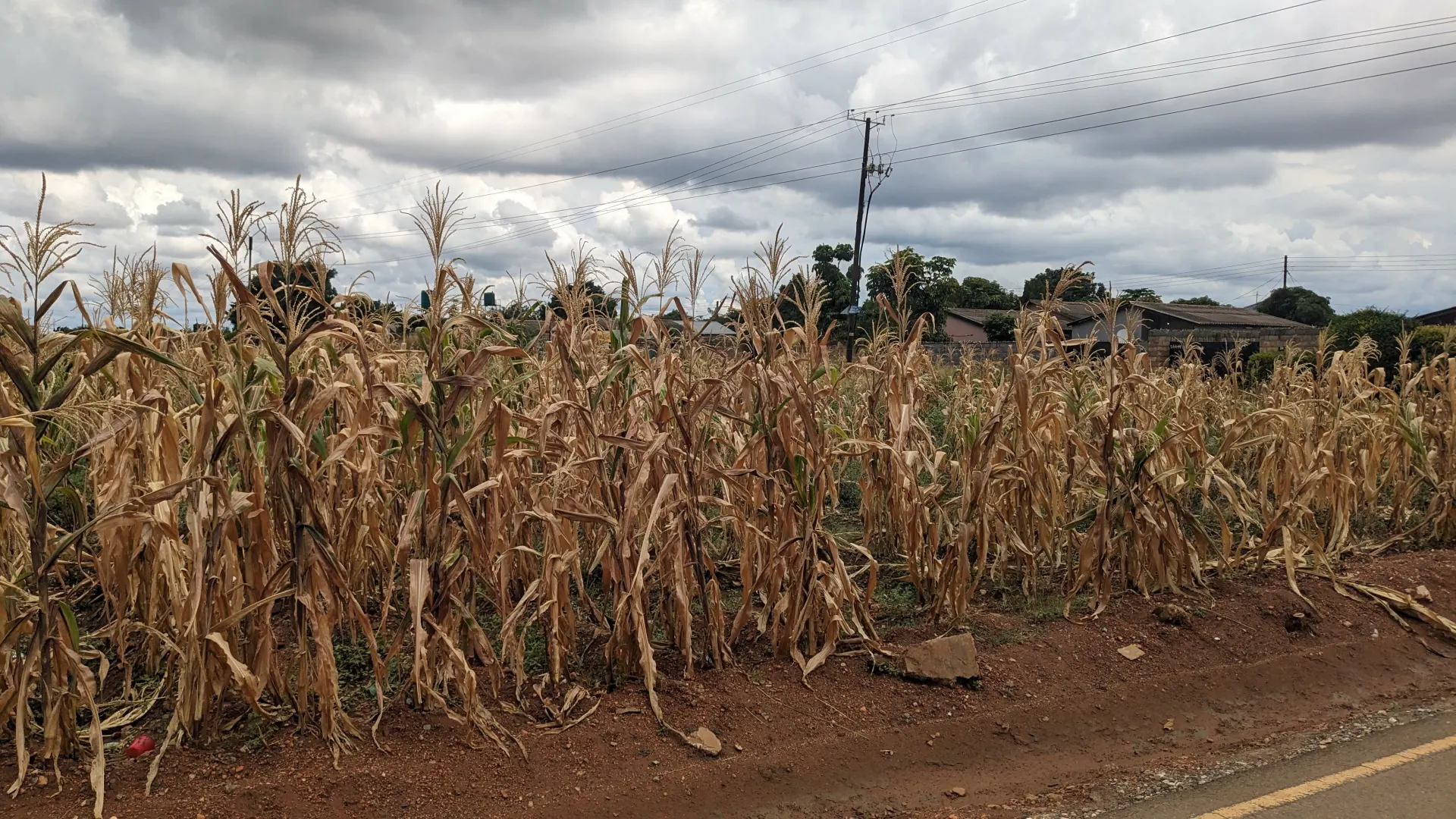
In South Sudan, crops have withered after a prolonged lack of rain. A World Food Programme photograph shows a farmer walking through her maize field where the crop has failed (WFP/Vivacqua, 2026). For African Rivers, this pattern is deeply familiar. Erratic rainfall means either devastating floods in East Africa or crippling droughts in Southern Africa, including Zambia (WMO, 2026). Drought reduces river flows, hydropower generation, irrigation, fisheries and pastoral livelihoods (Quiñones, 2026).
Not only an African problem
The impacts are not confined to Africa (WMO, 2026). Spain is battling climate change on several fronts. In the Gredos mountains west of Madrid, a farmer now grazes his cows among blackened pine and oak trees, the legacy of a July wildfire that merged with two others to burn around 80,000 hectares, the biggest blaze Spain has ever registered (Hedgecoe, 2026). In Indonesia, the health ministry says more than 12.5 million people have been exposed to haze from El Niño-fuelled wildfires (Indonesia Health Ministry, 2026).
The impacts extend to public health and critical infrastructure (Weldon and Wallace, 2026). Extreme heat triggers amber and red heat-health alerts, school closures and pressure on electricity networks. In South West England, heat has closed schools and left more than 800 homes in Devon without power (Weldon and Wallace, 2026), and earlier this year 36.1C at Gosport set a new UK record for June. Forestry England has raised its wildfire risk to red, warning that forest fires “put lives at risk, destroy habitats, kill wildlife and put our emergency services in harm’s way” (Mansell, 2026).
Why this El Niño is different
The UK Met Office says scientists have been signalling for months that the developing El Niño will be an unprecedented event in modern climate records (Scaife, 2026). The reason is that it is happening in a hotter world (Quiñones, 2026). Background global warming combined with the heat El Niño releases from the Pacific means extremes could be magnified well beyond what was experienced in 2015 (Rich and King, 2026; Scaife, 2026).
Agrifood systems as a solution
We must recognise agrifood systems as a solution, not just a victim (Quiñones, 2026). The Food and Agriculture Organization (FAO) argues that restoring degraded land, expanding agroforestry and making livestock and aquaculture more sustainable can strengthen resilience while also supporting food security, biodiversity and efforts to cut emissions. As Kaveh Zahedi, FAO Assistant Director-General, puts it: “There is no better investment in climate, or in food security, probably in biodiversity as well, than agrifood system solutions” (Quiñones, 2026).
Protecting ecosystems, from gardens to catchments
We must also protect our ecosystems (RHS, 2026). The UK has around 30 million residential gardens and only 2.5% natural woodland cover, and its built-up areas are increasingly affected by the urban heat island effect (RHS, 2026). Planting trees, protecting soil, harvesting grey water and supporting pollinators are small actions with systemic impact (RHS, 2026; Mansell, 2026). For Africa, protecting our rivers, catchments and forests is protecting our economic lifeline (WMO, 2026; Quiñones, 2026).
Carbon emissions and climate change are often treated as the same thing, on the assumption that lowering the first will make the second go away. But climate is complex (Francis, 2015). It interacts with poverty, conflict, urbanisation and inequality (Burton, 1990; Ramsbotham et al., 2016; Wallensteen, 2019). Tackling it requires an integrated approach that restores both nature and human dignity (Francis, 2015).
What this means for Zambia
Editor’s note: Zambia’s Meteorological Department expects a drier, hotter 2026/2027 rainy season, and Government has already directed Permanent Secretaries, provincial administrations and local authorities to activate El Niño contingency plans. The exposure runs through maize, the Kariba and Kafue hydropower systems and the rivers that feed irrigation and fisheries. The 2023/2024 drought, which Southern Africa experienced as its worst in over a century, is the most recent reminder of what that costs in food prices, load-shedding and public spending.
The adaptation test
Ultimately, El Niño is a test of whether the world can adapt to a changing climate (Quiñones, 2026). We have the science (WMO, 2026; Scaife, 2026), we have the warning (WMO, 2026) and we have the solutions (Quiñones, 2026). What we need is the will. The world is hotter (Quiñones, 2026), the stakes are higher, and the resilience of our food, water and energy systems is on the edge (Fletcher, 2026). This is the moment to prove that anticipation is possible.
For comments, contact the researcher and author at kamayoyokm@gmail.com.
References
- Burton, J. (1990) Conflict: Resolution and Prevention. London: Macmillan.
- Fletcher, T. (2026) Statement on El Niño anticipatory action. UN Office for the Coordination of Humanitarian Affairs, New York.
- Francis (2015) Laudato Si’: On Care for Our Common Home. Vatican City: Vatican Press.
- Hedgecoe, G. (2026) Spain battling climate change on several fronts. BBC News, 21 September.
- India Meteorological Department (2026) Southwest monsoon rainfall statistics to 22 September. New Delhi: IMD.
- Indonesia Health Ministry (2026) Wildfires and public health impact update. Jakarta.
- Mansell, K. (2026) Forestry England wildfire red alert statement. Forestry England, 22 September.
- Quiñones, L. (2026) How El Niño offers a test of whether the world can adapt to a changing climate. UN News, 22 September.
- Ramsbotham, O., Woodhouse, T. and Miall, H. (2016) Contemporary Conflict Resolution. 4th edn. Cambridge: Polity Press.
- Rich, B. and King, S. (2026) El Niño and global weather impacts. Met Office Briefing, 20 September.
- Royal Horticultural Society (RHS) (2026) Urban heat island and natural woodland cover in the UK. London: RHS.
- Scaife, A. (2026) Head of Long Range Prediction, Met Office, on El Niño development. Met Office, 19 September.
- Wallensteen, P. (2019) Understanding Conflict Resolution. 5th edn. London: SAGE.
- Weldon, C. and Wallace, J. (2026) Extreme heat causes school closures and power cuts in South West England. BBC South West, 22 September.
- World Food Programme / Vivacqua, G. (2026) Photo report: Farmer walks through maize field in South Sudan. Rome: WFP.
- World Meteorological Organization (WMO) (2026) WMO El Niño update. Geneva: WMO, 22 September.
Related reading: El Niño Is Global, Not Just African, Supersized El Niño 2026/2027 To Stress Rivers, Zambia Leads with Foresight in Preparing for the 2026/2027 Supersized El Niño, Super El Niño 2026/2027: Why a Warm Patch in the Pacific Threatens Zambia’s Food, Power and Budget, Government Orders Immediate Drought Preparations as Zambia Faces a Drier, Hotter Rainy Season and Zambia’s Maize Export Opportunity Faces Food-Security and Climate Risk.
WARNING! All rights reserved. This material and all other digital content on this website may not be reproduced, published, broadcast, rewritten, or redistributed, in whole or in part, without the prior express permission of The Zambian Economist. Where permission is granted, the content must be clearly credited to “The Zambian Economist,” with “www.zambianeconomist.com” prominently displayed.
WhatsApp: +260775574228 | Email: info@zambianeconomist.com
© 2026 The Zambian Economist.