Zambia has been trying to diversify beyond copper since independence in 1964. Every national development plan has said so. Every administration has agreed. Six decades later, copper and traditional exports still accounted for 64.4 percent of export earnings in April 2026.
When a policy objective survives sixty years, eleven presidencies and unanimous cross-party agreement without being achieved, the honest conclusion is not that Zambians lack commitment. It is that the objective has been misdiagnosed, or that the instruments applied to it were the wrong ones.
This article argues that a significant part of the answer lies in economic diplomacy — and that the diversification numbers Zambia currently celebrates deserve closer reading than they usually receive.
The uncomfortable truth inside the diversification statistics
Non-traditional exports are the standard measure of Zambian diversification. They are defined simply as exports other than copper and cobalt, and the recent numbers look genuinely encouraging: NTE earnings rose 20.9 percent between March and April 2026, from K7.5 billion to K9.0 billion.
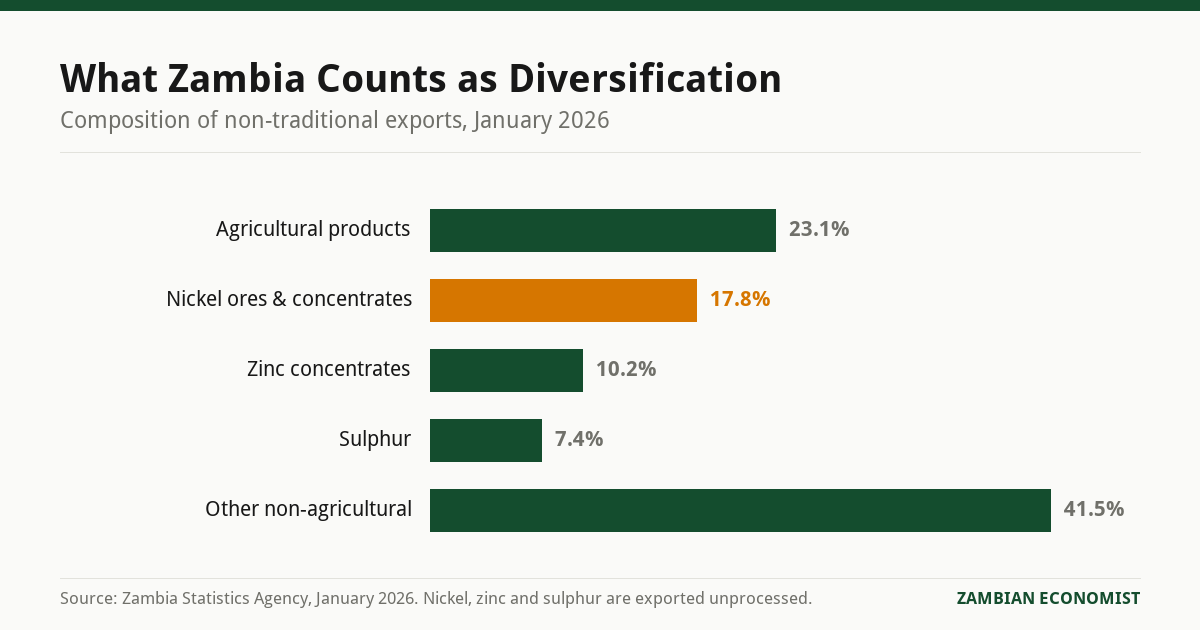
Now look at the composition. In January 2026, agricultural products made up 23.1 percent of non-traditional exports. The remaining 76.9 percent was non-agricultural, and the leading components were nickel ores and concentrates at 17.8 percent, zinc concentrates at 10.2 percent, and sulphur at 7.4 percent.
Nickel ore. Zinc concentrate. Sulphur.
These are minerals, exported unprocessed. Zambia’s headline diversification measure is substantially recording diversification within extraction rather than diversification away from it. Swapping dependence on one mineral for dependence on four is a genuine risk reduction — commodity cycles are not perfectly correlated — but it is not structural transformation, and it does not solve the employment problem that motivates diversification in the first place.
This matters for policy design. If the measure treats a zinc concentrate shipment and a processed food export as equivalent progress, it will reward the easier of the two, which is always the concentrate.
Why diversification keeps failing
Four mechanisms, none of which are unique to Zambia.
The exchange rate channel. Strong copper receipts support the kwacha. A stronger kwacha makes every other Zambian export less competitive. Success in mining mechanically taxes agriculture, tourism and manufacturing. Economists call the general phenomenon Dutch disease, and it operates regardless of anyone’s intentions.
The talent and capital channel. Mining offers the highest returns and the clearest career paths, so it attracts the best engineers, the most capable managers and the most available finance. Other sectors compete for what remains.
The fiscal attention channel. Mining generates the majority of export earnings and a large share of revenue, so it commands ministerial time in proportion. Sectors that would diversify the economy receive attention in inverse proportion to how much they currently contribute — which is precisely backwards from what diversification requires.
The market access channel. This is the one economic diplomacy directly addresses, and it is the most neglected. Copper needs almost no market access work; it is a globally fungible commodity sold into deep exchanges. Honey, beef, horticulture, processed foods and manufactured goods need sanitary and phytosanitary recognition, standards equivalence, testing infrastructure, certification and often specific quota negotiation.
A Zambian mining company can sell into any market. A Zambian food processor frequently cannot — and the obstacle is usually not price or quality but paperwork that only governments can negotiate away.
Where diplomacy converts directly into diversified exports
Agriculture
Agricultural exports including maize and tobacco contributed significantly to the April 2026 NTE increase. Zambia has arable land, water and a favourable position relative to structurally food-importing neighbours.
The diplomatic work is specific and unglamorous:
- Sanitary and phytosanitary agreements establishing that Zambian produce meets an importing country’s health requirements. Without one, the trade is simply illegal regardless of quality.
- Standards equivalence, so that a test conducted in Lusaka is accepted in the destination market rather than repeated on arrival at the exporter’s cost.
- Quota and preference negotiation under AGOA, AfCFTA, COMESA and SADC arrangements.
- Rules of origin, which determine whether a Zambian processed good qualifies for preferential treatment or is treated as a re-export.
None of this can be done by a firm. All of it must be done by a state, and it is done well only when missions know which specific barriers matter to which specific Zambian exporters.
Tourism
Tourism is the clearest current success and the clearest demonstration of the diplomatic mechanism.
International arrivals grew from just over one million in 2022 to approximately 2.3 million in 2025, with 2024 arrivals of over 2.2 million representing a 35 percent annual increase. Government targets over 2.5 million arrivals and US$1 billion in tourism revenue by the end of 2026, supported by a K1.5 billion allocation for infrastructure, wildlife management and marketing. Domestic visits to national parks, museums and heritage sites exceeded 562,000 in 2025.
The interventions driving this are diplomatic instruments, not marketing ones. Visa waivers have been extended to 167 nations — a sovereign decision negotiated bilaterally. Aviation route expansion depends on air service agreements between governments. Destination marketing matters, but it markets an access regime that diplomacy created.
Tourism also has the labour characteristics diversification actually requires: it is employment-intensive, geographically distributed beyond the Copperbelt and Lusaka, and accessible to workers without advanced technical qualifications.
Regional trade
Zambia borders eight countries and runs merchandise trade deficits with the regions nearest to it — K4.8 billion with SADC-exclusive markets and K2.7 billion with Asia in April 2026.
A deficit with neighbours is, viewed correctly, an inventory of demand that Zambian producers are not currently meeting. The goods are already flowing; the question is the direction. Import substitution is unfashionable and often badly executed, but supplying a neighbouring market that is already buying the same product from further away is simply competitiveness.
The diplomatic work here is border efficiency, mutual recognition of standards, harmonised documentation and payment systems. These are unglamorous, technical and cumulatively decisive.
Services and the digital economy
Services exports are the most under-attempted category. They are less exposed to transport costs, which for a landlocked country is a structural advantage rather than a marginal one, and they scale with skills rather than with capital.
The diplomatic requirements are qualification recognition, data adequacy arrangements, and mode-of-supply commitments in services trade negotiations.
A realistic sequencing framework
Diversification strategies fail when they attempt everything simultaneously. A defensible sequence orders interventions by how quickly they can produce results.
| Horizon | Focus | Diplomatic instrument | Employment intensity |
|---|---|---|---|
| 0–2 years | Tourism, regional trade | Visa regimes, air services, border facilitation | High |
| 2–5 years | Agricultural exports, agro-processing | SPS agreements, standards equivalence, quotas | High |
| 5–10 years | Mineral value addition | Tariff escalation talks, technology transfer terms | Moderate |
| 5–15 years | Manufacturing, tradeable services | Rules of origin, qualification recognition | Very high |
The ordering is deliberate. The early wins are in sectors where the binding constraint is an access rule that a government can change with a signature, rather than infrastructure that takes a decade to build. Those early wins matter politically, because they sustain support for the slower work behind them.
What would have to be true for this to work
Honesty requires stating the preconditions rather than only the opportunities.
Electricity must be resolved. Agro-processing, cold chains, manufacturing and mineral processing all require reliable power. Zambia’s electricity deficit is the constraint that gates everything downstream of raw export.
The measure must change. If non-traditional exports continue to count zinc concentrate alongside processed foods, policy will keep rewarding the wrong outcome. A published sub-measure separating extractive from non-extractive NTEs would change behaviour at negligible cost.
Testing and certification infrastructure must exist domestically. Standards equivalence is meaningless without accredited laboratories capable of issuing recognised certificates.
The strategy must outlive an electoral term. Market access negotiations run for years. A country that restarts its diversification approach every five years will negotiate the same agreements repeatedly without concluding them.
What businesses should do
- Identify your specific market access barrier and name it. Not ‘we struggle to export’, but ‘this destination does not recognise our certification for this product’. Only the specific version is actionable by a mission.
- Build certification capability before capacity. A processing line without accredited certification produces goods that cannot legally enter the target market.
- Look at neighbours before looking overseas. The regional deficit represents demand that is already proven and geographically close.
- Treat the kwacha as a strategic variable. Non-mineral exporters are structurally exposed to copper-driven currency strength. Hedge accordingly, and price accordingly.
- Use tourism sector growth as a domestic market. Rising arrivals create demand for food, crafts, transport and construction that does not require any export licence at all.
What policymakers should consider
Publish an extractive and non-extractive split of non-traditional exports. The cheapest reform on this list, and the one most likely to change behaviour.
Give missions specific product mandates. A mission tasked with securing SPS recognition for three named products will achieve more than one tasked with promoting Zambian exports generally.
Protect diversification spending from copper cycles. Diversification budgets are typically cut when copper revenue falls, which is exactly when diversification matters most. This is the pro-cyclicality problem in a different guise.
Sequence honestly and communicate the sequence. Publishing what will be attempted in which order, and what will not be attempted yet, is more credible than a strategy in which everything is a priority.
Risks and opportunities
Risks: a copper price surge strengthening the kwacha and undercutting non-mineral exporters; electricity constraints blocking processing; diversification budgets cut during a fiscal squeeze; strategy discontinuity after the August election; over-counting extractive NTEs as diversification progress.
Opportunities: tourism momentum with clear diplomatic levers available; large and proximate regional food demand; AfCFTA implementation lowering intra-African barriers; critical minerals interest creating leverage for technology transfer terms; a services sector unconstrained by Zambia’s landlocked geography.
What other resource economies actually tried
Zambia is not the first country to attempt this, and the international record is more instructive than encouraging. Three cases bracket the range of outcomes.
Indonesia and the nickel ore export ban. Indonesia restricted and then banned exports of unprocessed nickel ore, forcing processing onshore. The policy succeeded on its own terms: substantial smelting and refining capacity was built, and Indonesia moved materially up the value chain. It also drew trade disputes, required very large foreign capital inflows dominated by a small number of external partners, and carried significant environmental costs. The lesson is not that export bans work or fail, but that they only function where the resource is globally scarce enough that buyers must follow it. Copper is more substitutable in sourcing than Indonesian nickel was.
Malaysia and palm oil. Malaysia built an integrated value chain from plantation through refining to consumer products over several decades, supported by sustained research investment, deliberate standards development and persistent market access negotiation. The relevant feature is duration: the strategy was maintained across multiple administrations. It is the clearest available demonstration that diversification is a generational project rather than a term-length one.
Chile and copper. Chile remains heavily copper-dependent despite decades of effort, but managed the consequences rather than eliminating the dependence — through counter-cyclical fiscal rules, sovereign saving, and heavy investment in mining-adjacent services and technology. Chile now exports mining expertise, engineering services and equipment alongside the metal itself.
That third model deserves particular attention in Lusaka, because it reframes the objective. Chile did not escape copper. It built an economy around copper in which the associated services, skills and technology became exportable in their own right.
For Zambia, with a century of mining history, an established engineering workforce and the largest copper resource base in the region after the DRC, mining-adjacent services may be a more realistic near-term diversification path than either agriculture or manufacturing — and it is one that trades on capability Zambia already possesses rather than capability it must build from nothing.
Key takeaways
- A large share of Zambia’s non-traditional exports are unprocessed minerals, so headline diversification overstates structural change.
- Copper success mechanically disadvantages other exports through the exchange rate.
- The binding constraint for most non-mineral exports is market access paperwork, which only governments can remove.
- Tourism demonstrates the mechanism working: visa waivers to 167 nations and air service agreements produced arrivals growth from 1 million in 2022 to 2.3 million in 2025.
- Sequencing matters more than ambition; quick access-rule wins fund political patience for slower structural work.
Frequently Asked Questions
What are non-traditional exports in Zambia?
Non-traditional exports are all Zambian exports other than copper and cobalt. They include agricultural goods, gemstones and manufactures, but also substantial volumes of other unprocessed minerals such as nickel ore, zinc concentrate and sulphur.
Has Zambia successfully diversified its economy?
Only partially. Non-traditional exports have grown, reaching K9.0 billion in April 2026, but a majority of that category consists of unprocessed minerals rather than processed or agricultural goods.
What is Dutch disease?
Dutch disease describes how strong resource exports strengthen a country’s currency, making its other exports less competitive. In Zambia, copper strength mechanically disadvantages agriculture, tourism and manufacturing.
How many tourists visit Zambia?
Zambia recorded approximately 2.3 million international arrivals in 2025, up from just over one million in 2022. Government targets more than 2.5 million arrivals and US$1 billion in tourism revenue by the end of 2026.
What are sanitary and phytosanitary agreements?
SPS agreements establish that an exporting country’s produce meets the health and safety requirements of an importing country. Without one, agricultural trade cannot legally proceed regardless of product quality.
Why is tourism good for diversification?
Tourism is employment-intensive, geographically distributed beyond the main urban centres, accessible to workers without advanced technical qualifications, and responsive to policy levers such as visa regimes and air service agreements.
What is AfCFTA and how does it help Zambia?
The African Continental Free Trade Area reduces trade barriers between African states, giving Zambian producers preferential access to a continental market far larger than the domestic one.
Why does Zambia import so much from its neighbours?
Zambia’s industrial base is narrower than several regional partners, so it imports manufactured and consumer goods while exporting primary commodities. The resulting deficits represent demand Zambian producers could potentially supply.
What are rules of origin?
Rules of origin determine whether a good qualifies as originating in a country for preferential tariff purposes. They decide whether a Zambian processed product receives trade preferences or is treated as a re-export.
Can services exports work for a landlocked country?
Yes, and unusually well. Services are largely unaffected by transport costs, which removes the principal disadvantage of being landlocked. The constraints are skills, connectivity and qualification recognition.
Why do diversification budgets get cut?
They are typically reduced when commodity revenue falls, which is precisely when diversification is most needed. This pro-cyclical pattern is a recurring feature of resource-dependent public finance.
What single measure would most improve diversification policy?
Publishing a split of non-traditional exports between extractive and non-extractive categories, so that policy stops rewarding mineral concentrate shipments as evidence of structural transformation.
Conclusion
Zambia’s diversification debate has been conducted for six decades in the language of ambition. The sectors change — textiles, then tourism, then agro-processing, now critical minerals value chains — but the structure of the argument does not.
What has been comparatively absent is the technical, patient, largely invisible work of removing the specific barriers that stop specific Zambian products entering specific markets. That work is economic diplomacy, and it does not photograph well.
The tourism numbers suggest it functions when applied. Arrivals more than doubled between 2022 and 2025, driven substantially by visa and aviation decisions that cost the Treasury very little. There is no obvious reason the same approach, applied with the same specificity to agricultural and processed goods, would not produce comparable results.
The first step costs nothing at all: measure diversification honestly, so that a shipment of zinc concentrate stops counting as evidence that Zambia is moving beyond copper.
The copper dependence quantified against the wider national ledger appears in What the Next Government Inherits.
Which Zambian sector do you think is most likely to break the copper dependence? Zambian Economist welcomes evidence-based responses and opinion submissions.
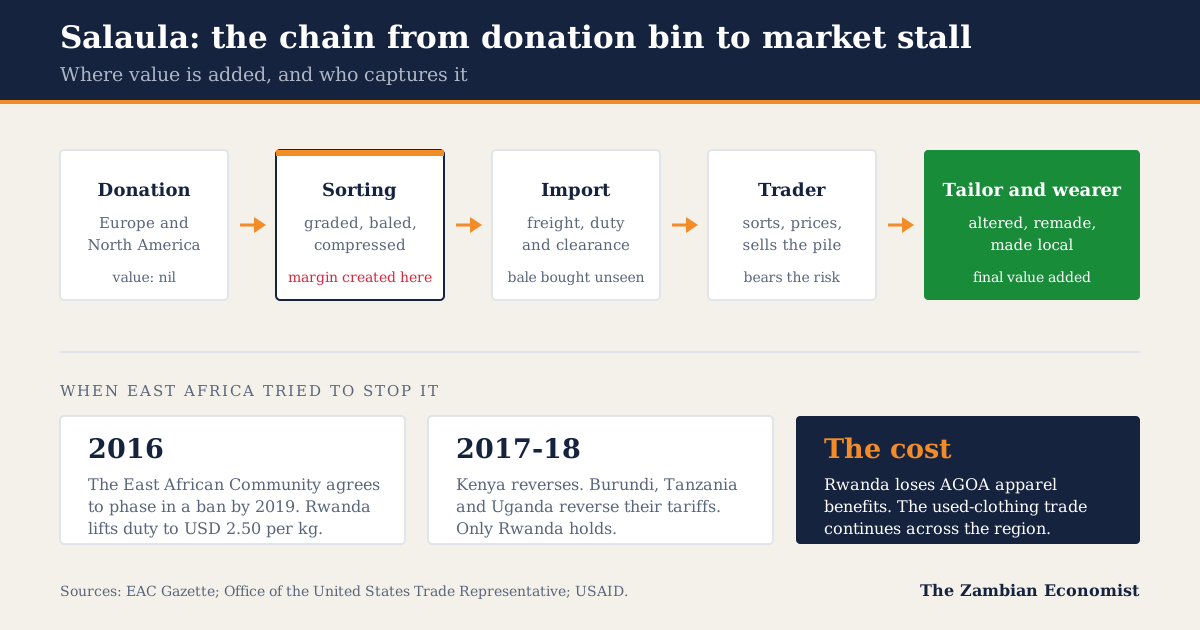
A case study in what diversification actually costs: the economics of Zambia’s second-hand clothing trade.
Series hub: Economic Diplomacy and Zambia in the Global Economy.