
Registration is the gate. Without it you cannot open a business bank account, you cannot bid for a government tender, most lenders will not look at you, and the Citizens Economic Empowerment Commission and Constituency Development Fund both require it before they will consider a loan application.
The process itself is not complicated. What trips people up is the decision they make before it starts.
The decision that actually matters
The Patents and Companies Registration Agency separates two different things, and people routinely apply for the wrong one.
A business name
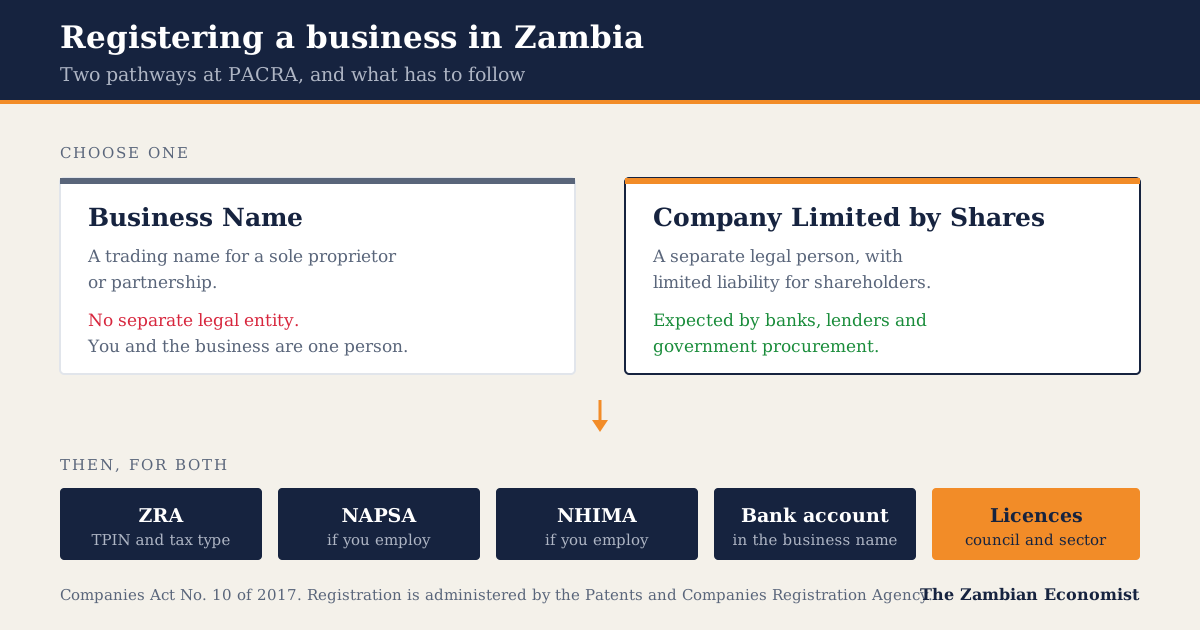
This registers a trading name for a sole proprietor or a partnership. It is quick and cheap. What it does not do is create a separate legal entity. You and the business remain the same person in law. If the business owes money, you owe money. Your personal assets are exposed.
It suits a small trading operation, a service business run by one person, or anyone testing an idea before committing.
A private company limited by shares
This is incorporation under the Companies Act No. 10 of 2017. It creates a separate legal person that can own assets, sign contracts and be sued in its own name. Shareholder liability is limited to what they put in.
It costs more and carries obligations a business name does not, annual returns, proper accounting records, a company secretary. In exchange it is the structure banks, investors and government procurement expect to see.
For anyone who intends to employ people, borrow, or bid for contracts, the limited company is almost always the right answer. Registering a business name first and converting later means doing the work twice.
Before you apply: clear the name
Name clearance is a separate step from registration, with its own fee, and it comes first. Submit your proposed name and PACRA checks whether it is available.
Names are rejected for being identical or confusingly similar to something already on the register, and for containing restricted words, Bank, Insurance, University and similar terms need approval from the relevant regulator before PACRA will accept them. A limited company name must end in Limited or Ltd.
Submit two or three options in order of preference. Searching the register yourself first, through the PACRA business search, saves a wasted cycle.
Documents to have ready
- Certified copies of the National Registration Card, or passport for non-Zambians, for every director and shareholder
- Two or three proposed names, in order of preference
- A physical address for the registered office, not a post box
- Contact details for each director and shareholder
- Details of share capital and how shares are divided, for a limited company
- The company constitution, where you are not adopting the standard articles
- The applicable PACRA form for the structure you have chosen
Where a company uses its own constitution rather than the standard articles, PACRA requires multiple copies of the filing pack. Check the requirement before you print.
The steps
- Search the register for your proposed names.
- Apply for name clearance and pay the clearance fee.
- Complete the registration form for your structure, making sure names, addresses and shareholdings match across every document in the pack.
- Submit through the PACRA portal or at a PACRA office.
- Pay the registration fee.
- Collect the certificate once the application is approved.
The portal handles the whole sequence online, which is faster than a counter visit and gives you a record of where the application sits.
What it costs
Fees come in two parts, and this is where most published guidance goes wrong. Name clearance is charged separately from registration, and the two use different amounts for a business name and for a company. For a limited company, the registration fee is banded against nominal share capital, so the figure you pay depends on the share capital you declare, not on a single flat rate.
We are not publishing a fee table here yet. The amounts circulating on other Zambian sites contradict each other by a wide margin, and a fee schedule that is wrong is worse than no fee schedule at all. PACRA publishes the current amounts on its forms and fees page, and those are the figures to work from.
We will add a dated table to this article once we have confirmed the current schedule at source, and we will record the date it was verified so you can see how fresh it is.
Budget separately for the things people forget: certified copies, transport to a PACRA office if you are not filing online, and any regulatory approval a restricted name requires.
How long it takes
Registration itself is a matter of days rather than weeks when the pack is complete and the name is clear. Getting fully operational takes longer. Allow two to three weeks from starting the name search to having the certificate, a tax number, statutory registrations and a working bank account.
The delays are almost never at PACRA. They are at the bank, and in the time it takes to assemble documents you did not know you needed.
What has to happen after registration
The certificate is the beginning, not the end. In roughly this order:
- Zambia Revenue Authority, register for a TPIN and the tax types that apply to you. Turnover tax, VAT and income tax have different thresholds and different filing obligations.
- NAPSA, register as an employer before your first employee starts, not after.
- NHIMA, the health insurance registration, on the same trigger.
- Bank account, in the business name, using the certificate, TPIN and directors’ identification.
- Council and sector licences, a trading licence from your local authority, plus whatever your sector requires. Food, health, transport, mining and financial services all carry their own regulator.
Miss the statutory registrations and the penalties accumulate quietly until something forces you to deal with them, usually a tender, a loan application or an audit.
Why applications get rejected
- The name is not available, or it is too close to something already registered.
- A restricted word was used without the regulator’s approval.
- Details do not match across the pack, a director’s name spelled two ways, or an address that changes between forms.
- Identification is not certified, or has expired.
- The registered office is a post box rather than a physical address.
- The wrong form for the structure, which is what happens when the business name and company decision was never consciously made.
What to do next
- Decide your structure. If you will employ, borrow or tender, incorporate.
- Search the register and shortlist three names.
- Assemble certified identification for everyone involved before you start.
- Confirm the current fees on the PACRA forms and fees page.
- Plan the post-registration sequence, ZRA, NAPSA, NHIMA, bank, licences, so it does not surprise you.
Primary sources: Companies Act No. 10 of 2017 · Patents and Companies Registration Agency, forms and fees · PACRA
Part of our Doing Business in Zambia series of practical guides.
Related reading: Grilled Ambition, the young entrepreneurs turning charcoal and goat meat into a living at Desire, Nyumba Yanga.