
By Zambian Economist Analyst
Ask a Zambian manufacturer what their biggest cost was in 2024 and they will probably say electricity. Then, if you push, they will correct themselves: it was not electricity. It was the absence of it.
The distinction matters, because one of those appears on the profit and loss account and the other does not.
Where the deficit came from
Zambia built its economy on hydropower, the Kafue and Zambezi basins, through Kariba North Bank, Kafue Gorge, Itezhi-Tezhi and Victoria Falls. For decades that was a strength: cheap, clean, abundant power that attracted mining and manufacturing.
It was also a concentrated bet on rainfall.
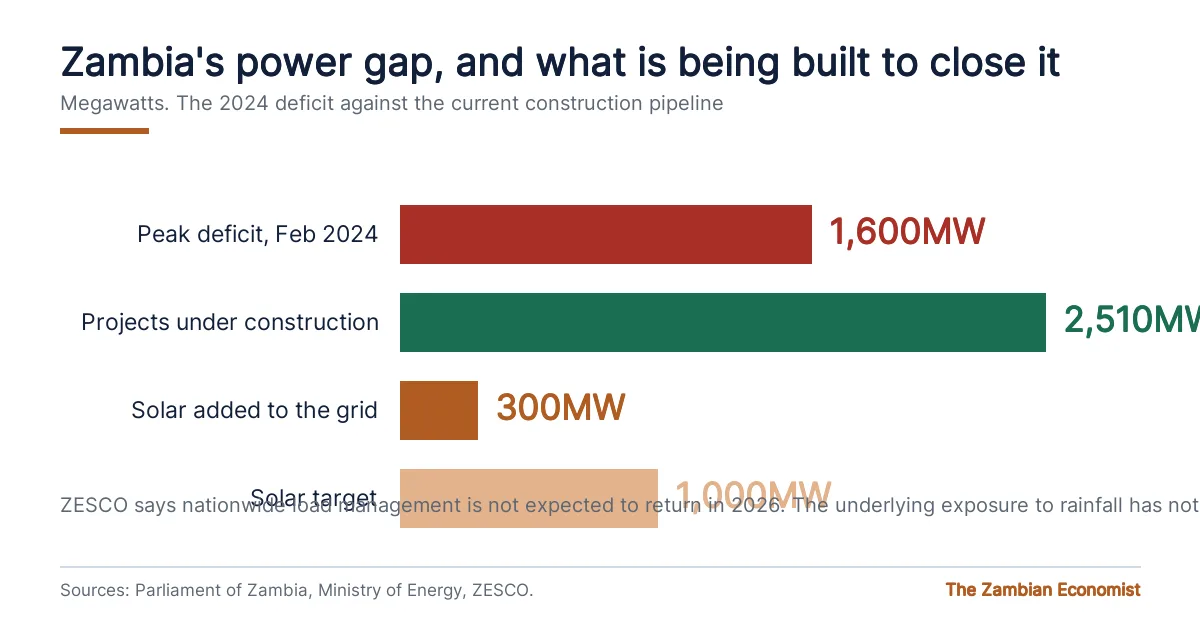
The 2023/24 drought, the worst in the region in decades, severe enough that government declared a national disaster, collapsed generation. The shortfall reached roughly 1,600 megawatts by February 2024, according to figures presented to Parliament. ZESCO responded with load management that escalated to as much as twelve hours a day for ordinary customers.
Mining, which is not on rotational load shedding, was asked to curtail demand instead, a pattern that goes back to at least 2015 and which reduces output, defers expansion and costs jobs without ever appearing in a load-shedding schedule.
Where things stand in 2026
Materially better.
In June 2026, ZESCO Managing Director Justin Loongo stated that the national electricity supply situation was stable and that the country was not expected to return to nationwide load management for the rest of the year. He attributed this to increased output from hydro, thermal and solar, and to deeper partnerships with independent power producers and independent power traders. In July he reiterated that normal supply would continue after the elections.
He was careful to distinguish isolated outages, from vandalism of infrastructure or localised network faults, from structured nationwide load management. That distinction is worth holding onto, because a business that loses power for six hours does not much care about the taxonomy.
On the build-out: the Ministry of Energy has pointed to a pipeline of 29 public and private energy projects totalling around 2,510MW under construction for commissioning across 2025 and 2026, including Maamba Phase II (300MW), CEC Itimpi II (136MW) and ZESCO’s Mansa solar plant (50MW). ZESCO has reported over 300MW of solar added to the grid against a 1,000MW target.
Two structural reforms have done quiet work too. The open access regime allowed power traders into the market, enabling imports through the Southern African Power Pool to cover shortfalls. And the shift away from a pure single-buyer model has let market-driven tariffs emerge, which is uncomfortable for buyers but is the thing that actually attracts generation investment.
The cost nobody puts on the balance sheet
Here is the part that matters for business planning.
When you ask a firm what load shedding cost them, they usually quote diesel. Diesel is the smallest part of it.
The generator bill. Real, visible, and typically several times the cost of grid power per unit. This is the number that gets quoted.
Idle labour. You pay a full shift and get a partial one. In a 60-person operation losing six hours a day, that is not a rounding error, it is a substantial share of your payroll producing nothing.
Spoilage. Cold chain is the obvious case: dairy, meat, fish, pharmaceuticals, vaccines. But it also covers half-finished batches in food processing, brewing and chemicals that have to be discarded when a process stops mid-cycle.
Equipment damage. Repeated hard stops and voltage fluctuations shorten the life of motors, compressors, refrigeration and electronics. This shows up two years later as an unplanned capital expense that nobody attributes to load shedding.
Lost orders. The most expensive item and the only one that is completely invisible. A processor who cannot guarantee delivery does not quote. A quote not submitted is a sale that never appears in any record, and it is not recoverable.
Deferred investment. The expansion that was not undertaken because power could not be guaranteed. This is the compounding one, the cost that keeps accruing for a decade.
An observation from the last cycle: the businesses that survived 2024 best were rarely the ones with the biggest generators. They were the ones that restructured operations around the load schedule, running energy-intensive processes in known-on windows, shifting to night operation, and separating processes that must never stop from those that can wait. Capital helps. Scheduling helps more, and costs less.
What business should do now
Do not dismantle your resilience. The temptation, with supply stable, is to sell the generator and cancel the solar quote. Zambia’s hydro dependence has not fundamentally changed. One poor rainy season restores the problem.
Price power properly. If you have never calculated your true cost per unit of output including outage losses, you are almost certainly underpricing work in energy-intensive lines.
Look seriously at solar plus storage. The economics have moved. With a strong kwacha reducing the landed cost of imported panels and inverters, 2026 is an unusually favourable moment to buy equipment that mostly comes from abroad. That window is a currency window, and currency windows close.
Understand open access. Larger consumers can now, in principle, contract with power traders rather than relying solely on ZESCO. If your consumption is significant, this is worth professional advice.
Track the grid commitment. Zambia’s debt-for-energy swap commits up to US$275 million of interest savings to strengthening and modernising the electricity network over fifteen years. Transmission and distribution is exactly where investment has historically been thinnest, because generation projects are announceable and grids are not. Whether that money reaches substations and lines is a question worth asking annually.
Why this is the diversification question
Every Zambian economic strategy calls for moving beyond copper into manufacturing and agro-processing. Both are energy-intensive.
You cannot build an agro-processing sector on twelve hours of power a day. You cannot attract a manufacturer who has to size a generator for their entire load. Reliable electricity is not one item on the diversification checklist, it is the precondition for most of the others, and it is also what unlocks the mining expansion discussed in copper and the kwacha.
That is why the grid commitment in the debt swap is more economically significant than its size suggests.
Zambia’s power position in 2026 is much better than it was in 2024, and the people who worked on that deserve to be told so.
But the underlying exposure, a hydro-heavy system in a region with increasingly volatile rainfall, is not resolved. It is being managed, with new thermal and solar capacity, imports, market reform and now a funded grid programme.
For a business, the correct response to stable supply is not relief. It is to build the resilience you wish you had had in 2024, while equipment is cheap and the lights are on.
Figures current as at 28 July 2026. Part of our Zambia Economy 2026 series.
Related: Salaula and the case for a Zambian garment industry.
Related coverage: on the transport side of the energy transition, see Electric Freight: From India to Africa, Drivers Will Benefit Only If Finance Keeps Pace.
Related coverage: Kariba Ferry Disaster Death Toll Hits 93: What It Means for Zambia’s Power and Tourism, on why Zambia’s stake in the shared Lake Kariba reservoir goes beyond sympathy for a neighbour.
Related: El Nino Warning: Zambia Told to Fix Its Power Gap Before the Drought Bites