By Zambian Economist Analyst
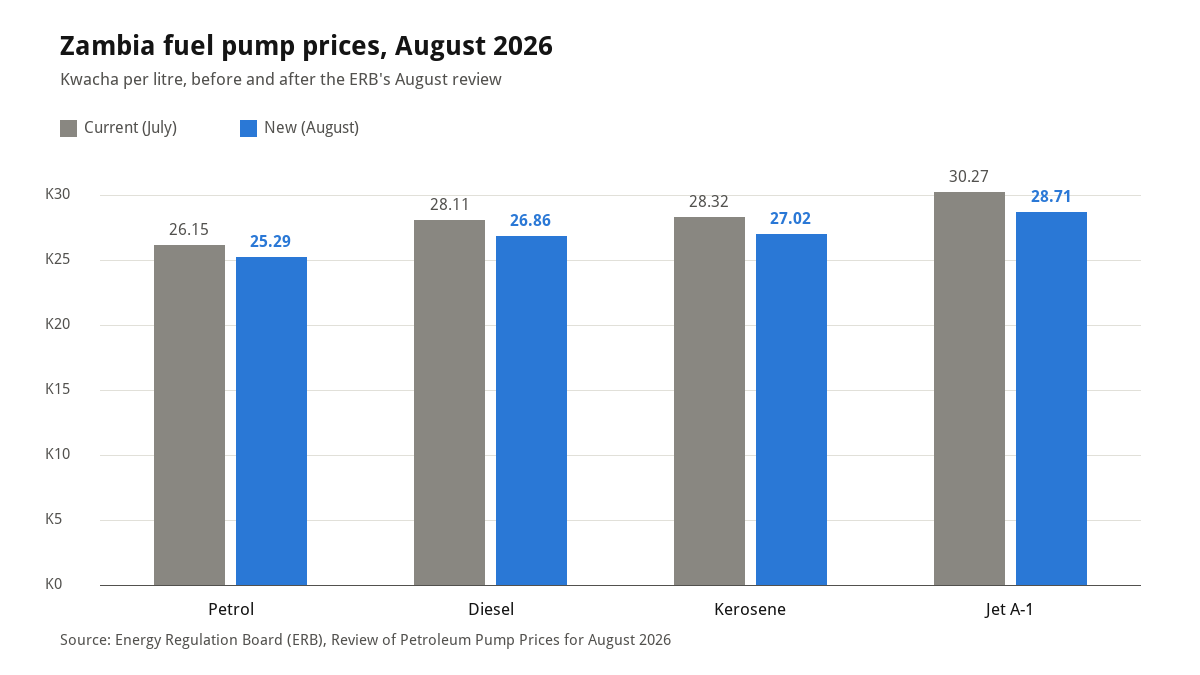
Zambia’s pump prices are falling for August 2026. The Energy Regulation Board (ERB) has cut the national uniform pump price of petrol, diesel, kerosene and Jet A-1, even as the kwacha weakened against the US dollar over the review period, a reminder that fuel prices in Zambia move on two variables at once, not one.
What changed
According to the ERB’s press release announcing the review, effective midnight on 31 July 2026:
| Product | Current (K/litre) | New (K/litre) | Absolute variance | % change |
|---|---|---|---|---|
| Petrol | 26.15 | 25.29 | (0.86) | (3.29%) |
| Diesel | 28.11 | 26.86 | (1.25) | (4.45%) |
| Kerosene | 28.32 | 27.02 | (1.30) | (4.59%) |
| Jet A-1 | 30.27 | 28.71 | (1.56) | (5.15%) |
Source: Energy Regulation Board, Review of Petroleum Pump Prices for August 2026, issued 31 July 2026.
The new prices remain in force until the ERB’s next scheduled review.
Why prices fell despite a weaker kwacha
The ERB’s monthly pump price reviews are built on two moving parts: the international dollar price of each refined product, and the kwacha-dollar exchange rate used to convert that dollar cost into local pump prices. This cycle, the two pulled in opposite directions, and the international price move was large enough to dominate.
On the international side, the average price of petrol fell from US$105.82 to US$96.92 per barrel, and Kerosene/Jet A-1 fell from US$158.97 to US$123.59 per barrel, both sizeable declines, even as the ERB noted that markets remained affected by ongoing geopolitical tensions in the Middle East. Diesel was the exception: its international price held relatively stable, edging up marginally from US$125.65 to US$126.58 per barrel.
On the currency side, the kwacha depreciated against the US dollar over the same period, moving from K18.35/US$ to K19.01/US$, a weaker kwacha that, on its own, would push local pump prices up, since imported fuel is priced in dollars.
The net effect for August: the drop in international oil prices was large enough to outweigh the currency depreciation for petrol, kerosene and Jet A-1, producing net price cuts across the board. Diesel’s smaller decline reflects that its international price barely moved this cycle, leaving the exchange rate as a bigger share of the net change.
What this means for households and businesses
A lower pump price for petrol and diesel feeds fairly quickly into transport costs, and from there into the price of goods that depend on road freight, which, in Zambia, is most of them. For a minibus operator on the Cairo Road route or a trader restocking from the Copperbelt, a K1.25 per litre cut in diesel is a direct reduction in the single largest variable cost of doing business.
The kerosene cut matters most for households that rely on it for lighting or cooking rather than grid electricity, a group that skews toward lower-income and rural consumers. The Jet A-1 change is the least visible to ordinary households, since it affects airline operating costs rather than a price anyone pays directly at a pump.
Common mistakes when reading fuel price announcements
- Assuming a weaker kwacha always means higher pump prices. It usually pushes prices up, but a large enough move in international oil prices can offset or even reverse that effect, as happened this cycle.
- Treating all four products as moving identically. Diesel’s cut was smaller than petrol’s this cycle precisely because its international price barely changed, while petrol’s international price fell sharply.
- Forgetting the review is monthly, not continuous. The new prices are fixed until the ERB’s next scheduled review, regardless of what happens to oil prices or the exchange rate in the interim.
The ERB’s next scheduled pump price review, and whether the kwacha’s recent depreciation trend continues or stabilises, a sustained move past K19/US$ would narrow the room for further cuts even if international oil prices keep falling. Full wholesale and pump price build-ups for August 2026 are available on the ERB website, erb.org.zm.
What is the new petrol price in Zambia for August 2026?
K25.29 per litre, down from K26.15, a reduction of K0.86 (3.29%), effective midnight on 31 July 2026.
What is the new diesel price in Zambia for August 2026?
K26.86 per litre, down from K28.11, a reduction of K1.25 (4.45%).
Why did fuel prices fall even though the kwacha weakened?
Because the decline in international oil prices for petrol, kerosene and Jet A-1 was large enough to outweigh the effect of the kwacha’s depreciation from K18.35/US$ to K19.01/US$.
Who sets pump prices in Zambia?
The Energy Regulation Board (ERB), which reviews and announces national uniform pump prices on a regular cycle based on international oil prices and the exchange rate.
When do the new prices take effect?
Midnight on 31 July 2026, and they remain in force until the ERB’s next price review.
Lower pump prices also ease pressure on road transport costs more broadly, a factor in how far the K2.1 billion in NRFA toll revenue collected in H1 2026 stretches on maintenance and new road works.