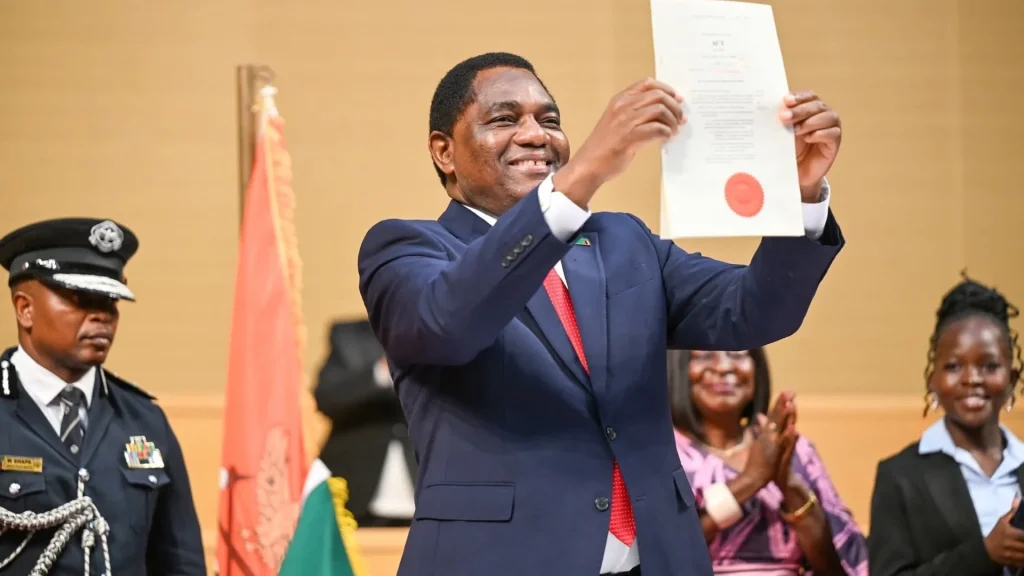
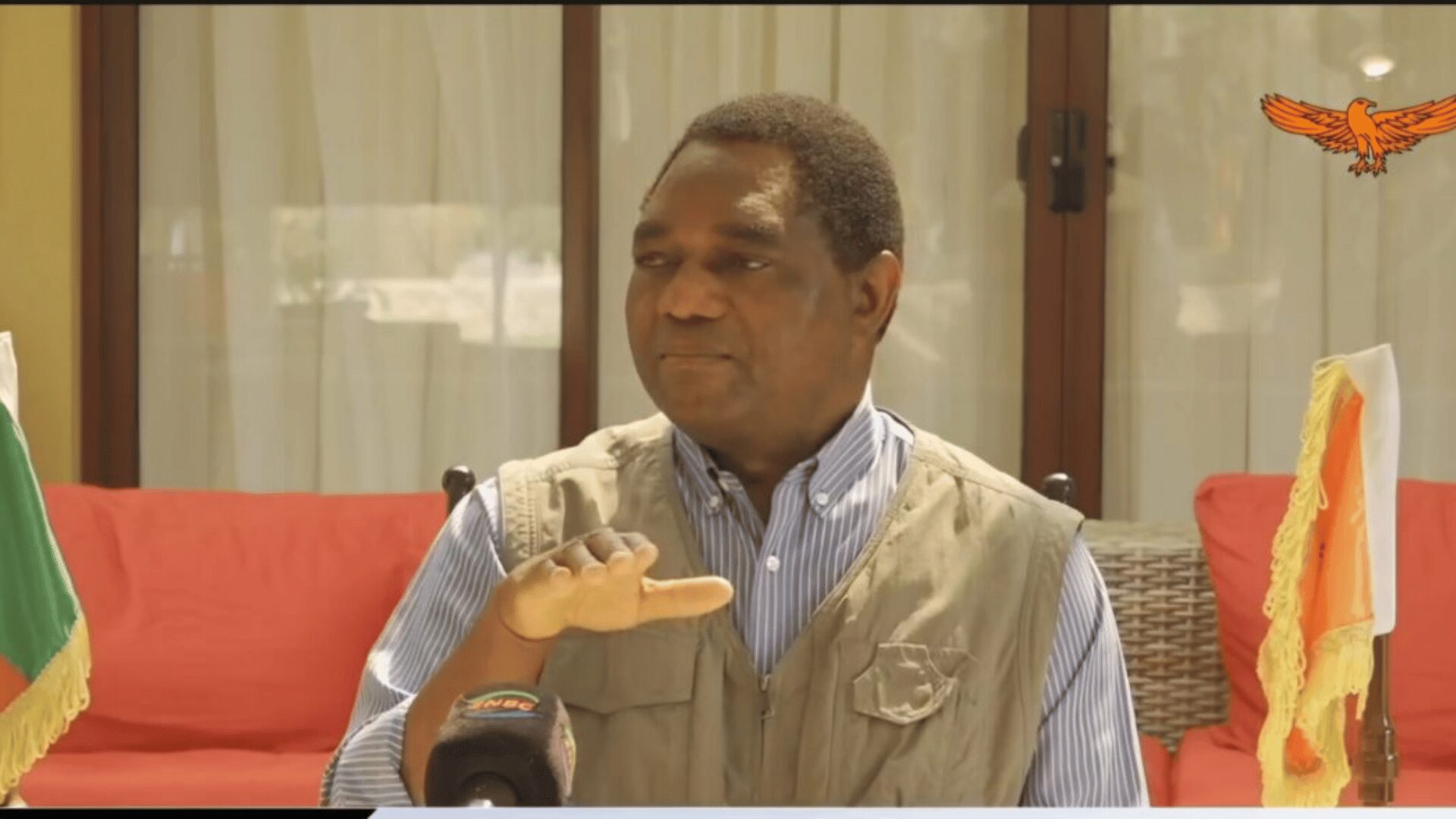
President Hakainde Hichilema has warned that anyone involved in plans to disrupt Thursday’s general election will be arrested, saying he has information that some opposition leaders sent people abroad for military training.
Speaking during a Special Interview in Lusaka with ZNBC, Hichilema said he was monitoring the situation and described himself as “Chief Shushushu,” a local term for chief spy.
Warning Over Alleged Military Training
“I’m the Chief, Shushushu. I know what is happening,” Hichilema said. “My friend, you cannot send people to a foreign country to receive military training and expect them to return and disrupt elections in this country without being arrested.”
“You will be arrested. If you commit a crime, you must be prepared to face the consequences,” he said. “Why would you send people to train somewhere so that they can return and plan to kill?”
The President also condemned remarks attributed to an opposition leader that he was prepared to kill or be killed. “An opposition leader has said that he is prepared to kill or be killed. Nobody wants to kill him,” Hichilema said. “If he says he is prepared to kill, then who is he prepared to kill? Fellow citizens. And for what? Political competition?”
Patriotic Front Record on the CDF and Free Education
Hichilema also turned his attention to the Patriotic Front, which governed Zambia for ten years, criticising the party for not introducing free education. He questioned why the PF did not increase the Constituency Development Fund from 1.6 million kwacha, an amount he said could only cover a 1×3 classroom block, to the 40 million kwacha now allocated under his administration.
“A few people were sleeping on cash, using it as mattresses and pillows,” Hichilema said. “Where was that money coming from? It was coming from loans, including Eurobonds, which they failed to repay. The result was a debt service burden of about 2.3 billion US dollars.”
He said much of that borrowing financed questionable contracts, including projects that were never completed. “That was money they accessed through questionable contracts, including contracts for projects that were never completed. Some contractors received 50 percent down payments and never built the roads. They used that money as if it were their personal wealth. Is that how you run a country? No.”
No Return to Load-Shedding, President Says
Hichilema dismissed claims that Zambia will return to load-shedding after the elections. He said government is expanding electricity generation capacity to meet growing demand, targeting 10,000 megawatts from solar and other non-hydro sources.
Why It Matters
The interview came two days before Zambians vote in Thursday’s general election, at a moment when security agencies and the Electoral Commission of Zambia have been finalising preparations at the National Results Centre in Lusaka. Public reassurance from the Head of State on security and continuity of power supply is aimed partly at markets and investors, who watch pre-election statements from incumbents closely for signs of instability that could affect the kwacha, portfolio flows and business confidence in election week.
On energy, the 10,000 megawatt target signals continuity in Zambia’s diversification away from hydropower dependence, a policy priority since the 2024/2025 drought exposed the vulnerability of Kariba-linked generation to climate shocks. Investors in the power sector will be watching whether this commitment translates into concrete project timelines after the vote.
By Zambian Economist Analyst
Related Reading
- Hichilema Condemns Political Violence, Warns of ‘Full Consequences’ for Offenders
- Hichilema Meets ICGLR Election Observers
- ECZ Launches National Election Results Centre at Mulungushi Ahead of Thursday’s Vote
- Civil Society Deploys Over 600 Election Monitors Nationwide Ahead of Thursday’s Polls
WARNING! All rights reserved. This material and all other digital content on this website may not be reproduced, published, broadcast, rewritten, or redistributed, in whole or in part, without the prior express permission of The Zambian Economist. Where permission is granted, the content must be clearly credited to “The Zambian Economist,” with “www.zambianeconomist.com” prominently displayed.
WhatsApp: +260775574228 | Email: info@zambianeconomist.com
© 2026 The Zambian Economist.
Work With The Zambian Economist
Related: Kafwaya’s Wife Seeks Court Order Over Husband’s Detention
nRelated reading: Kafwaya Was Shot and Later Died: Police on the Kabulonga Raid That Killed the Former Lunte MP.
n