
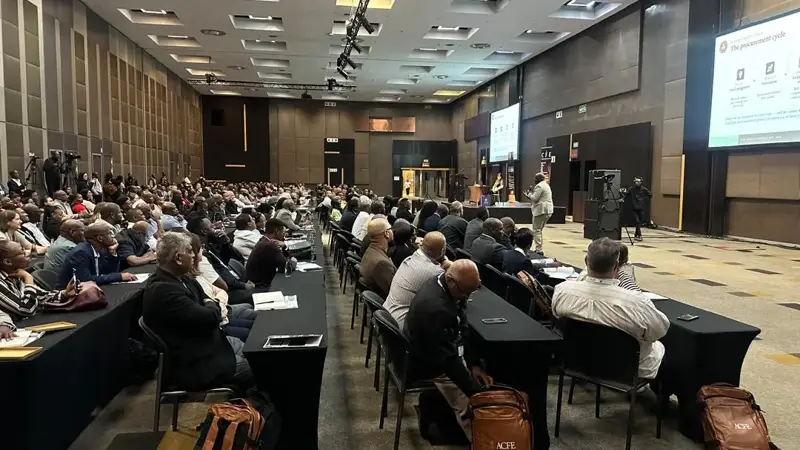
A Certified Fraud Examiner told this year’s ACFE Africa Conference that procurement fraud follows a pattern. The international standards written to stop it follow the same pattern back.
By The Zambian Economist Analyst
KEY TAKEAWAYS
- At the 19th Annual ACFE Africa Conference 2026, Certified Fraud Examiner Dr Masiye W. Banda mapped procurement fraud onto four recurring families: collusion among contractors, collusion between contractors and employees, defective pricing, and post-award abuse.
- His four pillars of prevention, employee education, internal controls, continuous monitoring and vendor due diligence, mirror the structure of ISO 37001:2025, the international standard for anti-bribery management systems.
- The OECD’s Recommendation on Public Procurement and the World Bank’s own procurement framework rest on the same principles: open competition, proportionate controls, and a documented justification for every departure from competitive bidding.
- Zambia’s Public Procurement Act No. 8 of 2020 already writes several of these safeguards into law, including bidding thresholds and the Zambia Public Procurement Authority’s power to investigate, suspend and debar.
- The distance between having a standard and applying it is where most procurement fraud actually survives.
A session built on a global standard
Procurement fraud does not look different in Lusaka than it does in Lagos, Nairobi or Johannesburg. That was the working assumption behind a session at the 19th Annual ACFE Africa Conference 2026, where Dr Masiye W. Banda, a Certified Fraud Examiner, walked delegates through what he called the art of contract rigging: the schemes, the red flags and the detection methods that recur across sectors and borders.
The session itself sat on a standard most Zambian institutions already lean on without naming it. The Association of Certified Fraud Examiners sets the credential Dr Banda holds and publishes the Fraud Examiners Manual that trains examiners on every continent, including those working inside Zambia’s own audit and anti-corruption institutions. When a Zambian auditor flags a red flag in a tender file, the method usually traces back to that same body of practice.
Where fraud enters the cycle
Dr Banda anchored every scheme to a phase of the procurement cycle, on the reasoning that knowing where a scheme lives tells an examiner which records to pull. Pre-solicitation is where an entity defines what it needs and how much. Solicitation is where specifications are drafted and bids invited. Evaluation and award is where bids are opened, compared and a winner chosen. Post-award and administration covers delivery, inspection, payment and change orders.
Fraud can enter at any of these four points, and the earlier it enters, the harder it is to unwind. A need invented at the first phase, or a specification quietly written around one vendor, corrupts everything that follows it.
Four families, one taxonomy
Everything Dr Banda covered fell into four families. Collusion among contractors covers competitors who agree to defeat open competition from outside the buyer’s organisation: complementary or cover bidding, bid rotation, bid suppression and market division all belong here. Collusion between contractors and employees brings the buyer’s own staff into the scheme, through manufactured needs, tailored specifications, manipulated bid pools, leaked bid data, bid splitting to dodge thresholds, and sole-source awards issued without genuine justification. Defective pricing lives almost entirely in negotiated contracts, where a contractor knowingly submits inaccurate cost or pricing data to inflate a price the buyer cannot independently verify. Post-award abuse strikes once the ink is dry, through non-conforming goods billed as compliant and change orders used to erase whatever advantage competitive bidding was meant to secure.
None of this is exotic. It is the same taxonomy that international standard-setters have spent two decades formalising into instruments Zambian institutions are already, in part, bound by.
Why an international standard matters
ISO published a revised edition of ISO 37001, its standard for anti-bribery management systems, in 2025. The standard asks an organisation to build policies, due diligence procedures, financial and non-financial controls, training and continuous monitoring into how it manages bribery risk, across public, private and not-for-profit sectors alike. Set next to Dr Banda’s four pillars of prevention, education, internal controls, monitoring and vendor due diligence, the overlap is close to exact. Two different bodies, working from two different starting points, arrived at the same architecture.
The OECD’s Recommendation on Public Procurement, adopted in 2015 and still the reference instrument its member and partner governments implement, rests on the same logic: procurement should stay open to competition, controls should be proportionate to risk, and any exception to competitive bidding needs a documented, defensible justification. The World Bank and other multilateral lenders build their own procurement frameworks on the same principles, which matters directly for Zambian institutions managing donor-funded contracts, where a lender’s procurement rules sit alongside domestic law.
Zambia’s own law already reaches for this
Zambia is not starting from nothing. The Public Procurement Act No. 8 of 2020 gives the Zambia Public Procurement Authority the mandate to investigate complaints, conduct procurement audits, and suspend or debar bidders and suppliers, the same enforcement backbone the international standards assume a functioning procurement system needs. The Act’s bidding thresholds exist for the same reason Dr Banda flagged bid splitting as a red flag: once a purchase is broken into pieces small enough to dodge competitive tender, the law’s own safeguard has been defeated by design rather than by omission.
This publication has covered the practical end of that safeguard before, including the Emoluments Commission’s own call for closer scrutiny of supplier ownership as a way to keep conflicted vendors out of the bidding pool in the first place. Dr Banda’s session gives that instinct a name: vendor due diligence, the outer wall of any prevention programme, because much of the fraud his four families describe depends on a compliant vendor getting through the door.
The standard only works if someone applies it
Dr Banda closed his session with a line that sits well outside procurement theory: when it is in our power to act, it is also in our power not to act, and in the end virtue lies in our power. Every scheme he described, from a cover bid engineered to lose to a change order quietly inflating a contract already won, depended on someone choosing to look away.
That is the honest limit of any standard, whether it comes from Geneva, Paris or Lusaka’s own statute book. ISO 37001, the OECD’s Recommendation and Zambia’s Public Procurement Act all describe what a sound procurement system looks like. None of them can force an examiner to pull the file, an official to refuse the bribe, or an institution to fund the monitoring its own law already requires. The standards exist. What determines whether they work is the same thing it has always been: whether the people running the system choose to use them.
Related reading: EC’s Mbula Urges Supplier Ownership Checks to Prevent Corruption, OAG Reports Simplified: How Zambia Audits the Constituency Development Fund, and What’s Actually in an Auditor General’s Report? A Plain-Language Guide.
WARNING! All rights reserved. This material and all other digital content on this website may not be reproduced, published, broadcast, rewritten, or redistributed, in whole or in part, without the prior express permission of The Zambian Economist. Where permission is granted, the content must be clearly credited to “The Zambian Economist,” with “www.zambianeconomist.com” prominently displayed.
WhatsApp: +260775574228 | Email: info@zambianeconomist.com
© 2026 The Zambian Economist.