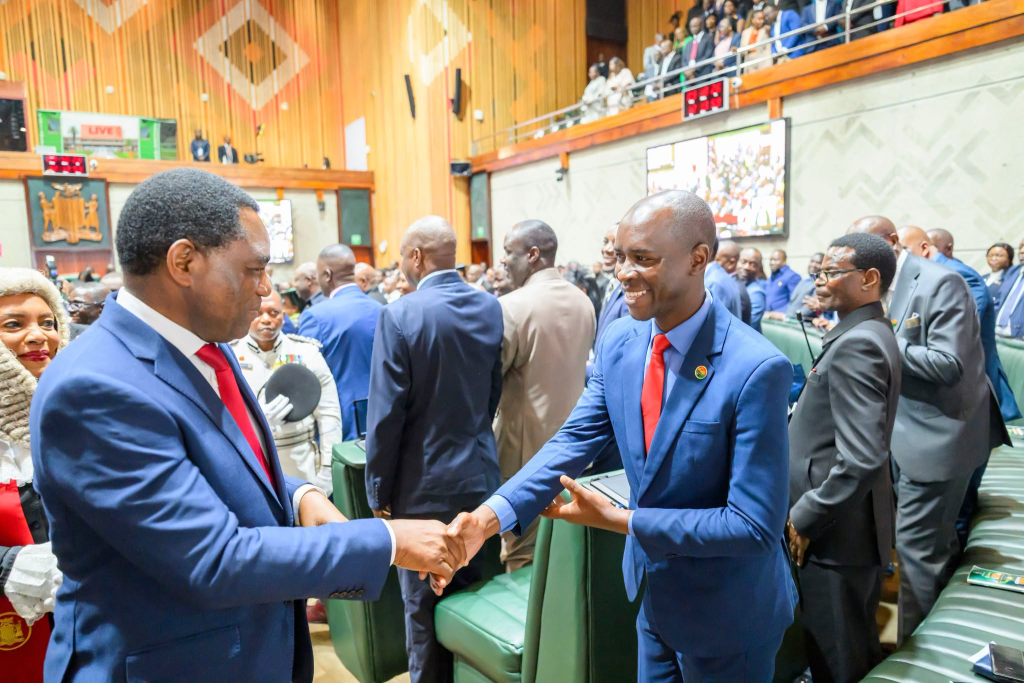
President Hakainde Hichilema swore in four ministers on Monday, pairing continuity at Finance with three appointments that put technical specialists in charge of foreign policy, health and the environment.
By The Zambian Economist Analyst
KEY TAKEAWAYS
- President Hichilema swore in four ministers on Monday: Mulambo Haimbe returns as Minister of Foreign Affairs and International Cooperation, Dr Situmbeko Musokotwane is retained at Finance and National Planning, Gilbert Siame takes Green Economy and Environment, and Roma Chilengi takes Health.
- Musokotwane’s retention keeps continuity at the centre of economic policy, while the other three appointments bring in figures with direct technical backgrounds in their new portfolios.
- Hichilema told the new ministers to focus on delivering results under the Grow Zambia Agenda and to treat Cabinet as a body of collective responsibility, not individual mandates.
- All four were sworn in days after Haimbe, Chilengi and Siame were confirmed as nominated Members of Parliament, moving quickly from the National Assembly into Cabinet.
Four ministers, one message on collective responsibility
President Hakainde Hichilema has appointed four ministers to his Cabinet, including the return of former Lusaka Central Member of Parliament Mulambo Haimbe as Minister of Foreign Affairs and International Cooperation. Hichilema also appointed Situmbeko Musokotwane as Minister of Finance and National Planning, Gilbert Siame as Minister of Green Economy and Environment, and Roma Chilengi as Minister of Health.
Speaking after swearing in the four on Monday, Hichilema urged them to focus on delivering results under the government’s Grow Zambia Agenda. He also called on the ministers to respect rules of engagement, uphold confidentiality and embrace collective responsibility.
“Collective responsibility. That’s why it’s called Cabinet. It’s more than one. So that goes to all of us, including your colleagues this side. Responsibility to the people. There are many times civil servants think that the rules for the executive are different,” Hichilema said.
Who holds which portfolio
Musokotwane’s reappointment keeps the same hand on fiscal policy that has overseen Zambia’s debt restructuring and macroeconomic stabilisation, a continuity point covered in our earlier analysis of what his retention signals for the economy.
The other three appointments bring specific technical backgrounds into portfolios that match them closely. Haimbe, a lawyer and the former Lusaka Central MP, previously served as Minister of Justice before losing his seat, and now returns to Cabinet at Foreign Affairs and International Cooperation. Chilengi moves into Health from his role as director of the Zambia National Public Health Institute, giving the ministry a public health specialist rather than a career politician. Siame, an academic in city and regional planning at the University of Zambia, takes on Green Economy and Environment, a portfolio that sits at the intersection of urban development and climate policy.
All three were confirmed as nominated Members of Parliament only days earlier, moving from the National Assembly directly into Cabinet appointments.
What collective responsibility is meant to signal
Hichilema’s remarks on collective responsibility were addressed to the four new ministers, but framed as a standing rule for the whole Cabinet. The distinction he drew, between individual ministers and the executive acting as one body, speaks to a recurring tension in coalition-style cabinets: portfolios are assigned to individuals, but decisions and their consequences are meant to be owned jointly.
For businesses and investors tracking policy continuity, the practical test is less about the speech and more about whether the four ministries coordinate on the issues that cut across them, fiscal space for environmental programmes, health financing within the national budget, and how foreign policy commitments translate into the investment climate Musokotwane’s ministry has to manage.
The President’s own words
Hours after the ceremony, Hichilema issued a statement in his own name summarising what he expects from the four. “Our charge is clear: advance the Grow Zambia Agenda by putting our nation first, upholding integrity, rejecting corruption, working hard and smart, and delivering measurable results for our people,” he said.
“Public office is a trust. Every Ministry must therefore become an engine of the Grow Zambia Agenda, driving investment, production and job creation, strengthening public services and translating economic growth into improved livelihoods for every Zambian.”
— Hakainde Hichilema, President of the Republic of Zambia
The statement closed with a short call to action: “Together, let us work, produce and Grow Zambia.” It is a shorter, more public-facing version of the collective-responsibility message Hichilema gave the four ministers directly at State House, and it puts a number on what businesses and investors should watch for next: whether each ministry can show, in its own numbers, a contribution to investment, production or jobs rather than a general reference to growth.
Why markets should read the two messages together
Taken together, the State House remarks and the published statement set two different tests for the same four appointments. The first is procedural: whether Cabinet functions as a single body rather than four ministries pursuing separate mandates. The second is measurable: whether Finance, Foreign Affairs, Health and Green Economy and Environment can each point to a specific investment, production or employment outcome tied to their portfolio within a defined period. Musokotwane’s ministry, given its role in the 2027 budget cycle and continued engagement with external creditors, is the most immediate test case. Haimbe’s foreign policy brief will be judged in part on whether diplomatic engagement translates into the mineral-sector and trade partnerships the government has been courting. Chilengi and Siame, both moving from technical institutions into political office, carry the added task of proving that subject expertise converts into budget execution.
Related reading: Hichilema Nominates Five MPs, Including Ex-Foreign Minister Haimbe and Musokotwane’s Reappointment Shows Policy Continuity, Next Phase Set for Productive Economics.
Budget follow-up: Cabinet sets Zambia’s 2027 budget priorities for growth, jobs and tax compliance.
Related: Mwewa Installed as Lusaka Mayor, Puts Waste, Drainage and Roads at the Top of His List
Related: Ministry of Health Sends 123 Headquarters Officers Back to Their Stations in Restructuring Exercise.
WARNING! All rights reserved. This material and all other digital content on this website may not be reproduced, published, broadcast, rewritten, or redistributed, in whole or in part, without the prior express permission of The Zambian Economist. Where permission is granted, the content must be clearly credited to “The Zambian Economist,” with “www.zambianeconomist.com” prominently displayed.
WhatsApp: +260775574228 | Email: info@zambianeconomist.com
© 2026 The Zambian Economist.
Work With The Zambian Economist
Related: Musokotwane Named Finance Minister of the Year 2026, Credits ‘Collective Zambia’.
Related: Haimbe Represents Zambia at Commonwealth Ministerial Meeting in New York.