
Zambia’s 2027 budget is framed by a gap the 2026 numbers left behind: revenue K12.1 billion under target by June, spending ahead of plan, and only about K6.9 billion of uncommitted space in a K271.9 billion envelope.
Key takeaways
- Finance Minister Dr Situmbeko Musokotwane presents the 2027 National Budget on Friday, 30 October 2026, within an envelope of K271.9 billion, up 7.4 per cent on 2026.
- Revenue and grants fell K12.1 billion short of target in the first half while spending ran K12.0 billion over, mostly from FRA maize purchases, fuel tax relief and grants that did not arrive.
- After existing commitments and K44.9 billion of planned borrowing, roughly K6.9 billion is free for new spending.
- Holding the Constituency Development Fund at K40 million across 226 constituencies would cost K9.04 billion, more than that free space, and audit findings show councils still struggle to finish projects and recover loans.
- The budget’s credibility will rest on whether revenue targets rest on new measures rather than compliance hopes, and whether FRA and FISP are funded well enough to avoid a third supplementary estimate.
Special report
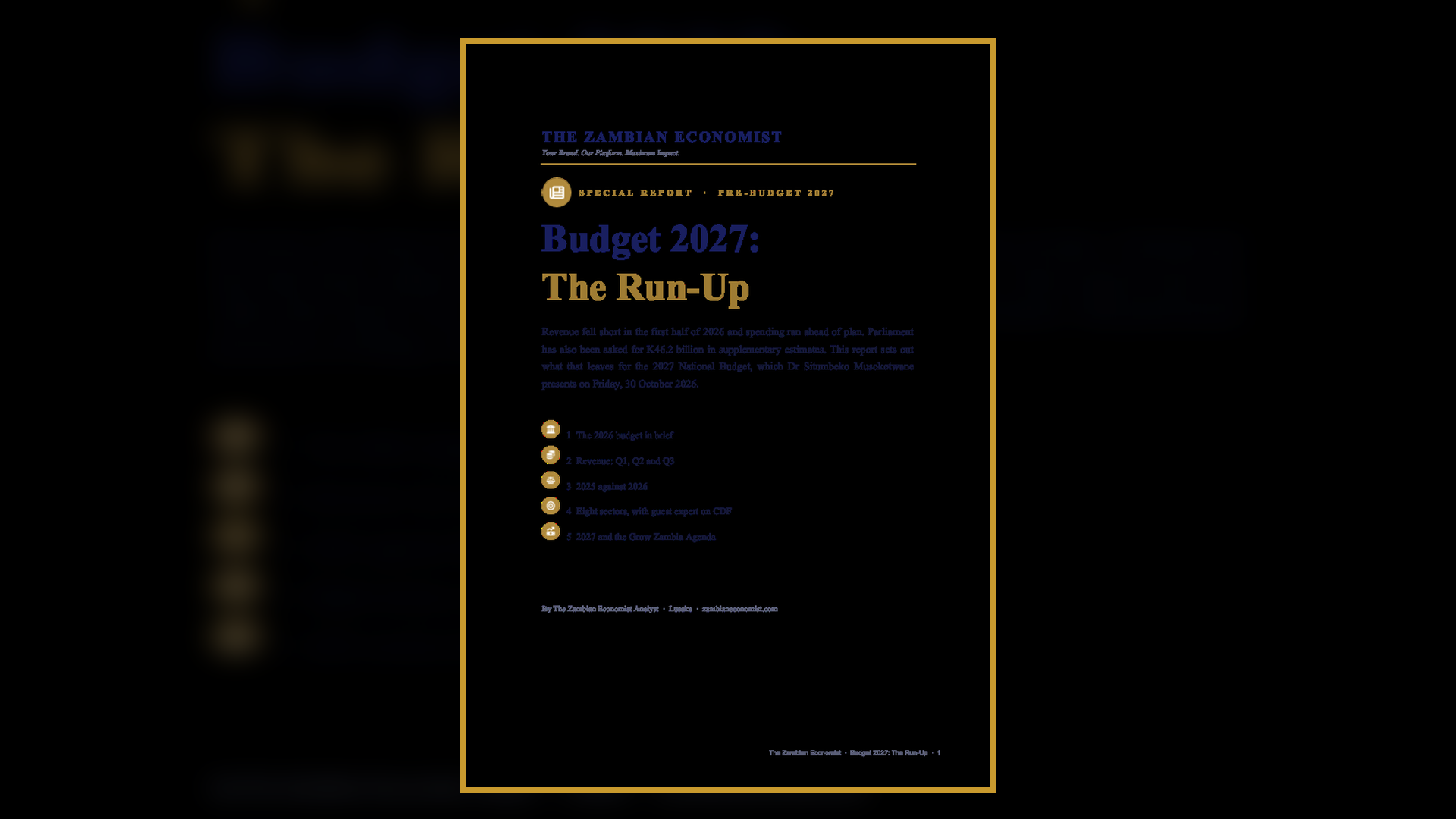
Budget 2027: The Run-Up
The Zambian Economist, 26 October 2026 · PDF, 9 pages, 709 KB
Friday’s budget answers one question above all: what can a government that collected less than it planned in 2026 actually spend in 2027. The arithmetic says the honest answer is about K6.9 billion of genuinely new money, less than 3 per cent of the envelope.
Our pre-budget special report, Budget 2027: The Run-Up, sets out how that constraint arose and what it means for health, education, agriculture, energy, mining, debt and the Constituency Development Fund. This article carries its findings, with the full report available to download above.
The report draws on the Ministry of Finance and National Planning’s first and second quarter 2026 Economic Reviews, the 2025 and 2026 Budget Speeches, Auditor General reports on the CDF and local authorities for 2024, and the October 2027 budget hearings. The third quarter review had not been published when the report went to print, so third-quarter revenue remains an open question the Minister may answer on Friday.
A good half-year for prices, a weak one for the till
The 2026 budget, presented on 26 September 2025 under the theme “Consolidating Economic and Social Gains Towards a Prosperous, Resilient and Equitable Zambia”, totalled K253.1 billion, or 27.4 per cent of GDP. Debt service took K73.7 billion of it, close to 29 per cent of everything government planned to spend.
The first half of 2026 brought mixed news. The economy grew 7.7 per cent in the first quarter against 3.8 per cent in 2025. Inflation ended June at 6.5 per cent, inside the 6 to 8 per cent band. Reserves reached US$6.2 billion, 5.2 months of import cover, and the kwacha averaged K18.55 to the dollar in the second quarter, 4.4 per cent stronger.
The fiscal accounts did not match that performance. By June government had collected K95.2 billion in revenue and grants against a K107.4 billion target. VAT was the weakest line in the second quarter: K5.9 billion against K11.3 billion expected. Part of that was deliberate, since government suspended excise duty on petrol and diesel and zero-rated fuel for VAT from April to June, at about K1.3 billion a month, to soften oil prices after the Middle East conflict. Grants came to K2.5 billion in the half-year, less than half the K5.6 billion planned.
| Objective | 2026 target | Latest outturn | Status |
|---|---|---|---|
| Real GDP growth | 6.4% | 7.7% in Q1; 5.3% projected for the year | Below |
| Inflation | 6 to 8% | 6.5% at end-June | Met |
| Reserves | Above 4 months | US$6.2bn, 5.2 months (end-June) | Met |
| Domestic revenue | 22.3% of GDP | H1 domestic revenue 8.9% below target (calc.) | Off track |
| Fiscal deficit | 2.1% of GDP | H1 spending 9.4% above target (calc.) | At risk |
Spending ran the other way. Expenditure reached K139.7 billion against a half-year target of K127.7 billion. FISP alone took K7.87 billion in the first quarter, and two supplementary estimates followed: K26.3 billion in May and K19.9 billion in October, most of it for FRA maize. Parliament has been asked for K46.2 billion in total.
The Zambia Revenue Authority now projects 2026 collections of K169.6 billion against its K185 billion target. Its Commissioner General says compliance must rise by at least 10 percentage points to close the gap, which is the same as saying the plan now depends on taxpayers who have so far not paid.
Where the growth went between 2025 and 2026
Between 2025 and 2026 the budget grew K36.0 billion, or 16.6 per cent. Debt service rose K19.7 billion, more than half that increase, at over twice the pace of the whole budget. Education’s share fell from 14.5 per cent to 13.0 per cent even as its allocation rose 4.9 per cent. Social protection fell 3.0 per cent in kwacha terms.
Those movements frame the 2027 choices. A budget whose fastest-growing line is interest has to find money for classrooms and clinics from somewhere else, and that somewhere is now largely exhausted.
The CDF question: K40 million times 226
The report’s guest expert section, by economist Lubinda Sinyani, takes on the question every MP will ask first: what happens to the Constituency Development Fund now that Zambia has 226 constituencies instead of 156.
Holding K40 million per constituency would cost K9.04 billion, a rise of K2.80 billion on 2026, and would use about 40 per cent of the entire uncommitted envelope. Holding the 2026 total instead would mean about K27.6 million each, a 31 per cent cut per constituency.
His verdict is that the case for simply raising the rate is weak, because the published rate already overstates what constituencies receive. In 2024 Treasury released K2.63 billion of the K4.78 billion provided, about 55 per cent, and councils began that year holding K3.56 billion carried over from earlier.
The audit record is harder still. The Auditor General’s CDF report for 2024, covering all 156 constituencies then existing, found 3,060 of 4,879 projects completed and 526 not started. Councils paid K514.2 million for 356,460 school desks; by September 2025, 71,301 desks worth K130.7 million had not arrived. Clinics, police posts and classrooms worth K22.0 million in 18 constituencies were finished but had stood unused for up to 23 months. Of K375.3 million in CDF loans due by October 2025, councils had collected K63.8 million, about 17 per cent, without terminating a single defaulting agreement.
The report’s alternative is an equal base, say K30 million per constituency released in full and on time, with up to K10 million more only for councils that complete projects and account for the base. Councils’ capacity to finish projects, enforce contracts and recover loans, not the headline rate, is what limits what CDF delivers.
What to watch on Friday
Six things decide whether this budget adds up. How far third-quarter revenue went towards closing the K12.1 billion gap. The 2026 deficit, and what K44.9 billion of borrowing implies for interest bills that already consume K73.7 billion. Whether new tax measures appear, or the K218.6 billion revenue target rests on compliance alone. Whether FRA and FISP are funded well enough to avoid a third supplementary. The CDF rate and total across 226 constituencies. And how the budget replaces donor money in health, where grants ran at 45 per cent of plan in the first half.
The production agenda gives the spending a direction: 1.08 million tonnes of copper in 2027, 10,000 MW of generation in the medium term, and 6.9 per cent average growth from 2027 to 2029. The report’s caution is that stability, in the Minister’s own words, is not an end in itself. Each sector has been asked to state what it will produce and where it will invest, and Friday is when those statements get a price tag.
What it means for households and businesses
For households, the budget touches three prices directly: fuel, through excise and VAT treatment restored after the suspension; food, through what FISP and FRA receive; and borrowing, through the interest bill crowding other spending out. For businesses, the K37.3 billion of domestic borrowing planned for 2027 competes with private credit, and government securities of K270.7 billion outstanding at end-June already anchor the yield curve.
For investors, the numbers that matter are smaller than the headline: whether revenue realism returns, whether supplementaries stop, and whether the debt share of the budget finally stops rising. That, more than any theme, is what a rating or a Eurobond price will read.
Special report
Budget 2027: The Run-Up
The Zambian Economist, 26 October 2026 · PDF, 9 pages, 709 KB
Source and disclosure: This article draws on The Zambian Economist special report Budget 2027: The Run-Up, 26 October 2026, which analyses Ministry of Finance and National Planning quarterly reviews, Budget Speeches and Auditor General reports. The guest expert section is by Lubinda Sinyani, economist and Principal Research Officer at the Emoluments Commission; the views are his own and do not represent the Commission or other institutions he serves.
Explore our Business & Economy analysis and our report on the 30-ministries motion. Get future briefings through The Ledger.
WARNING! All rights reserved. This material and all other digital content on this website may not be reproduced, published, broadcast, rewritten, or redistributed, in whole or in part, without the prior express permission of The Zambian Economist. Where permission is granted, the content must be clearly credited to “The Zambian Economist,” with “www.zambianeconomist.com” prominently displayed.
WhatsApp: +260775574228 | Email: info@zambianeconomist.com
© 2026 The Zambian Economist.