
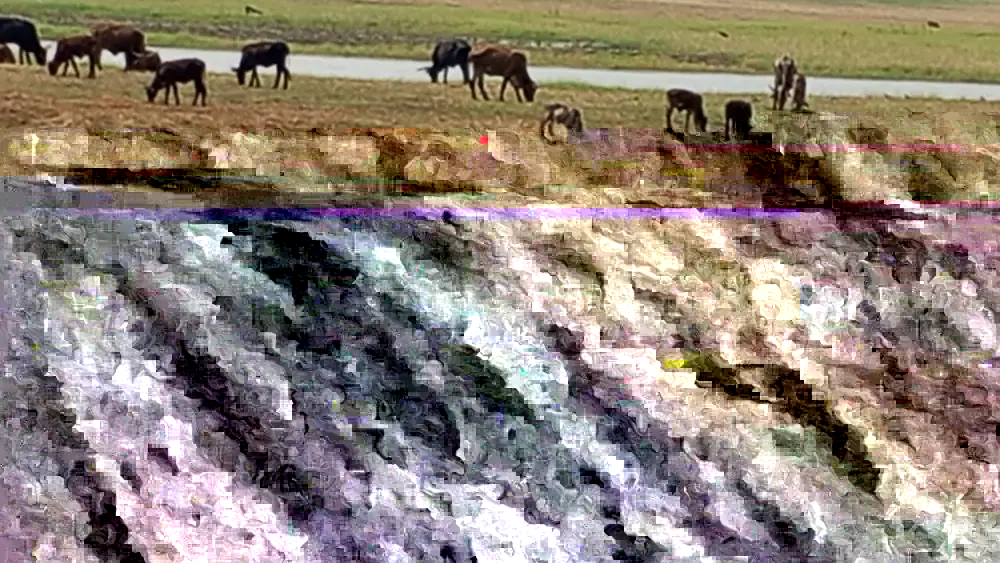
Major El Niño events have cost the global economy trillions of dollars, not because the phenomenon itself destroys anything, but because it amplifies the hazards that do. In 2026/2027, rivers are where that amplification is showing up first.
By Dr Kelvin Kamayoyo, Technical Advisor, African Rivers | The Zambian Economist Analyst
KEY TAKEAWAYS
- Historical major El Niño events carried enormous costs: over $4.1 trillion globally after 1982-1983 and around $5.7 trillion after 1997-1998, according to climate scientist Christopher Callahan’s research with Justin Mankin.
- El Niño does not cause damage directly. It amplifies existing hazards, and in the 2026/2027 event, rivers are one of the most exposed pressure points, from the Rhine and Danube in Europe to the Congo, Zambezi and Nile in Africa.
- The World Food Programme estimates this El Niño could push nearly 50 million people into acute hunger, a rise of more than one fifth on current levels, while the African Development Bank puts the potential hit to gross output in affected countries at up to US$20 billion.
- With less than 37 years left to Agenda 2063, protecting the rivers that underpin transport, energy, tourism, livestock and agriculture across the continent has to move from a background concern to a central one.
Rivers as the continent’s real engine
With less than 37 years remaining before the target date of Agenda 2063, “The Africa We Want”, more attention needs to go toward protecting Africa’s rivers and other waterbodies. They are the continent’s real engines for economic transformation and development. Rivers, by their nature, fuel growth across a range of economic sectors, from transport, energy and tourism to livestock and agriculture. The economic consequences of the supersized El Niño of 2026/2027 are already being calculated, and the numbers are stark.
What El Niño actually does to an economy
According to climate scientist Christopher Callahan, major El Niño episodes have historically imposed enormous costs on the global economy. The 1982-1983 event led to over $4.1 trillion in losses, while the 1997-1998 event caused around $5.7 trillion (Callahan and Mankin, 2023).
Crucially, El Niño does not in itself cause damage. It amplifies the hazards that do. Those losses are realised through failed crops, damaged infrastructure and disrupted markets and trade routes (Callahan and Mankin, 2023). In 2026/2027, rivers are emerging as one of the most exposed pressure points.
A global pattern of stressed water
Regionally, the pattern is becoming clearer. The Indian summer monsoon is running well below normal rainfall as El Niño strengthens (WMO, 2026). Central America, west Pacific nations and tropical South America are also at risk of low rainfall (WMO, 2026). In the Atlantic basin, El Niño increases wind shear and tends to suppress hurricane activity, yet it only takes one major storm to produce devastating impacts (WMO, 2026).
In Europe, the influence is already visible in amplified heatwaves and in the drying of major rivers such as the Rhine and Danube, raising immediate concerns for transport, energy and water supply (WMO, 2026). “Major rivers like the Rhine and Danube are critical trade corridors and sources of water for industry and energy generation, so when water levels fall, the effects extend far beyond the waterways themselves,” said Liz Saccoccia, water security lead at the World Resources Institute. Low water levels threaten barge traffic, cool nuclear and thermal power plants, and reduce drinking water reserves for millions.
In the tropics, the impacts are more direct and livelihood-focused. In Peru, unusually warm coastal waters have driven anchovies away from traditional fishing grounds, leaving boats idle and threatening thousands of jobs that depend on nutrient-rich upwelling (WMO, 2026). In Ecuador, warmer waters are undermining plankton, algae and small fish that form the base of the food web for endangered birds and penguins, with early reports of ecosystem stress along the Humboldt Current (WFP, 2026). These marine disruptions are early warnings of how ocean-river systems are being destabilised.
Asia is bracing for a mix of extremes. In Pakistan, the ongoing monsoon is producing localised flooding in the north, while El Niño increases drought risk in the south and west (WFP, 2026). In India and Vietnam, forecasts point to severe heatwaves, up to a 50 percent drop in rainfall in some areas, and an increased risk of flash floods when rains do arrive (WMO, 2026). Such volatility places immense stress on river basin management.
Africa’s exposure, and Zambia’s stake in it
Across Africa, the outlook is equally sobering. Recent World Food Programme analysis finds this El Niño could push nearly 50 million people into acute hunger, an increase of more than one fifth from current levels (WFP, 2026). The African Development Bank estimates the pattern could shrink gross output by up to US$20 billion in affected countries and trigger cross-border migration (AfDB, 2026). In Côte d’Ivoire, the world’s top cocoa producer, drought is slowing sales and forcing premiums as the next harvest is threatened (AfDB, 2026). For a continent where most trade, hydropower and agriculture depend on major river systems like the Congo, Zambezi and Nile, stressed rivers mean stressed economies.
Zambia’s own exposure runs through the Zambezi. The river feeds Lake Kariba, which in turn feeds the hydropower that much of the country’s industry and households depend on, a link this publication has traced through the 2018-2021 drought years and the power deficits that followed. A river basin under stress two seasons in a row does not stay a hydrology story. It becomes a power-generation story, then a manufacturing-output story, then a jobs story.
What the response has to include
The message from 2026/2027 is clear. As the climate system warms, El Niño events are becoming more intense and their hydrological impacts more severe. Protecting rivers through improved forecasting, watershed restoration, tree planting, efficient irrigation and resilient infrastructure must now be central to any adaptation strategy. Without healthy rivers, there can be no food security, energy security or economic stability in the years ahead.
References
African Development Bank (AfDB) (2026) African Economic Outlook 2026: Climate Shocks and Growth. Abidjan: AfDB.
Callahan, C.W. and Mankin, J.S. (2023) ‘Persistent effect of El Niño on global economic growth’, Science, 380(6640), pp. 106-109.
World Food Programme (WFP) (2026) El Niño Anticipatory Action and Food Security Outlook 2026-2027. Rome: WFP.
World Meteorological Organization (WMO) (2026) El Niño/La Niña Update. Geneva: WMO.
Related reading: Understanding the ‘Supersized’ El Niño of 2026/2027, El Niño Warning: Zambia Told to Fix Its Power Gap Before the Drought Bites and Africa Must Prepare Now for the Unrelenting 2026 El Niño Wave.
WARNING! All rights reserved. This material and all other digital content on this website may not be reproduced, published, broadcast, rewritten, or redistributed, in whole or in part, without the prior express permission of The Zambian Economist. Where permission is granted, the content must be clearly credited to “The Zambian Economist,” with “www.zambianeconomist.com” prominently displayed.
WhatsApp: +260775574228 | Email: info@zambianeconomist.com
© 2026 The Zambian Economist.