Key takeaways
- El Niño’s first written record dates to 1578 in colonial Peru, where fishermen named the warm Pacific current after Christmas, “El Niño de Navidad.”
- The World Meteorological Organization confirmed in August 2026 that El Niño is firmly established and will intensify into a very strong event, with close to a 100% chance it persists through February 2027.
- The Met Office expects the 2026/2027 episode to be one of the most severe since formal records began in the 1950s, already described in scientific and policy circles as “supersized.”
- Large El Niño events raise global average temperature the following calendar year, making 2027 very likely to exceed 2024 as the warmest year on record.
- Zambia has already moved to order drought preparations ahead of a drier, hotter 2026/2027 rainy season; this event sits behind that decision.
14th September, 2026
A phenomenon four centuries in the written record
El Niño is not new, notes Dr Kelvin Kamayoyo, Technical Advisor for African Rivers. The natural climate phenomenon has occurred for thousands of years, but it was first recorded historically in 1578 in colonial Peru (Environment and Society Portal, 2024).
Centuries ago, Peruvian fishermen noticed unusually warm Pacific Ocean water arriving near the coast of South America around December. Because it coincided with Christmas, they named it El Niño de Navidad, meaning “The Christ Child” or “The Little Boy” in Spanish (NOAA NCEI, 2024; Welthungerhilfe, 2023).
Scientific documentation and tracking evolved significantly by the late nineteenth and twentieth centuries, but that first written record in 1578 remains the earliest archival reference (Environment and Society Portal, 2024).
Why 2026/2027 is being called “supersized”
In August 2026, the World Meteorological Organization, the United Nations weather agency, confirmed that El Niño is firmly established and will intensify into a very strong event in the coming months (WMO, 2026). Its peak is expected towards the end of 2026, and the WMO puts the likelihood of it continuing through February 2027 at close to 100 percent (WMO, 2026).
The organisation has projected that the 2026/2027 episode is likely to be intense and to place pressure on agriculture, water, energy, tourism, health and infrastructure sectors across the globe (WMO, 2026). For that reason it is already being referred to in scientific and policy circles as “supersized,” anticipated to be one of the most severe patterns since official records began in the 1950s (Met Office, 2026).
A warming effect that outlasts the rains
Beyond local weather, El Niño events also drive an increase in global average temperature. As Dr Nick Dunstone explains, “during large El Niño events significantly more heat is released from the ocean to the atmosphere leading to an increase in global average temperature, particularly in the calendar year following the winter peak of the El Niño. Hence, 2027 is very likely to replace 2024 as the warmest year on record and be another year to temporarily exceed +1.5°C above the preindustrial period” (Met Office, 2026).
“We should be clear that this is an unprecedented event. I have never seen an El Niño signal this intense in our forecasts… then 2026 will far exceed our recent experience of El Niño and its worldwide climate influences.”
Professor Adam Scaife, Head of Long Range Forecasting, Met Office (2026)
What it means for Zambia
Zambia is already acting on the strength of this forecast rather than waiting for it to arrive. Government has ordered immediate drought preparations ahead of a drier, hotter 2026/2027 rainy season, and earlier warnings tied the same El Niño signal directly to the country’s power gap, since Lake Kariba’s hydropower output falls with the rains that feed it (see Government Orders Immediate Drought Preparations as Zambia Faces Drier, Hotter 2026/2027 Rainy Season and El Nino Warning: Zambia Told to Fix Its Power Gap Before the Drought Bites).
The scale the WMO and the Met Office are describing, a “supersized” event with close to certain persistence through February 2027, is the reason those warnings have moved from caution to instruction. It is also why the continental case for coordinated preparedness, and the case for pre-arranged instruments such as drought cover for smallholder farmers, has hardened this year rather than softened (see Africa Must Prepare Now for the Unrelenting 2026 El Niño Wave and Njala Insurance: The Case for Paying Zambia’s Drought Cover in Maize, Not Kwacha).
For a country where hydropower still supplies most of the grid and rain-fed maize still supplies most of the food basket, an event this size is not a distant statistic. It is the variable sitting behind this season’s power planning, this season’s input distribution, and next year’s harvest (see Zambia’s Power Deficit and the Real Cost to Business and 9,890 Farmers Redeem Inputs Under Food Security Pack in Northern Province).
References
Environment and Society Portal (2024) First Recorded El Niño. Available at: https://www.environmentandsociety.org/tools/keywords/first-recorded-el-nino (Accessed: 13 September 2026).
Met Office (2026) 2026 El Niño Forecast Update. Exeter: Met Office Hadley Centre.
NOAA National Centers for Environmental Information (NOAA NCEI) (2024) What is El Niño?. Available at: https://www.ncei.noaa.gov/access/monitoring/dyk/el-nino (Accessed: 13 September 2026).
Welthungerhilfe (2023) El Niño and Climate Change. Available at: https://www.welthungerhilfe.org/what-we-do/focus-areas/climate-change/el-nino (Accessed: 13 September 2026).
World Meteorological Organization (WMO) (2026) El Niño/La Niña Update. Geneva: WMO.
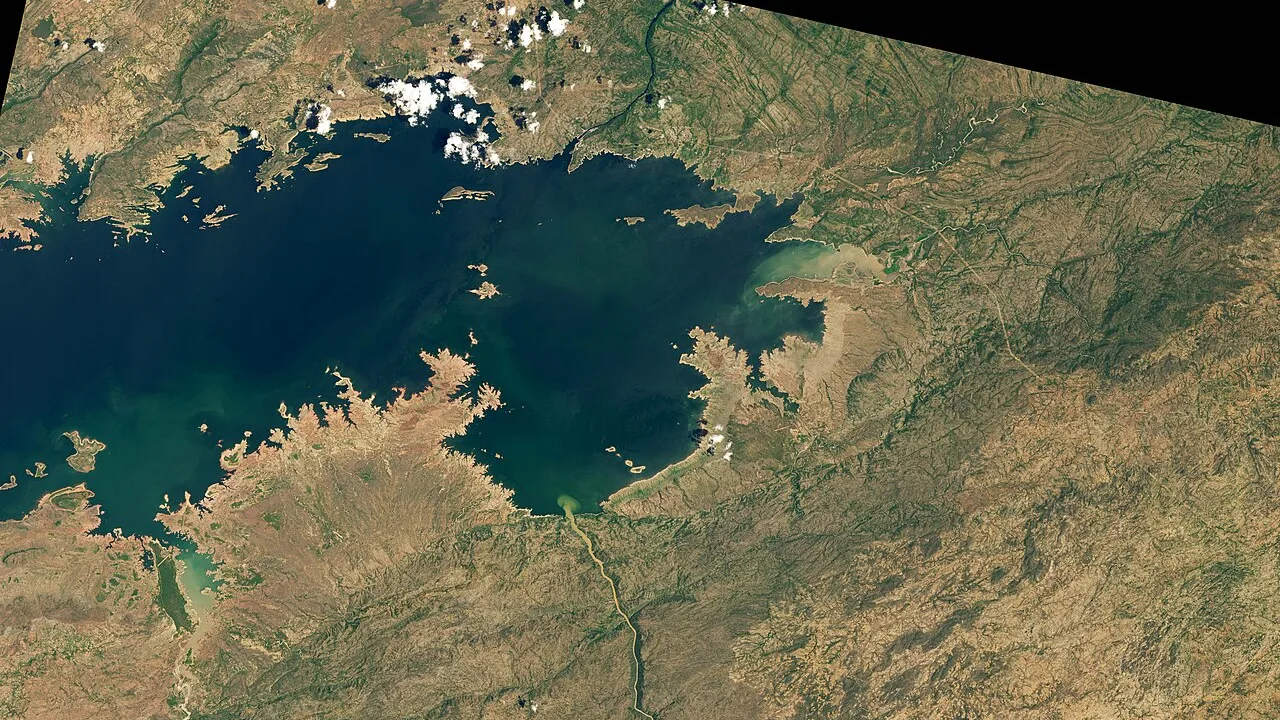
Featured image: Lake Kariba, 23 December 2019, during the 2018–2021 Southern African drought. NASA Earth Observatory image by Lauren Dauphin, using Landsat data from the U.S. Geological Survey (public domain).
WARNING! All rights reserved. This material and all other digital content on this website may not be reproduced, published, broadcast, rewritten, or redistributed, in whole or in part, without the prior express permission of The Zambian Economist. Where permission is granted, the content must be clearly credited to “The Zambian Economist,” with “www.zambianeconomist.com” prominently displayed.
WhatsApp: +260775574228 | Email: info@zambianeconomist.com
© 2026 The Zambian Economist.
Work With The Zambian Economist
Related: Government Orders Immediate Drought Preparations as Zambia Faces Drier, Hotter 2026/2027 Rainy Season | Africa Must Prepare Now for the Unrelenting 2026 El Niño Wave | El Nino Warning: Zambia Told to Fix Its Power Gap Before the Drought Bites