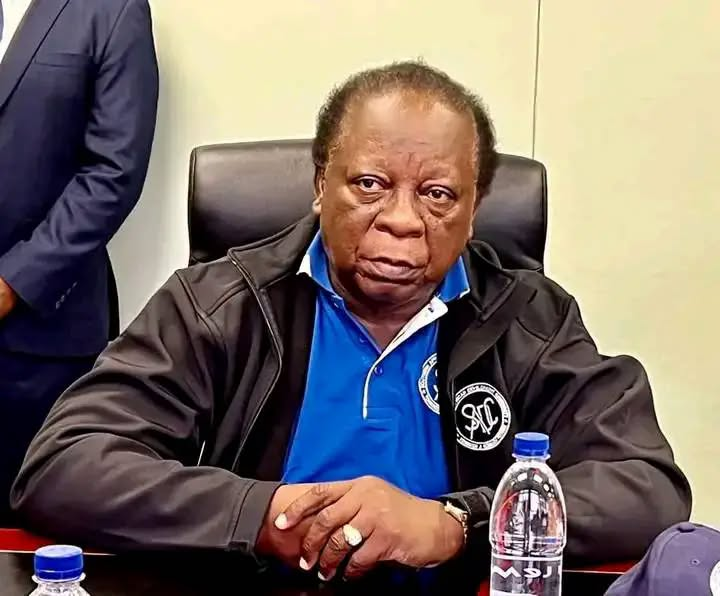
Former Vice-President Enock Kavindele has become the most senior Zambian figure yet to push back against Ian Khama’s “new dictator” remark, demanding evidence and reminding the former Botswana leader that Zambia settles its arguments at the ballot box and through diplomacy, not foreign commentary.
- Former Vice-President Enock Kavindele says Ian Khama’s claim that President Hichilema is “Africa’s newest dictator” must be backed by credible evidence or withdrawn.
- Kavindele points to Zambia’s record: peaceful transfers of power in 1991, 2011 and 2021, and a 2026 election observed by the AU, SADC, COMESA and the EU.
- SADC’s 106 observers found a calm atmosphere at 275 of 277 polling stations visited; Hichilema won with 60.49% of valid votes.
- The row carries real economic weight: Zambia and Botswana share the Kazungula Bridge, a joint bridge authority and a Bi-National Commission.
- Kavindele’s message: criticise Zambia with facts, through diplomatic channels, and expect the same respect Botswana demands for itself.
A diplomatic spat between two of southern Africa’s most stable neighbours has moved from social media video to formal press statement. Former Vice-President Enock Kavindele, speaking in Lusaka today, has told former Botswana President Ian Khama that serious allegations against a democratically elected Head of State “should be supported by credible evidence,” and that concerns about Zambia’s governance belong in established diplomatic channels, not in viral clips.
The remark that started it
Khama, who led Botswana from 2008 to 2018, described President Hakainde Hichilema as “Africa’s newest dictator” in a video that circulated widely on social media, and in September told AFP that Zambia’s political situation was “a very, very bad precedent.” Zambian commentators rounded on the claim within hours, with some noting the irony that Hichilema himself once labelled Khama a dictator while the Botswanan was in office. The strongest media coverage of the exchange has been Zambian; no major Botswana outlet, including Mmegi and Botswana Guardian, appears to have run the “new dictator” claim as a news story.
Kavindele’s rebuttal, by the numbers
Kavindele did not dispute Khama’s right to an opinion. He disputed the absence of evidence behind it. His statement, issued in Lusaka, rests on a factual scaffold:
| Claim in statement | Verifiable detail |
|---|---|
| Peaceful transfers of power | Incumbents lost and handed over power in 1991, 2011 and 2021 |
| 2026 election competitiveness | 13 presidential candidates on the August 13 ballot |
| International observation | AU, COMESA, SADC and EU missions deployed |
| SADC finding | 106 observers from 10 member states; calm at 275 of 277 polling stations visited |
| Result | Hichilema declared winner with 60.49% of valid votes (2,965,326) |
| Reform record | Death penalty abolished, criminal defamation of the President repealed, Access to Information Act enacted in 2023 |
| International standing | Elected to the UN Human Rights Council for 2027–2029 with 177 votes |
He also recalled the President’s own political history: Hichilema contested the presidency seven times, lost five, and spent roughly four months in detention in 2017 on a treason charge that was later discontinued. Kavindele noted that Khama himself wrote to then President Edgar Lungu urging restraint during that period. The implication is hard to miss: Khama once defended Hichilema’s rights as an opposition leader, and is now attacking him as an elected one.
Why two landlocked neighbours cannot afford this row
For traders and businesses, this is not abstract diplomacy. The Kazungula Bridge, opened in 2021, replaced the slow pontoon ferry across the Zambezi and cut a critical north-south trade corridor between Zambia, Botswana and the port of Durban. The two governments have since built the Kazungula Bridge Authority and a Bi-National Commission to manage the relationship. Kavindele cited all three deliberately. A war of words between Lusaka and Gaborone touches border posts, freight costs and the regional integration agenda both countries have invested in for decades.
He also extended Khama a measure of respect rarely seen in this spat, acknowledging Botswana’s own institutions, including Ntlo ya Dikgosi, the House of Chiefs, and accepting that Zambia, like any democracy, must remain open to scrutiny. His condition was symmetry: extend to Zambia the same respect Botswana expects from others.
What happens next
Khama has shown no sign of retracting. Zambia’s government has not officially responded to Kavindele’s statement, and may not need to: a former Vice-President from the business world carrying the rebuttal allows the state to stay above the fray. The real test is whether the exchange stays at the level of personalities or spills into the practical cooperation, on trade, energy and infrastructure, that both economies depend on.
WARNING! All rights reserved. This material and all other digital content on this website may not be reproduced, published, broadcast, rewritten, or redistributed, in whole or in part, without the prior express permission of The Zambian Economist. Where permission is granted, the content must be clearly credited to “The Zambian Economist,” with “www.zambianeconomist.com” prominently displayed.
WhatsApp: +260775574228 | Email: info@zambianeconomist.com© 2026 The Zambian Economist.
Work With The Zambian Economist: Advertise With Us · List With Us · Submit an Article