As China expands its economic partnerships and developing countries demand greater influence over international decisions, Dr Kelvin Kamayoyo examines why the Western-led international order faces growing resistance and what this means for Africa.
KEY TAKEAWAYS
- The Western-led international order faces growing questions about fairness, representation and credibility among developing countries.
- China’s infrastructure financing and alternative international institutions have expanded the choices available to African governments.
- China’s approach also raises concerns about debt, transparency and the long-term economic value of infrastructure projects.
- Zambia has an opportunity to negotiate with competing international partners, provided its decisions protect national interests.
- Dr Kamayoyo argues that Europe should combine strategic competition with selective cooperation rather than attempt to isolate China.
A world order facing a crisis of legitimacy
The liberal international order is facing a challenge in the Global South. Its institutions remain influential, but their legitimacy is increasingly contested by countries seeking greater representation and more control over their development choices.
For much of the period following the Second World War, the United States and Western Europe exercised considerable influence over global trade, finance and international institutions. That influence was supported by economic strength, diplomatic networks and institutions such as the International Monetary Fund and World Bank.
Dr Kelvin Kamayoyo argues that this arrangement is now under pressure as China expands its international influence and countries across Africa, Asia and Latin America seek a greater role in setting global rules.
The change is particularly relevant to Zambia, where relations with China, Western development partners and multilateral financial institutions influence infrastructure investment, debt management and economic policy.
Why the Global South is questioning Western leadership
The liberal international order was built around principles including sovereign equality, international cooperation, open markets and the rule of law.
Its critics, however, argue that these principles have not always been applied consistently.
The structural adjustment programmes introduced across several African economies during the 1980s and 1990s remain part of this debate. Governments were encouraged to liberalise markets, privatise state enterprises and reduce public expenditure, often amid substantial economic and social adjustment.
Economist Joseph Stiglitz has criticised aspects of this approach, arguing that international economic policies sometimes failed to account adequately for domestic conditions.
Kamayoyo draws on this literature to argue that Western influence has been weakened by perceptions of unequal treatment and insufficient recognition of developing countries’ priorities.
Yet the Global South is far from politically uniform. Countries differ considerably in their governance systems, economic interests and relationships with Western institutions.
China’s alternative: Infrastructure, finance and new partnerships
China’s expanding economic engagement has given developing countries additional financing and diplomatic options.
Through the Belt and Road Initiative, launched in 2013, China has supported transport, energy and other infrastructure projects across Asia, Africa and beyond.
The Addis Ababa–Djibouti Railway in Ethiopia and the Mombasa–Nairobi Standard Gauge Railway in Kenya illustrate the visibility of Chinese-backed infrastructure investment.
China has also participated in building or supporting international platforms such as the Asian Infrastructure Investment Bank, the Forum on China-Africa Cooperation and the wider BRICS framework.
These arrangements have created additional channels for development finance and diplomatic cooperation. They have not, however, displaced established international financial institutions.
Why China’s approach appeals to developing countries
Kamayoyo identifies the coordination of Chinese government institutions, policy banks and construction companies as one explanation for China’s appeal.
Large infrastructure projects can be financed and implemented through arrangements involving several Chinese institutions.
For governments facing electricity shortages, poor transport networks and limited industrial infrastructure, the possibility of securing financing for visible projects can be attractive.
Nevertheless, infrastructure delivery alone does not establish whether an investment has generated adequate economic returns.
Debt servicing costs, procurement transparency, environmental safeguards and domestic employment outcomes remain important measures of project performance.
The risks of China’s growing influence
The argument that China has gained influence should not be confused with a conclusion that Chinese financing is always preferable.
Some Chinese-supported projects have attracted criticism over debt sustainability, contractual transparency and environmental or labour practices.
Western institutions also continue to provide substantial financing, technical assistance and support for governance reforms.
The choice facing developing countries is therefore more complicated than selecting between Western conditions and Chinese infrastructure.
Governments must assess competing offers according to financing costs, development outcomes and the public interest.
What does the changing world order mean for Zambia?
For Zambia, the debate has practical implications.
The country has experience working with Chinese lenders and contractors, Western bilateral partners and multilateral financial institutions.
Its economic development depends partly on its ability to maintain productive relationships across these different systems.
Greater international competition could strengthen Zambia’s negotiating position, particularly in infrastructure financing, mining investment and industrial development.
But that advantage is not automatic.
Zambia must ensure that external financing supports projects with credible economic returns, transparent contractual arrangements and manageable repayment obligations.
A more multipolar international system could create opportunities for stronger bargaining. It could also expose countries to geopolitical pressure if development partnerships become increasingly politicised.
The objective should be to secure the best available terms for Zambia rather than to identify permanently with one international bloc.
Should Europe compete or cooperate with China?
Kamayoyo argues that the European Union should adopt a mixed strategy.
Competition remains relevant in infrastructure standards, technology, trade and investment. Cooperation may be necessary in areas such as climate action, global health and sovereign debt sustainability.
The European Union’s Global Gateway initiative offers one possible framework for strengthening infrastructure partnerships.
However, competing effectively requires more than announcing financing commitments. Development partners must demonstrate that proposed investments can be delivered and generate lasting benefits.
For African governments, the availability of competing proposals creates opportunities to compare costs, conditions and implementation records.
Towards a more representative international order
The central question is whether established international institutions can adapt to the changing distribution of economic and political influence.
Kamayoyo argues that developing countries increasingly want to participate in designing international rules rather than merely implementing decisions reached elsewhere.
Reform of international financial institutions, greater representation in global governance and fairer development partnerships could help address some of these concerns.
China’s rise has expanded the range of choices available to developing countries. It has also intensified competition over the principles that should govern international economic relations.
For Zambia, the test will be whether that competition translates into better infrastructure, stronger domestic industries and improved economic opportunities for citizens.
The international order may be changing, but the quality of national policy choices will remain decisive.
Related coverage Leadership & Governance · Zambia’s push for debt solutions and climate finance · Zambia’s Lobito railway plans
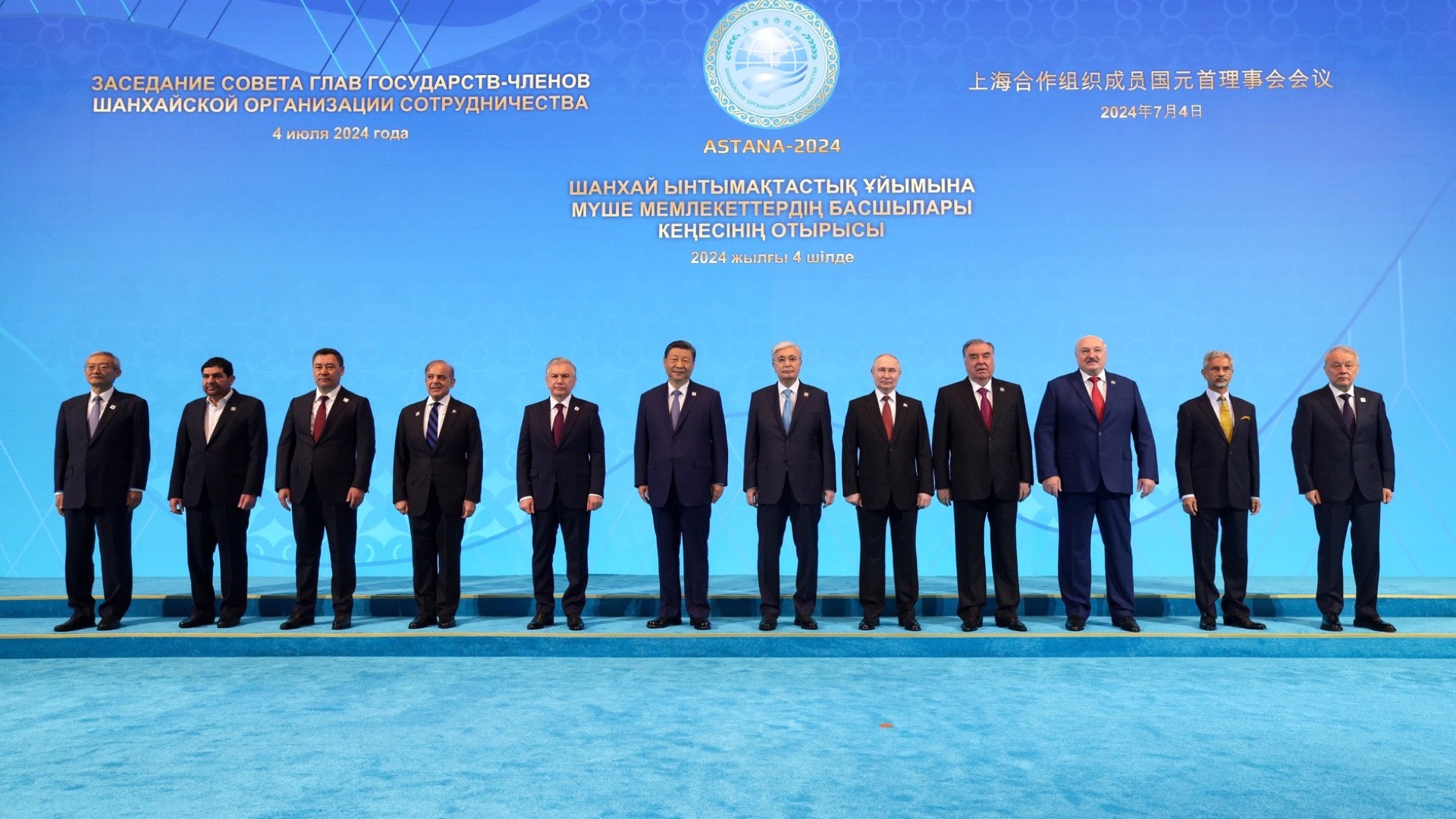
Featured photograph: Leaders at the 24th Shanghai Cooperation Organisation summit in Astana, Kazakhstan, on 4 July 2024. Photo by Kremlin.ru / Presidential Executive Office of Russia, CC BY 4.0.
References
- Acharya, A. (2018) Constructing global order: Agency and law in a changing world. Cambridge: Cambridge University Press.
- Alden, C. (2007) China in Africa. London: Zed Books.
- Alden, C. and Aran, A. (2017) Foreign policy analysis: New approaches. London: Routledge.
- Alden, C. and Large, D. (2019) New directions in Africa–China studies. London: Routledge.
- Banerjee, A. and Duflo, E. (2011) Poor economics: A radical rethinking of the way to fight global poverty. New York: PublicAffairs.
- Brautigam, D. (2009) The dragon’s gift: The real story of China in Africa. Oxford: Oxford University Press.
- Cooper, A.F. (2016) The BRICS: A very short introduction. Oxford: Oxford University Press.
- Deaton, A. (2013) The great escape: Health, wealth, and the origins of inequality. Princeton: Princeton University Press.
- European Commission (2019) EU-China: A strategic outlook. Brussels: European Commission.
- Godement, F. and Vasselier, A. (2017) China at the gates: A new power audit of EU-China relations. London: ECFR.
- Huntington, S. (1996) The clash of civilizations and the remaking of world order. New York: Simon & Schuster.
- Ikenberry, G.J. (2011) Liberal Leviathan: The origins, crisis, and transformation of the American world order. Princeton: Princeton University Press.
- Ikenberry, G.J. and Lim, D. (2017) ‘China’s emerging institutional statecraft’, Project on International Order and Strategy, Brookings Institution.
- Johns Hopkins SAIS-CARI (2023) Chinese loans to Africa database. Washington, DC: Johns Hopkins University.
- Khanna, P. (2019) The future is Asian. New York: Simon & Schuster.
- Krugman, P. (1991) Geography and trade. Cambridge, MA: MIT Press.
- Krugman, P. (1994) ‘The myth of Asia’s miracle’, Foreign Affairs, 73(6), pp. 62–78.
- Mahbubani, K. (2018) Has the West lost it? A restatement. London: Penguin.
- Mahbubani, K. (2020) Has China won? The Chinese challenge to American primacy. New York: PublicAffairs.
- Mearsheimer, J.J. (2019) ‘Bound to fail: The rise and fall of the liberal international order’, International Security, 43(4), pp. 7–50.
- Ndlovu-Gatsheni, S.J. (2013) Coloniality of power in postcolonial Africa. Dakar: CODESRIA.
- Spence, M. (2011) The next convergence: The future of economic growth in a multispeed world. New York: Farrar, Straus and Giroux.
- Stiglitz, J.E. (2002) Globalization and its discontents. New York: W.W. Norton.
- Stiglitz, J.E. (2019) People, power and profits: Progressive capitalism for an age of discontent. New York: W.W. Norton.
- Stiglitz, J. and Rashid, H. (2016) ‘The Asian Infrastructure Investment Bank’, Project Syndicate.
- Taylor, I. (2020) Africa: A modern history. London: Hurst Publishers.
- Tharoor, S. (2017) Inglorious empire: What the British did to India. London: Hurst.
- United Nations (2022) World population prospects 2022. New York: United Nations.
- White, H. (2012) The China choice: Why America should share power. Melbourne: Black Inc.
WARNING! All rights reserved. This material and all other digital content on this website may not be reproduced, published, broadcast, rewritten, or redistributed, in whole or in part, without the prior express permission of The Zambian Economist. Where permission is granted, the content must be clearly credited to “The Zambian Economist,” with “www.zambianeconomist.com” prominently displayed.
WhatsApp: +260775574228 | Email: info@zambianeconomist.com
© 2026 The Zambian Economist.
The featured photograph is available under the licence credited above.