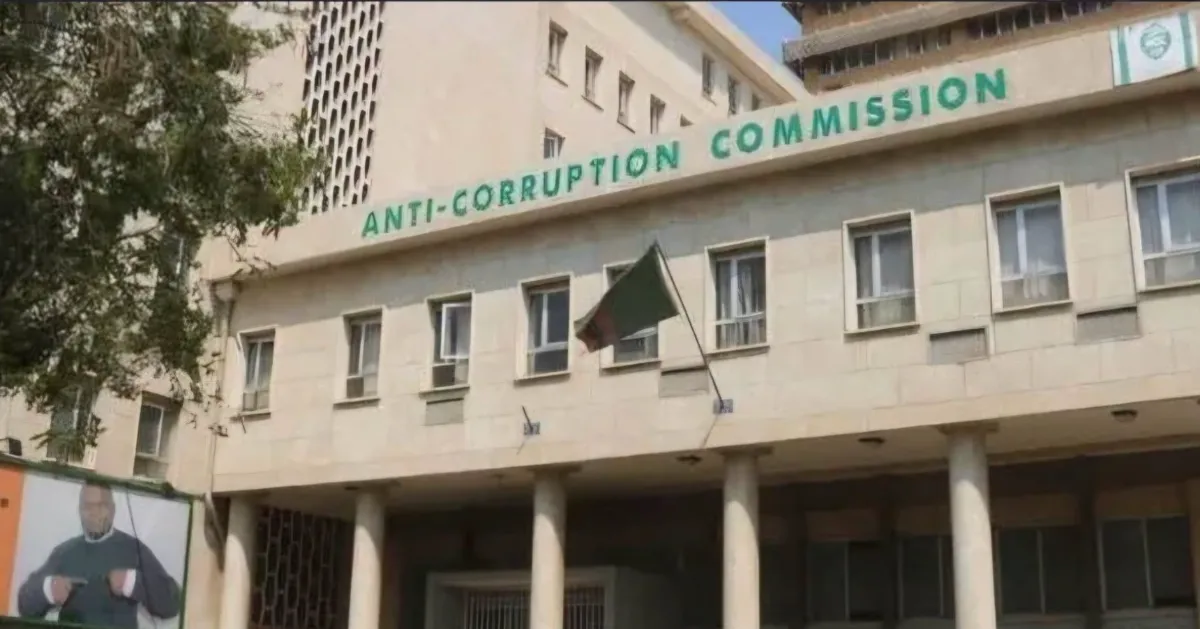
Fr. Titus Malama Sande of Lusaka Archdiocese faces four counts of possessing and concealing property suspected to be proceeds of crime, including two vehicles the ACC says were registered in his name on behalf of a former ministry official already charged in a K5.6 million case.
By The Zambian Economist Analyst
Key Takeaways
- The Anti-Corruption Commission has charged Fr. Titus Malama Sande, 45, a Catholic priest of Lusaka Archdiocese, with four counts of possession and concealment of property suspected to be proceeds of crime, worth a combined K1.5 million.
- The ACC alleges he held bonds worth K538,000 at a named bank and registered a Toyota Hilux and a Toyota Dyna, together worth about K1 million, in his name on behalf of Veronica Chisanga Kabwe, a former Ministry of Community Development officer.
- The charges arise under Section 71(1) of the Forfeiture of Proceeds of Crime Act No. 19 of 2010, covering conduct the ACC says occurred between January 2020 and December 2025.
- The case is linked to last month’s arrest of Kabwe and ZANIS senior news editor Chimangeni Banda over properties worth K5.6 million.
- Fr. Sande has been released on bond and is expected in court soon. All charges are allegations until a court determines otherwise.
What the ACC says happened
The Anti-Corruption Commission has arrested and charged Fr. Titus Malama Sande, 45, of 15 Miles in the Chikumbi area of Chibombo, with four counts of Possession and Concealment of Properties Reasonably Suspected of Being Proceeds of Crime, contrary to Section 71(1) of the Forfeiture of Proceeds of Crime Act No. 19 of 2010.
According to the particulars of the offences, between 1 January 2020 and 31 December 2025, in Lusaka District and jointly with other persons unknown, Fr. Sande allegedly possessed and concealed bonds valued at K538,000 held at a named bank. In the third and fourth counts, the Commission alleges he concealed two motor vehicles, a Toyota Hilux and a Toyota Dyna light truck with an estimated combined value of K1 million, by registering them in his name while they had in fact been acquired by Veronica Chisanga Kabwe.
The ACC says the properties are reasonably suspected of being proceeds of crime. Fr. Sande has been released on bond and is expected to appear in court soon.
The money trail the ACC outlines
| Property | Alleged value | Alleged holder | Alleged beneficial owner |
|---|---|---|---|
| Bank bonds (named bank) | K538,000 | Fr. Titus Sande | Persons unknown |
| Toyota Hilux | Part of K1,000,000 | Fr. Titus Sande (registered) | Veronica Chisanga Kabwe |
| Toyota Dyna light truck | Part of K1,000,000 | Fr. Titus Sande (registered) | Veronica Chisanga Kabwe |
| Total | K1,500,000 |
Connection to the K5.6 million case
The arrest is linked to the apprehension last month of Veronica Chisanga Kabwe, a former Executive Officer at the Ministry of Community Development and Social Services, and Chimangeni Banda, a Senior News Editor at the Zambia News and Information Services under the Ministry of Information and Media. The two were arrested for possession and concealment of properties worth K5.6 million.
If the ACC’s account holds in court, the priest’s role in the chain was registration: holding title to vehicles the Commission believes were bought by someone else. That is the mechanics the Forfeiture of Proceeds of Crime Act targets. Registering an asset in the name of a person who did not pay for it is one of the oldest concealment methods in money laundering, because it breaks the paper trail between dirty money and the asset it bought.
What the law actually provides
Section 71(1) of the Forfeiture of Proceeds of Crime Act No. 19 of 2010 criminalises possessing or concealing property one reasonably suspects to be proceeds of crime. Two things are worth noting for readers following the case.
First, the charge does not require the state to prove the underlying crime at this stage. The threshold is reasonable suspicion, which is why the Commission can bring counts covering conduct spread across six years, from 2020 to 2025, on dates unknown.
Second, conviction can trigger forfeiture of the properties themselves, not only a custodial sentence. For the families and congregations connected to this case, that means the K1.5 million in bonds and vehicles is itself at stake in court.
Why it matters for public finance
The origin of the alleged money sits in the K5.6 million case involving a former officer at the Ministry of Community Development and Social Services. That ministry administers social cash transfers and other welfare programmes meant for the poorest households in Zambia. Every kwacha allegedly diverted in schemes of this kind is a kwacha that did not reach a beneficiary household, and every concealment arrangement that succeeds makes the next one easier.
Zambia’s Auditor General reports have repeatedly flagged weaknesses in how ministries control disbursement and asset acquisition. Cases like this one are where those audit findings turn into criminal charges.
What happens next
Fr. Sande is expected in court soon. The ACC has urged the public to desist from corrupt practices and repeated that concealment of proceeds of crime will not be tolerated regardless of an individual’s position or status, and has encouraged members of the public to report suspected corruption to the Commission.
A charge is an accusation, not a conviction. The Constitution presumes Fr. Sande, Kabwe and Banda innocent unless the courts find otherwise, and The Zambian Economist will track the case as it proceeds.
Business and policy implications
- For banks: the case is a reminder that fixed-term deposits and bonds are on the ACC’s radar as concealment instruments, not only cash movements. Compliance teams will read the “named bank” detail closely.
- For vehicle dealers: the registration trail on the Hilux and Dyna will matter. Dealers and the Road Transport and Safety Agency records are often where concealment cases are proved or broken.
- For policymakers: the case strengthens the argument for a fully operational beneficial ownership register, so that assets registered in the name of a proxy can be flagged earlier than six years after the fact.
- For the Church: Lusaka Archdiocese will face questions about internal controls over clergy finances, and how it responds administratively will shape public trust as much as the court outcome.
WARNING! All rights reserved. This material and all other digital content on this website may not be reproduced, published, broadcast, rewritten, or redistributed, in whole or in part, without the prior express permission of The Zambian Economist. Where permission is granted, the content must be clearly credited to “The Zambian Economist,” with “www.zambianeconomist.com” prominently displayed.
WhatsApp: +260775574228 | Email: info@zambianeconomist.com © 2026 The Zambian Economist.