
Salaula is a Bemba word. It means to select from a pile by rummaging, and it is the only word in Zambian English that describes an entire industry, a shopping method and a wardrobe at the same time.
It is also the clearest case study Zambia has of a question the country keeps failing to answer: what happens when cheap imports serve consumers well and destroy producers at the same time?
How a shirt reaches Kamwala
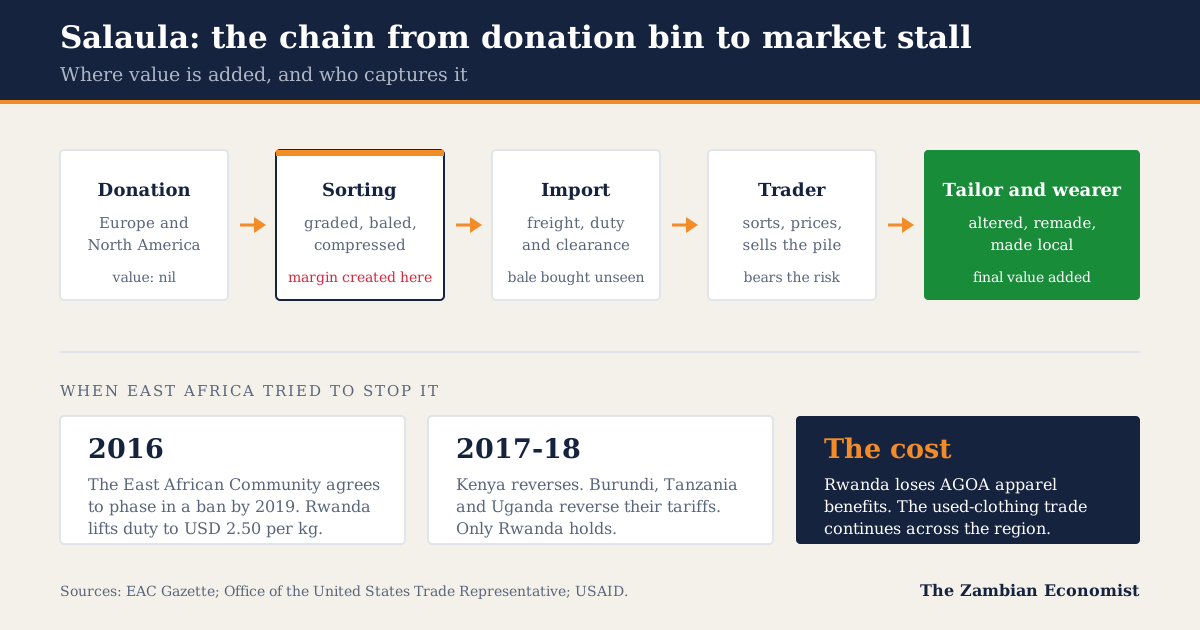
Someone in Manchester or Toronto puts a shirt in a charity bin. The charity keeps what it can sell locally and sells the rest by weight to a textile salvage firm. That firm does the work that actually creates the value: sorting by garment type, season and grade, then compressing the result into bales.
The bales are exported, cleared through customs, and sold to Zambian wholesalers. Traders buy a bale, usually without opening it, and take it to Soweto, Kamwala, Chisokone or a hundred smaller markets. There it is cut open and the rummaging that gives the trade its name begins.
Notice where the margin sits. The garment is worth nothing at donation. It becomes worth something at sorting, in Europe. The Zambian trader buys at the end of that chain and takes the inventory risk, because a bale is a gamble: the grade on the label is a promise, not a guarantee, and a bad bale can wipe out a month.
The last piece of value is added in Zambia, by tailors. Garments are shortened, taken in, recut and combined into something that reads as Zambian rather than as a hand-me-down. That work is real manufacturing, even though nobody counts it as such.
What the trade actually supports
The employment is spread thin and wide, which is precisely why it is easy to overlook in national statistics and impossible to miss in a market:
- Importers and wholesalers moving container volumes
- Transporters running bales from the border and between towns
- Market traders, overwhelmingly women, running stalls on working capital measured in a few thousand kwacha
- Tailors and menders who convert a bale garment into a fitted one
- Cleaners, pressers and the people who sell the plastic, hangers and stands around them
And on the consumption side, it clothes a large share of the country at prices that domestic manufacturing has never been able to match.
The charge against it
The standard argument is straightforward. Zambia once had a textile and garment industry. Cheap used imports arrived, undercut it, and it collapsed. Ban the imports and the industry can be rebuilt.
The trade is genuinely part of that story. But the sequence matters, and it is where the argument usually goes wrong.
Karen Tranberg Hansen’s study of the Zambian trade, still the definitive work on it, makes the awkward point that domestically produced cloth and garments were already expensive and of poor quality before salaula took hold. Used clothing did not create the gap between what Zambians could afford and what Zambian factories charged. It filled one that already existed.
That does not exonerate the trade. It does mean that removing it would not automatically produce a competitive industry, it would first produce more expensive clothes.
East Africa ran the experiment
This is not a hypothetical. In 2016 the East African Community agreed to phase in a total ban on used clothing and footwear imports by 2019, arguing it would build domestic garment manufacturing. Rwanda went furthest, raising duty from USD 0.20 to USD 2.50 per kilogram, with a stated goal of creating more than 25,000 garment jobs.
The scale being disrupted was substantial. A USAID study found that in 2015 the EAC accounted for close to 13 per cent of global used clothing imports, worth around USD 274 million, and that roughly 67 per cent of East Africans bought at least some of their clothing from used markets.
Then the retaliation came. A United States industry association petitioned the US Trade Representative, arguing the ban breached the conditions of the African Growth and Opportunity Act. Kenya reversed within a year, its AGOA exports were worth several hundred million dollars against Rwanda’s tens of millions, and the arithmetic was not close. Burundi, Tanzania and Uganda rolled their tariffs back in early 2018.
Rwanda held, and had its AGOA apparel benefits suspended. The used clothing trade continued across the region regardless.
The lesson is not that protection never works. It is that a trade measure aimed at one sector was answered in another, and the country that pressed hardest paid in exports it already had, for an industry it did not yet have.
What this means for the diversification argument
Zambia talks constantly about moving beyond copper. Textiles and garments come up in every version of that conversation, because the sector is labour-intensive, the entry barriers are lower than mining, and the jobs land where unemployment is worst.
Salaula is the test of whether that ambition is serious, because it forces the trade-off into the open. Protecting a domestic garment industry means making clothing more expensive for households who are already stretched, and disrupting the livelihoods of the traders and tailors who currently work in the trade. Those are real people with real income, not a statistical abstraction to be cleared away.
A serious industrial policy would have to answer three questions before touching the tariff:
- Can Zambian factories actually produce at competitive cost? That depends on power reliability, cotton supply, finance costs and freight, not on tariff policy. Our analysis of the power deficit and what it costs business covers one of those constraints.
- Where would the output be sold? Domestic demand alone will not support a garment sector at scale. That means regional and preferential market access, the subject of our work on repositioning Zambia in global trade.
- What happens to the people currently in the trade? A transition that does not answer this is not a policy, it is a shock.
The honest position
Salaula is not a symptom of national failure and it is not a development strategy. It is an efficient response to a real constraint: Zambians need affordable clothing, and domestic manufacturing has not been able to supply it.
The trade will shrink when local production becomes competitive, not before, and no tariff will reverse that order. The countries that tried to force it discovered as much, expensively and in public.
In the meantime, the industry deserves to be counted properly. It employs a great many Zambians, most of them women, most of them running a business on borrowed working capital with no formal record of it. If we want to know what a transition would cost, we first need to know how many people are in it, and that is a data question nobody has yet answered.
Primary sources: East African Community Gazette · Office of the United States Trade Representative · USAID · Karen Tranberg Hansen, Salaula: The World of Secondhand Clothing and Zambia · Zambia Statistics Agency trade statistics
Part of our Doing Business in Zambia series.