Key takeaways
- The Electoral Commission of Zambia (ECZ) declared Hakainde Hichilema winner of the 2026 presidential election early on 18 August, with more than 2.9 million valid votes, over 50% of the total, avoiding a run-off.
- With 192 of 226 constituencies declared, Hichilema of the UPND had polled 2,430,702 votes against 1,461,457 for NRPUP’s Brian Mundubile, a lead of 969,245.
- ECZ chairperson Mwangala Zaloumis said the outstanding constituencies would not change the outcome.
- The result gives Hichilema a second term to continue the fiscal reforms that helped stabilise the kwacha after the 2020 debt default, alongside free education and bursary programmes.
- Mundubile’s NRPUP has alleged irregularities in the count, and international observers flagged an uneven campaign field, questions the ECZ says the results do not change.
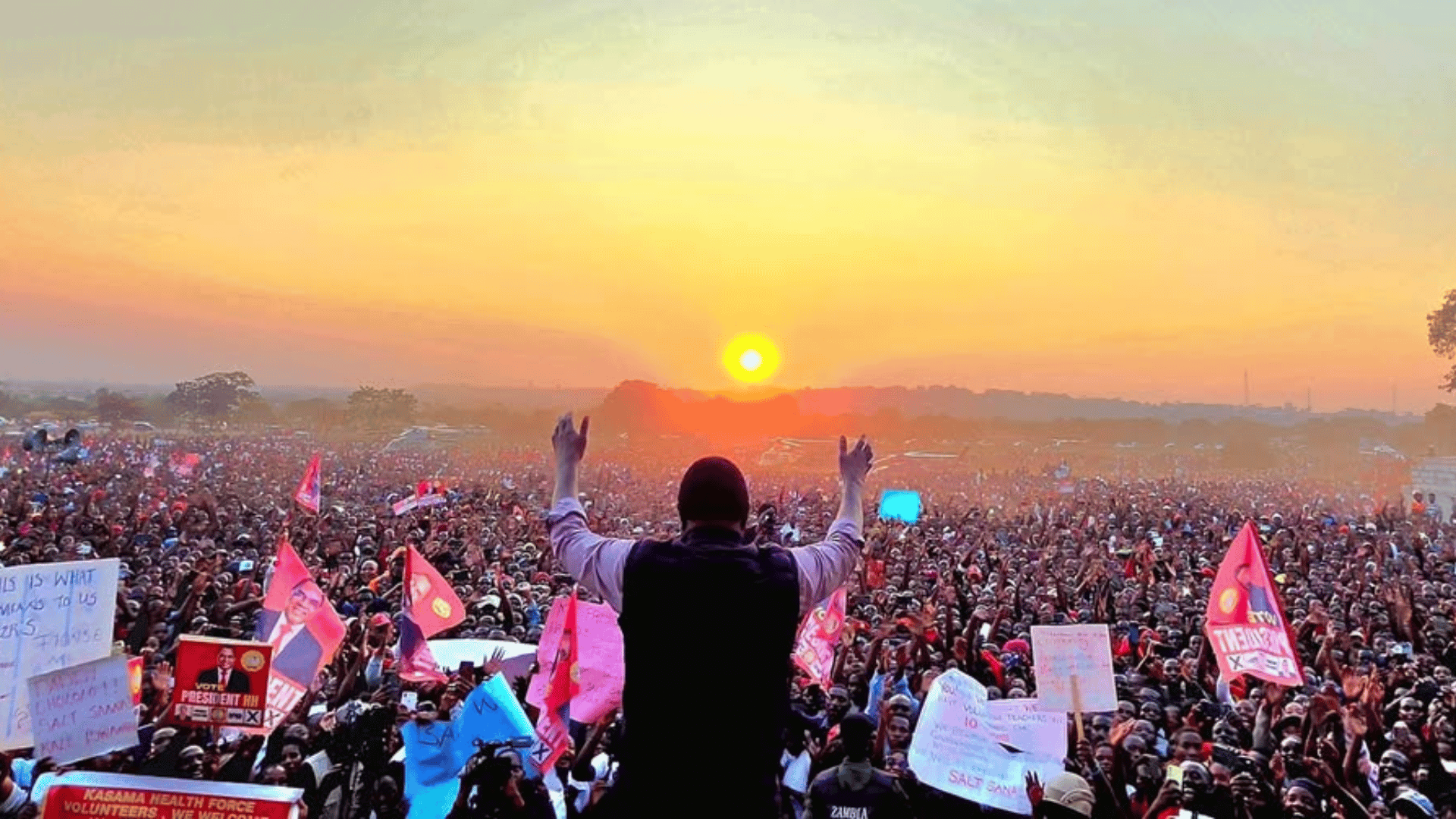
Zambia’s incumbent president, Hakainde Hichilema, has won re-election outright. The Electoral Commission of Zambia (ECZ) declared the result early on Tuesday, saying the United Party for National Development (UPND) leader had passed 2.9 million valid votes, more than 50% of the national total, meeting the constitutional bar for a first-round win.
ECZ chairperson Mwangala Zaloumis announced the outcome at the National Election Results Centre in Lusaka, more than four days after polls closed on 13 August. A handful of constituencies had yet to report at the time of the declaration, the commission said, but their results would not change who holds State House for the next five years.
How the count unfolded
The margin was already decisive before the formal declaration. With 192 of the country’s 226 constituencies announced on Monday, Hichilema had polled 2,430,702 votes against 1,461,457 for his closest rival, Brian Mundubile of the National Reconciliation Party for Unity and Prosperity (NRPUP), a lead of 969,245 votes.
| Candidate | Party | Votes (192 of 226 constituencies) | Share |
|---|---|---|---|
| Hakainde Hichilema | UPND | 2,430,702 | 62.4% |
| Brian Mundubile | NRPUP | 1,461,457 | 37.6%* |
Hichilema built his lead on commanding margins in Southern, Western and North-Western provinces, including a near sweep of his home turf in the south, while Mundubile ran strongest on the Copperbelt and in Muchinga and parts of Eastern Province. Turnout across the declared constituencies stood at roughly 57.8%, below the near 70% recorded in the 2021 election.
Counting was briefly suspended on 14 August after reports of violence against polling staff and theft of marked ballots at some stations, before resuming under tighter security. The delay stretched the tally beyond the pace of the 2021 count, when Hichilema’s win over then-president Edgar Lungu was confirmed within two days.
A contested backdrop
Mundubile’s campaign has disputed the trajectory of the count, citing its own parallel vote tabulation and alleging irregularities, including claims that military personnel controlled tallying centres in Mufulira and that result forms went missing in parts of North-Western Province. The ECZ has not upheld these claims and says the declared result stands.
International observer missions covering the poll flagged concerns about the fairness of the campaign environment ahead of the vote, including unequal access to state resources and media. Those concerns have not been shown to affect the vote count itself, and the ECZ says the outstanding constituencies will not alter the outcome.
Economic backdrop to a second term
Hichilema, 64, takes his second mandate on the back of a difficult but improving economic record. He inherited an economy in default in 2021, after Zambia became the first African country to miss Eurobond payments during the pandemic, and has since pushed through a debt restructuring under the G20 Common Framework alongside fiscal consolidation that helped the kwacha rank among the world’s better-performing currencies over the past two years.
His government has paired that consolidation with expanded social spending, introducing free basic education, wider bursaries and funding for tertiary and vocational training, and steadier support for elderly welfare programmes. Hichilema, among Zambia’s wealthiest individuals, has not drawn a presidential salary since taking office in 2021 and has continued to use his family home rather than State House as his residence.
Business implications
- Policy continuity: a second Hichilema term signals continuity on the mining fiscal regime, debt management and the IMF-backed reform programme, reducing near-term policy risk for investors already committed to Zambia.
- Currency and rates: continued fiscal discipline supports the case for a stable kwacha, though markets will watch the Bank of Zambia’s next moves on interest rates and inflation once the political transition settles.
- Mining and energy: expect continuity in copper sector policy, with implications for mining investment plans and power sector reforms tied to the country’s electricity deficit.
Investor implications
- Sovereign risk: a clear, uncontested constitutional outcome, once the outstanding constituencies are confirmed, is generally supportive of Zambia’s Eurobond spreads and its standing with the IMF programme.
- Watch points: how the government responds to opposition allegations of irregularities, and whether observer concerns about the campaign period feed into longer-term governance ratings.
Public and policy implications
- A second term extends the government’s runway to deliver on free education and bursary commitments at scale, with implementation and funding questions likely to dominate early post-election scrutiny.
- Pressure will build on the government to address the cost of living and the power deficit that shaped much of the campaign, alongside its debt restructuring commitments.
What happens next
The ECZ said it would complete tallying and verification of the outstanding constituencies in the coming days, with the formal gazetting of results and presidential inauguration arrangements to follow the standard constitutional timetable. The Zambian Economist will update this article as the commission confirms the remaining results.
Conclusion
Hichilema’s win extends a reform mandate built on debt restructuring and currency stability into a second term, against a backdrop of opposition allegations and observer concerns about the fairness of the campaign. For businesses and investors, the immediate signal is continuity; the harder test will be whether that continuity translates into faster progress on the cost of living, power supply and job creation that dominated the 2026 campaign.
Related coverage
- Zambia’s Election Count Signals a Strong Mandate…..But the Economic Test Comes After
- Zambia Holds Its Breath: What the Wait for a Presidential Declaration Means for Business
- HH Widens Gap to 225,971 Votes as ECZ Confirms 105 Constituencies
- Zambia Arrests Suspected Militia Members in Kabulonga Raid, Presidential Candidate Mundubile Named at Scene
WARNING! All rights reserved. This material and all other digital content on this website may not be reproduced, published, broadcast, rewritten, or redistributed, in whole or in part, without the prior express permission of The Zambian Economist. Where permission is granted, the content must be clearly credited to “The Zambian Economist,” with “www.zambianeconomist.com” prominently displayed.
WhatsApp: +260775574228 | Email: info@zambianeconomist.com
© 2026 The Zambian Economist.
Work With The Zambian Economist
Related: Mwandi MP-Elect Iris Kaingu Congratulates Hichilema on Re-Election