
The Economics Association of Zambia has taken its partnership drive from government to the banking sector. Its new leadership met FNB Zambia’s economics team on Monday to seek support for November’s Post-Budget Analysis Dinner and to propose a formal memorandum of understanding.
Photos: Economics Association of Zambia (EAZ)
KEY TAKEAWAYS
- An EAZ delegation led by President Dr Edna Kabala-Litana met FNB Zambia’s team, led by Country Economist Mr Chileshe Moono, as part of the new National Executive Committee’s stakeholder engagements.
- Discussions covered FNB’s support for the EAZ Post-Budget Analysis Dinner scheduled for November.
- EAZ wants the relationship formalised through a memorandum of understanding (MoU) covering economic literacy, financial inclusion, research and professional development.
- FNB said it was open to engagement beyond corporate membership, and both sides noted room to work together on FNB’s Quarterly SME Conferences and budget events.
- The meeting follows EAZ courtesy calls on the Ministry of Finance and the Bank of Zambia, as the association builds a wider support base for its programmes.
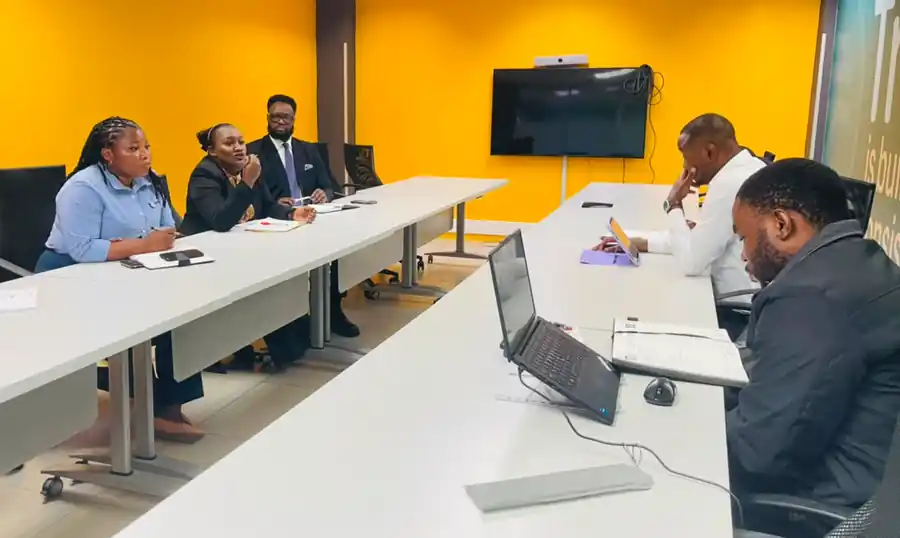
The Economics Association of Zambia (EAZ) met FNB Zambia in Lusaka on Monday afternoon to explore a partnership that would bring the bank’s research and financial literacy work closer to the association’s public programmes. It is the latest in a series of engagements by EAZ’s new National Executive Committee, elected in September, as it introduces itself to institutions it hopes will back its plans.
The EAZ delegation was led by President Dr Edna Kabala-Litana, with National Secretary Dr John Musantu, Deputy National Secretary Ms Betty Lwando and Secretariat officer Ms Tendai Posiana. FNB Zambia was represented by Country Economist Mr Chileshe Moono, Dealer Ms Matilda Chakulimba and Macro Analyst Mr Erick Mwiinga.
The Post-Budget Dinner comes first
The most immediate item on the table was FNB’s support for the EAZ Post-Budget Analysis Dinner in November. The dinner is the association’s main platform for unpacking the national budget with economists, business leaders and policymakers after the Finance Minister’s address. This year’s event will carry extra weight. The 2027 budget is the first of President Hakainde Hichilema’s second term, and Cabinet has already set its priorities around growth, jobs and tax compliance, as we reported last month.
Events of this kind depend on sponsors. A bank with its own macro research desk is a natural fit, because it brings both funding and analysts who already track the numbers the dinner will debate.
What EAZ is asking for
Dr Kabala-Litana told the FNB team that EAZ is looking for strong partnerships with institutions such as FNB as it prepares to roll out Economic Fairs, Public Discussion Forums and a Mentorship Programme. She said FNB’s work in financial literacy, financial inclusion, internships, research-based advocacy and professional development fits EAZ’s objectives and the wider Grow Zambia Agenda.
She also proposed that the two institutions sign an MoU to put long-term cooperation on a formal footing. EAZ has made the same request elsewhere. It asked the Ministry of Finance and National Planning for a formal partnership during a courtesy call on Minister Situmbeko Musokotwane last month, and pledged closer research and policy ties with the central bank during a visit to the Bank of Zambia last week.

FNB’s response
Mr Moono welcomed deeper engagement with EAZ beyond the bank’s corporate membership. He expressed support for joint work on the Post-Budget Analysis Programme, research and knowledge-sharing platforms. The meeting also identified openings for EAZ to take part in FNB’s Quarterly SME Conferences, its budget events and other economic dialogue platforms the bank runs.
Why it matters
Professional associations in Zambia often struggle to fund public education work from membership fees alone. Linking EAZ’s forums to a bank’s existing SME and budget events could give economists a wider audience, while giving FNB access to an independent network of researchers and commentators.
The financial inclusion angle is concrete. Many small businesses still struggle to access affordable credit, a gap we examined in The SME Credit Gap. Economic literacy programmes that explain how loans, interest rates and the budget affect households and firms are one practical way to close part of that gap.
For EAZ, the engagements are also a test of the new leadership. Dr Kabala-Litana was elected after a close vote in Livingstone in September, and the first months will show whether the association can turn courtesy calls into signed agreements and funded programmes.
What to watch
- Whether EAZ and FNB sign an MoU, and what commitments it contains on research, internships and financial literacy.
- Confirmation of sponsors and the date for the November Post-Budget Analysis Dinner.
- The launch dates for EAZ’s Economic Fairs, Public Discussion Forums and Mentorship Programme.
- Further meetings with commercial banks, insurers and other private sector bodies.
Are you an economist or business leader with a view on the 2027 budget? Submit an analysis or partner with The Zambian Economist on budget coverage.
Related: EAZ Seeks Formal Partnership With Finance Ministry as Musokotwane Calls for Practical Policy Ideas.
WARNING! All rights reserved. This material and all other digital content on this website may not be reproduced, published, broadcast, rewritten, or redistributed, in whole or in part, without the prior express permission of The Zambian Economist. Where permission is granted, the content must be clearly credited to “The Zambian Economist,” with “www.zambianeconomist.com” prominently displayed.
WhatsApp: +260775574228 | Email: info@zambianeconomist.com
© 2026 The Zambian Economist.