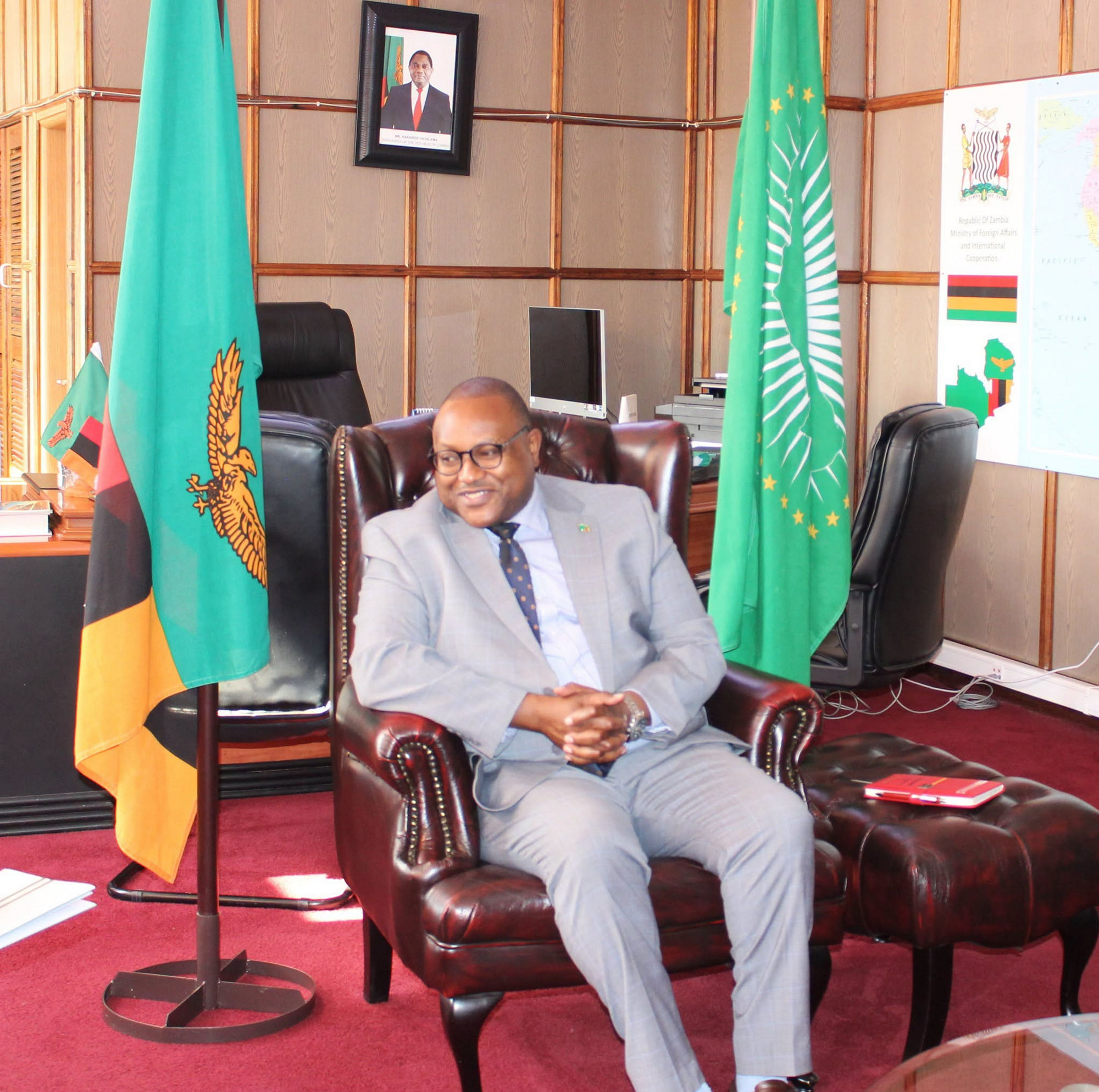
Foreign Affairs Minister Hon. Mulambo Haimbe S.C., M.P. The Ministry has issued a formal response to the European Parliament’s resolution on Zambia’s post-election situation. Photo: supplied.
KEY TAKEAWAYS
- Zambia’s government has formally answered the European Parliament resolution of 17 September 2026, which passed by 562 votes to one with 33 abstentions.
- The statement, signed by Foreign Affairs Minister Hon. Mulambo Haimbe S.C., regrets the death of Mutotwe Kafwaya and says the Zambia Police Service is investigating, with oversight by the Zambia Human Rights Commission.
- Government rejects the resolution’s framing as interference in Zambia’s internal affairs and defends its laws on the use of force, which it says are subject to necessity and proportionality.
- The economic stakes are real: Zambia exports to the EU duty-free under the Everything But Arms scheme, and a prolonged diplomatic rift could touch trade, aid flows and investor sentiment.
- Lusaka has invited the EU to engage on verified facts through established diplomatic channels rather than through public censure.
Zambia has rejected the European Parliament’s condemnation of its post-election record and invited the European Union to raise its concerns through diplomatic channels on the basis of verified facts. In a press statement signed by Foreign Affairs and International Cooperation Minister Hon. Mulambo Haimbe S.C., M.P., the government says the death of opposition figure Mutotwe Kafwaya on 14 August 2026 remains under active investigation by the Zambia Police Service, with independent oversight by the Zambia Human Rights Commission.
The response, issued for immediate release, is the government’s first formal answer to a resolution that has dominated Zambian political conversation since Thursday. Its tone is firm but measured: regrets are expressed, investigations are cited, and the door to dialogue is left open.
What the European Parliament said
On 17 September, the European Parliament adopted a resolution titled Post-electoral repression in Zambia and the killing of Mutotwe Kafwaya, passed by 562 votes to one with 33 abstentions. MEPs condemned the killing of the former minister, demanded independent investigations into his death and into allegations of arbitrary arrests, and called on Zambian authorities to respect fundamental rights and afford due process to all detainees.
The vote followed an election month that drew close international attention. The EU Election Observation Mission reported that the Electoral Commission of Zambia suspended the counting and announcement of results on 14 August, the day after polls closed, and observers pointed to biased media coverage and a controversial cyber law among the campaign’s weaknesses. President Hakainde Hichilema’s re-election nonetheless drew congratulations from 31 countries and five global institutions.
What the government’s response says
The Ministry’s statement makes four main moves. It expresses regret over the loss of life and says the circumstances of Kafwaya’s death on 14 August are under active police investigation, with the Zambia Human Rights Commission providing independent oversight. It says the bereaved family has been offered support.
It then turns to law. The government clarifies that the Constitution and laws of Zambia recognise circumstances in which law enforcement officers may use force in the execution of lawful duties, but only subject to legal safeguards and the principles of necessity and proportionality.
On the resolution itself, the government objects to what it sees as judgement delivered before the investigations have concluded, and pushes back against public censure as a breach of diplomatic practice. It closes by reaffirming Zambia’s commitment to transparent investigations, the rule of law and democratic institutions, and invites the EU to engage on the basis of verified facts, mutual respect and established diplomatic channels.
| European Parliament resolution | Government response |
|---|---|
| Condemns the killing of Mutotwe Kafwaya and post-election repression | Regrets the loss of life; death under active police investigation with oversight by the Zambia Human Rights Commission |
| Demands independent, impartial investigations | Points to domestic processes already under way and rejects pre-judgement of their outcome |
| Calls for due process and respect for fundamental rights | Says use of force is lawful only under necessity and proportionality safeguards |
| Public censure in a plenary resolution | Invites the EU to engage on verified facts through established diplomatic channels |
Why this matters for trade and investment
European Parliament resolutions are not binding on member states, but they shape the political weather in Brussels, and the weather matters for an economy still rebuilding its standing with creditors and investors after the 2020 default.
Zambia sends the bulk of its exports to the EU duty-free and quota-free under the Everything But Arms scheme, and those exports are dominated by copper. The EU is also a major source of development finance and budget support, and Zambia’s current IMF programme depends partly on continued goodwill from international partners. A resolution adopted by 562 votes to one signals that goodwill is no longer automatic.
The more immediate channel is sentiment. Portfolio investors and mining houses price political risk into every decision, and headlines pairing Zambia with the words “repression” and “killing” raise the risk premium on Zambian debt and on new projects, whatever the facts of the case turn out to be. The government’s decision to answer in writing, cite institutions by name and keep the diplomatic door open is partly aimed at that audience.
What happens next
Three things will decide whether this episode cools or escalates. The first is the police investigation into Kafwaya’s death, and whether the Zambia Human Rights Commission’s oversight produces findings the public and Zambia’s partners accept as independent. The second is the treatment of detainees and opposition figures in the coming weeks, which the resolution specifically flags. The third is whether Brussels follows words with any review of funding or partnership arrangements, something the resolution’s supporters have floated and the government is keen to pre-empt.
For now, both sides have kept the language of engagement alive. The government’s closing line, that Zambia remains committed to the rule of law and invites the EU to engage on verified facts, leaves room for the quiet diplomacy that both parties still claim to prefer.
What this means for you
For businesses: no immediate change, but firms trading with Europe should watch for any EU review of partnership arrangements. Anything that raises Zambia’s political risk premium eventually feeds into the cost of credit and the kwacha.
For investors: the investigation’s credibility is the thing to track. A process seen as independent, with the Human Rights Commission’s oversight, limits the damage. A process seen as compromised would reopen questions that Zambia worked hard to close after debt restructuring.
For policymakers: the response shows the government betting on institutions rather than denials. That bet only pays if the investigations are seen through to a public conclusion.
WARNING! All rights reserved. This material and all other digital content on this website may not be reproduced, published, broadcast, rewritten, or redistributed, in whole or in part, without the prior express permission of The Zambian Economist. Where permission is granted, the content must be clearly credited to “The Zambian Economist,” with “www.zambianeconomist.com” prominently displayed.
WhatsApp: +260775574228 | Email: info@zambianeconomist.com © 2026 The Zambian Economist.
Work With The Zambian Economist: Advertise With Us | List With Us | Submit an Article