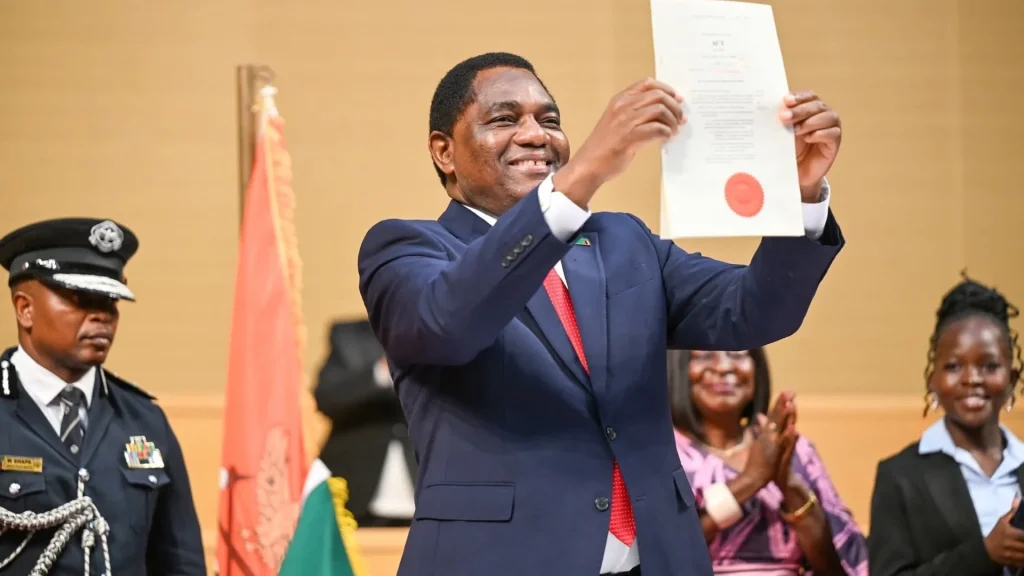
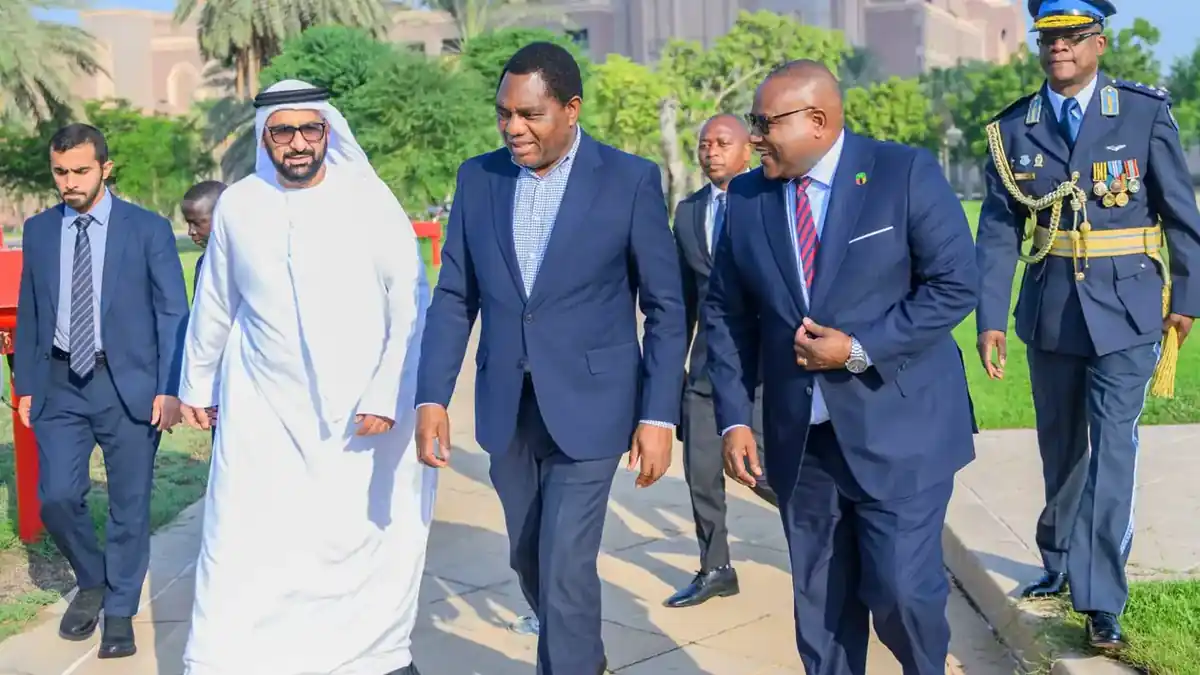
President Hakainde Hichilema has arrived in the United Arab Emirates for a two-day working visit built around investment, a bilateral meeting with Sheikh Mohamed bin Zayed Al Nahyan and talks on a trade agreement the two governments discussed concluding in February.
KEY TAKEAWAYS
- President Hichilema arrived in Abu Dhabi on Monday, 28 September, for a working visit scheduled for 29 and 30 September at the invitation of UAE President Sheikh Mohamed bin Zayed Al Nahyan.
- The programme includes an official bilateral meeting, the signing of memoranda of understanding, a Zambia-UAE Business and Investment Forum and a meeting with Zambians living in the UAE.
- Non-oil trade between the two countries reached US$3.4 billion in 2025, up 64.5% on 2024, according to the UAE news agency WAM.
- Talks on a Comprehensive Economic Partnership Agreement (CEPA), which would cut barriers to goods, services and investment, are on the agenda.
- Abu Dhabi’s largest existing stake in Zambia is International Resources Holding’s 51% share of Mopani Copper Mines, acquired in 2024 for US$1.1 billion.
President Hakainde Hichilema arrived in Abu Dhabi on Monday to begin a two-day working visit to the United Arab Emirates, his government’s latest attempt to turn a fast-growing trade relationship with the Gulf state into new capital for mining, energy, agriculture and infrastructure.
“Strong international partnerships and more inward investment are crucial to our Grow Zambia agenda,” the President said in a statement on arrival, thanking citizens for their “continued support and prayers”.
What is on the agenda in Abu Dhabi?
The visit follows an invitation from Sheikh Mohamed bin Zayed Al Nahyan, President of the UAE and Ruler of Abu Dhabi. According to the Ministry of Foreign Affairs and International Cooperation, the two leaders will hold an official bilateral meeting, and both governments expect to sign memoranda of understanding and review commitments made in earlier engagements.
President Hichilema will also address a Zambia-UAE Business and Investment Forum, meet UAE business leaders and hold talks with Zambians living in the Emirates. The priority sectors listed by government are mining and mineral value addition, agriculture, energy, infrastructure, transport and logistics, tourism and healthcare.
Announcing the trip, Dr Situmbeko Musokotwane, who was acting as Minister of Foreign Affairs and International Cooperation, said the engagements “are expected to help translate existing bilateral commitments into tangible investments, partnerships and development outcomes”.
A trade relationship that has grown quickly
The numbers explain why Lusaka is paying attention. Non-oil trade between Zambia and the UAE reached US$3.4 billion in 2025, a 64.5% rise on the previous year, according to figures carried by WAM when UAE Minister of Foreign Trade Dr Thani bin Ahmed Al Zeyoudi visited Lusaka in February 2026. During that visit he met President Hichilema and several cabinet ministers, and both sides discussed concluding a CEPA.
Diplomatic ties have deepened alongside the trade. Zambia opened an embassy in Abu Dhabi in 2023, and the UAE deployed its first resident ambassador to Zambia this month.
| Milestone | Date |
|---|---|
| Zambia opens embassy in Abu Dhabi | 2023 |
| IRH takes 51% of Mopani Copper Mines (US$1.1 billion) | 2024 |
| Non-oil trade hits US$3.4 billion, up 64.5% | 2025 |
| UAE trade minister visits Lusaka, CEPA talks advance | February 2026 |
| First resident UAE ambassador to Zambia | September 2026 |
| Presidential working visit to Abu Dhabi | 29 to 30 September 2026 |
Mopani is the test case
The clearest example of Emirati capital in Zambia is on the Copperbelt. Abu Dhabi-based International Resources Holding (IRH) completed its purchase of a 51% stake in Mopani Copper Mines in 2024, a deal valued at US$1.1 billion, with ZCCM Investments Holdings retaining the balance.
IRH reported in July 2025 that contained copper output in the first half of that year was 54% higher than a year earlier, that the mine employed more than 13,000 people, and that it was targeting 300,000 tonnes of copper a year by 2029. These are company figures and have not been independently audited, but they give government a reference point when it pitches further Gulf investment in mining. How Mopani performs against that 2029 target will shape how other investors read the Zambian mining sector.
What is a CEPA, and what could it mean for Zambia?
A Comprehensive Economic Partnership Agreement is the UAE’s standard trade deal. It typically lowers or removes tariffs on goods, opens up trade in services and sets rules to protect and encourage investment. The UAE had concluded 37 such agreements by July 2026 and was negotiating with about 20 more countries, according to Dr Al Zeyoudi.
For Zambia, a CEPA could give exporters of agricultural produce, processed food and minerals easier access to a Gulf market that also serves as a re-export hub for the Middle East and Asia. It could also give Emirati investors firmer legal protection, which tends to lower the cost of financing large projects. The terms will matter. Zambian negotiators will need to weigh investor protections against the state’s room to set mining tax and local content policy, a question that has come up repeatedly in the mining sector.
What should businesses and investors watch?
- The MoUs. Memoranda of understanding are statements of intent, not investment. The useful detail is which sectors they cover, which companies sign them and whether they carry values and timelines.
- Energy. With Zambia still short of power after the drought years, any commitment on solar or grid investment would matter for manufacturers and small businesses that have run on generators.
- Agriculture and logistics. Export routes and cold chain investment would determine whether Zambian farm produce can reach Gulf buyers at a competitive price.
- The CEPA timetable. A signed agreement, or a firm date for one, would be the most concrete outcome of the visit.
Why does this matter to ordinary Zambians?
Inward investment is how the Grow Zambia agenda expects to create jobs beyond the public payroll. Finance Minister Dr Musokotwane has said that 300,000 to 400,000 young Zambians enter the labour market each year. Foreign capital in mines, farms and power plants is one of the few sources large enough to absorb a meaningful share of them, provided the deals signed in Abu Dhabi turn into projects on the ground.
The Zambian Economist will report on the agreements and figures announced once the visit concludes on Wednesday.
Related reading: Economic Diplomacy and Zambia in the Global Economy, Musokotwane Pivots Zambia Toward Export-Led Growth as Jobs and Investment Take Centre Stage, Zambia After the Oath: The Economic and Diplomatic Tests of Hichilema’s Second Term and Zambia Makes Its Investment Pitch to South African Business Leaders.
Also on Grow Zambia: Grow Zambia Targets Offer Real Opportunities, Says Haabazoka and From Aid to Enterprise: The Zambia-Finland Partnership Enters Its Investment Years.
Is your business looking at the Gulf market? List it in the Zambian Economist Business Directory or submit an analysis.
WARNING! All rights reserved. This material and all other digital content on this website may not be reproduced, published, broadcast, rewritten, or redistributed, in whole or in part, without the prior express permission of The Zambian Economist. Where permission is granted, the content must be clearly credited to “The Zambian Economist,” with “www.zambianeconomist.com” prominently displayed.
WhatsApp: +260775574228 | Email: info@zambianeconomist.com
© 2026 The Zambian Economist.