
Every five years Zambians are offered two things at once: a vision and a bill. The vision is loud. The bill arrives quietly, usually eighteen months later, in the form of a supplementary budget, a domestic borrowing plan, or a queue of unpaid suppliers.
With 14 presidential candidates cleared by the Electoral Commission of Zambia for the 13 August poll, and manifestos now in public circulation, the useful question is not which promises sound best. It is which promises the Zambian Treasury can actually finance without undoing what took four painful years to rebuild.
This analysis does not grade parties. It sets out the arithmetic any voter, investor, or civil servant can apply to any manifesto.
Why manifesto arithmetic matters more in 2026 than in 2021
In 2021, Zambia campaigned from a position of distress. The country had defaulted on its Eurobonds in November 2020, inflation was in double digits, and the kwacha was under sustained pressure. Almost any promise was cheap to make, because the fiscal position was already broken.
2026 is different, and the difference is the whole story.
Zambia enters this election having completed a 38-month Extended Credit Facility with the International Monetary Fund in January 2026, drawing roughly US$1.7 billion in total. Debt restructuring agreements now cover approximately 94 percent of the restructuring perimeter, according to the IMF staff mission that visited Lusaka between 30 April and 13 May 2026. Gross international reserves stood at about US$6.4 billion, equivalent to 4.4 months of import cover. S&P Global Ratings has moved Zambia’s long-term foreign currency rating out of selective default to CCC+.
Inflation, which stood at 11.2 percent in December 2025, fell to 6.5 percent by June 2026, inside the Bank of Zambia’s 6-8 percent target band. The Monetary Policy Committee has cut the Policy Rate three consecutive times, most recently by 25 basis points to 13.25 percent in May 2026.
In other words, Zambia now has something to lose. A promise that would have been merely optimistic in 2021 is, in 2026, a decision to spend a hard-won stabilisation.
The starting position: what the 2026 Budget already commits
Before any new promise is priced, it helps to know what is already spoken for.
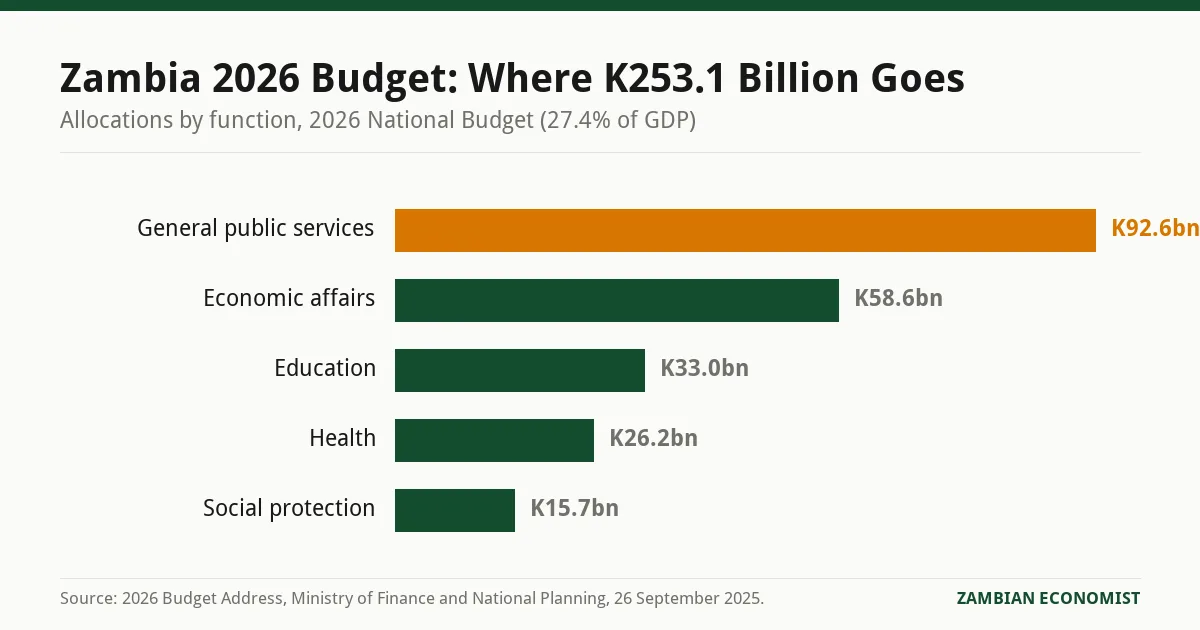
| 2026 National Budget | Amount | Share |
|---|---|---|
| Total expenditure | K253.1 billion | 27.4% of GDP |
| Domestic revenue | K206.5 billion | 81.6% of budget |
| Grants | K12.1 billion | 4.8% |
| Borrowing | K34.5 billion | 13.6% |
| General public services (incl. debt service) | K92.6 billion | 36.6% |
| Economic affairs | K58.6 billion | 23.2% |
| Education | K33.0 billion | 13.0% |
| Health | K26.2 billion | 10.4% |
| Social protection | K15.7 billion | 6.2% |
Two numbers in that table do the heavy lifting.
The first is K92.6 billion for general public services, the single largest line, dominated by debt service and the public administration machine. This is not discretionary. It is the cost of yesterday’s decisions.
The second is K206.5 billion in domestic revenue. That is the real constraint. Everything a government wishes to do beyond this figure must come from grants, which are limited and donor-determined, or borrowing, which is repayable and increasingly domestic.
Zambia’s 2025-2027 Medium-Term Debt Strategy targets a financing mix of 30 percent external and 70 percent domestic borrowing, a deliberate shift toward the local market. That shift matters enormously for manifesto costing, because domestic borrowing competes directly with private sector credit. When the Treasury absorbs the savings pool, the Lusaka hardware supplier and the Kabwe agro-processor pay for it in interest rates.
The fiscal space question: how much room actually exists?
Fiscal space is one of those terms that sounds technical and is actually simple. It is the difference between what a government collects and what it has already promised, the room left for new choices.
Zambia’s room is narrower than the headline growth figures suggest.
The IMF’s May 2026 assessment projected the primary fiscal surplus falling to 1.1 percent of GDP in 2026, down from 3.1 percent achieved in 2025, and well below the 3.8 percent that had been projected at the time of the sixth ECF review. The Fund attributed the deterioration to four causes: weaker tax revenues, the suspension of fuel VAT and excise duties, pre-election spending pressures, and a civil service wage adjustment.
That is a two-percentage-point swing in a single year. Expressed against a budget of K253.1 billion, roughly two points of GDP is the difference between financing and not financing an entire ministry.
The evidence of that pressure is already on record. In May 2026 the Minister of Finance and National Planning tabled Supplementary Estimates of K26.3 billion, of which K7.4 billion went to the Ministry of Agriculture. The financing plan was instructive: K2.1 billion from cooperating partners, K1.4 billion from unprojected domestic revenue, and K10 billion from expenditure rationalisation within the approved budget. In plain terms, most of the money was found by moving it, not by earning it.
Working conclusion: Zambia’s genuine new fiscal space for 2026-2027 is measured in low single-digit billions of kwacha per year, not tens of billions, unless revenue rises structurally or existing spending is cut.
What the manifestos are offering
Both major offerings are ambitious, and both are ambitious in ways that require capital Zambia does not currently hold.
The UPND manifesto, launched on 11 June 2026 at Mulungushi International Conference Centre, is structured around five pillars, growing the economy, connecting the nation, serving the people, building a delivery-oriented public sector, and financing the future. At its centre are seven goals the party projects will generate roughly US$65 billion in annual economic value: ten gigawatts of power generation, ten million tonnes of maize, five million tourist arrivals, three million tonnes of copper, three million tonnes of soya, one million tonnes of wheat, and one billion dollars in beef exports, together expected to create over two million jobs. The framing is continuity: the foundations are laid, the benefits now spread.
The Tonse Alliance manifesto, under Brian Mundubile, is the more interventionist document. Its headline commitment is more than one million additional formal jobs, lifting formal employment from approximately 1.18 million to 2.5 million. It proposes mobilising US$12 billion to close the electricity deficit, local processing of copper, cobalt and lithium before export, formalisation of artisanal and small-scale mining, replacement of provincial administration with Regional Development Authorities, and digitisation of more than 90 percent of government services. Campaign commitments have also included the cancellation of student loans.
Other candidates have advanced comparable pledges on employment, agriculture and the cost of living.
Where the promises overlap
Strikingly, the two documents converge on diagnosis. Both identify the same constraints: electricity, jobs, agricultural productivity, and the fact that Zambia exports raw minerals and imports finished goods. Neither disputes that copper output must rise sharply, the existing national strategy targets three million tonnes by 2031, against actual 2025 production of 890,346 tonnes, itself a record and an 8 percent increase on 2024.
The disagreement is about method and speed, not destination. That is healthier for policy continuity than it may appear from the rallies.
How to price a promise: four tests
Here is the framework. Apply it to any pledge, from any party.
Test 1, Is it recurrent or capital?
A capital promise is paid once. A recurrent promise is paid every year, forever, and grows with inflation and headcount.
Building a district hospital is capital. Staffing it is recurrent. The K700 across-the-board increase in public service basic salaries, agreed with unions and effective in early 2026, is recurrent, it enters the wage bill permanently and compounds through allowances, pensions and future negotiations.
Rule: treat every recurrent promise as substantially more expensive over a term than a capital promise of the same headline value. Manifestos rarely make this distinction. Budgets always do.
Test 2, Where does the money come from?
There are only five honest answers: new taxes, better collection of existing taxes, cutting other spending, borrowing, or grants. Anything else, efficiency savings, plugging leakages, unlocking value, is a hope, not a financing source, until a number is attached.
This is where most manifestos, across the political spectrum, are thinnest. A US$12 billion energy programme is not implausible in itself; the global capital exists. But it would require a specific combination of independent power producer agreements, development finance, sovereign guarantees and tariff reform, and sovereign guarantees are contingent liabilities that count against debt sustainability whether or not they are ever called.
Rule: if a promise does not name its financing instrument, price it at zero probability until it does.
Test 3, Can the system absorb it?
Zambia’s binding constraint is frequently not money. It is implementation capacity, procurement lead times, engineering supervision, extension officers, transmission lines, teachers on payroll.
Agro-industrial parks and irrigation expansion appear in more than one manifesto, and both are sound economics. They also typically deliver returns over a decade, not a five-year electoral cycle. Similarly, tripling copper output requires smelter capacity and reliable power before it requires political will.
Rule: a promise deliverable only in year six of a five-year term is a promise for the next election, not this one.
Test 4, Is it reversible?
Some spending can be switched off. Some cannot, politically or legally.
The suspension of excise duty and the zero-rating of VAT on petroleum products cushioned pump prices and helped hold inflation inside the target band. The Bank of Zambia’s own Monetary Policy Committee acknowledged that fuel prices would otherwise have been higher. But the measure is a fiscal subsidy with a revenue cost, and subsidies are famously easier to introduce than to withdraw. Zambia’s own history with fuel and maize subsidies, and Nigeria’s protracted experience with petrol subsidy removal, both illustrate the ratchet.
Rule: ask not whether we can afford this in 2027, but whether we can stop it in 2029 if copper falls sharply.
A worked example: the student loan write-off
Take one concrete, popular pledge, cancelling outstanding higher education loans.
- Recurrent or capital? Capital in appearance, recurrent in consequence. Once cancelled, the expectation of future cancellation is established, and the loan scheme’s repayment assumptions collapse permanently.
- Financing? The write-off destroys a receivable, so the fiscal cost is the foregone future recoveries plus continued gross funding of new cohorts.
- Absorption? Administratively simple, one of the few promises executable within months.
- Reversible? No. This is the defining feature.
That does not make the policy wrong. There is a serious equity argument that graduate debt suppresses household formation and entrepreneurship among exactly the cohort Zambia needs taking risks. But it should be argued on those grounds, with a costing, rather than presented as free.
What changed on debt, and what did not
Debt restructuring has been the central economic achievement of the outgoing parliamentary term, and it is widely misunderstood in campaign rhetoric.
What changed: Zambia’s payment profile. Maturities were extended and coupons reduced, freeing near-term cash flow. Agreements now cover roughly 94 percent of the restructuring perimeter, with bilateral agreements more than 60 percent concluded as of May 2026.
What did not change: the stock. Zambia still owes the money. The IMF continues to assess public debt as sustainable but at high risk of overall and external debt distress. Reaching moderate risk over the medium term is explicitly conditional on maintaining the projected fiscal consolidation path.
This is the single most important sentence in Zambian public finance right now, and it deserves plain restatement: the debt relief Zambia obtained is conditional on behaviour Zambia has not yet demonstrated across an election cycle.
Any manifesto that treats restructuring as a completed event rather than an ongoing obligation is mispricing the country’s position.
What this means for businesses
For a Lusaka SME, a Solwezi mining supplier, or a Chipata agro-dealer, manifesto season translates into four practical exposures:
- Interest rates. Heavy domestic borrowing crowds out private credit and pushes lending rates up regardless of the Policy Rate. Watch bond auction subscription levels, not just MPC statements.
- Payment delays. Fiscal squeezes are absorbed first by suppliers. Government arrears are the classic pre- and post-election working capital shock. Tighten credit terms on public sector contracts now.
- Tax policy volatility. Revenue shortfalls invite mid-year measures. Budget for the possibility of changed VAT treatment or new levies in 2027.
- Exchange rate. Kwacha stability has rested on copper receipts and restored confidence. Both are policy-sensitive.
A practical checklist for the next six months: stress-test cash flow against a 60-day extension of public sector receivables; fix rates on borrowing where you can; avoid taking on new kwacha debt priced off short-term paper; and hold forward cover on import-heavy input lines.
What policymakers should consider
Three things, whoever forms government.
First, publish costings. Zambia would benefit from an independent parliamentary budget office empowered to cost manifesto pledges before polling day, as exists in the Netherlands and Australia. This is a structural reform that survives any change of administration.
Second, protect the primary balance as a rule, not a preference. A legislated fiscal rule with an escape clause for genuine shocks is more credible than an annual promise of discipline.
Third, treat the successor IMF arrangement as a policy choice, not an inevitability. Government has signalled its intention to pursue a full successor programme after the elections rather than an extension. The terms of that programme will be shaped by the fiscal position the next administration inherits, which is being determined right now, in campaign season.
Conclusion
Zambia’s 2026 election is not a contest between a fiscally responsible option and a reckless one. It is a contest between two sets of ambitions, both of which exceed the resources currently available, and both of which will have to be sequenced once the ballots are counted.
That sequencing is the real policy question, and it will be settled in the 2027 Budget rather than at any rally. The most useful thing citizens, businesses and analysts can do between now and 13 August is to insist that every headline pledge is accompanied by three things: a number, a financing source, and a date.
A country that has just spent four years rebuilding its credibility should be able to ask that much.
For the fiscal position those pledges will actually meet, see What the Next Government Inherits, our assessment of the ledger as it stands on 14 August.
Which promise from this campaign would you most want to see independently costed before polling day? Zambian Economist welcomes evidence-based responses and opinion submissions.
Related coverage: for the budget arithmetic behind every manifesto promise, see why every Zambian should understand the budget before voting.
Related coverage: the professional body whose members do much of this costing work has opened its leadership contest, see EAZ Opens Nominations for 2026 Elective Extra-Ordinary General Meeting.
Related: The Viral 57% Poll Is Fake: What Zambia’s Real Economic Numbers Say