Related: Hichilema vs Mundubile: Zambia’s Two-Horse Race, Seven Days Out
A graphic claiming Brian Mundubile leads President Hakainde Hichilema 57% to 41% has spread widely this week. Its sample size and its own margin of error contradict each other. Here is how to see that in under a minute, and what Zambia’s actual economic data says five days before the vote.
By Zambian Economist Analyst
Five days before Zambians vote, the most widely shared “data” about this election is not data at all. It is a set of coloured rectangles. A graphic circulating on WhatsApp and Facebook this week reports that opposition candidate Brian Mundubile leads President Hakainde Hichilema by 57% to 41%, with 2% for everyone else, attributed to a firm calling itself American Independent Polls Consultants. It carries a date, a pie chart, and a confidence level. It has the visual grammar of evidence. It has none of the substance.
A Poll With No Survey Behind It
Fabricated polls are not new to Zambian elections. Researchers dissected a similarly dressed-up survey ahead of the 2021 vote, and the damage this genre does is well documented: it creates bandwagon effects, manufactures false expectations among rival supporters, and pushes a contested outcome to look normal before a vote is even cast. Five checks will expose almost any fake poll graphic. Apply them to the one in your own feed.
1. Does the sample size match the margin of error?
This is the fastest kill. At 95% confidence, a sample of roughly 1,200 respondents produces a margin of about plus or minus 2.8%. A sample of 3.7 million would produce a margin some fifty times tighter, near plus or minus 0.05%. A graphic claiming both a 3.7 million sample and a 2.8% margin is stating two facts that cannot both be true about the same survey. Someone pasted the confidence figure from a standard national poll beside a fantasy sample size.
2. Is the sample physically plausible?
The Electoral Commission of Zambia has registered 8,786,300 voters for this election. A survey of 3.7 million people would be roughly 42% of the entire electorate, a scale no polling operation on the continent has ever reached. “Online sampling” makes it worse, not better: Zambian internet access skews young, urban and male, which is exactly why credible pollsters weight results by province, age, gender and rural or urban residence. A graphic with no weighting described has told you it is not measuring the country.
3. How many candidates are on the ballot, and how many are on the graphic?
The ECZ closed nominations in May with 14 candidates from 13 parties plus one independent. A graphic showing two names and folding twelve others, including Fred M’membe, Harry Kalaba and Kelvin Fube Bwalya, into a 2% residual is not measuring the election that is actually being held.
4. Where did the undecided voters go?
Genuine surveys carry undecided, refused and non-voting categories, often in the double digits in African elections, and this is usually the most interesting number in the release. A poll whose categories sum to exactly 100% with no undecideds has not measured opinion. It has allocated it.
5. Does the sponsoring firm exist?
A credible release names the principal investigator, the fieldwork dates, the questionnaire and the sampling frame without being asked. Search for “American Independent Polls Consultants” and the graphic itself is the only result. The firm is the graphic.
A sixth test is less technical but often decisive: does the graphic’s own arithmetic hold together? A separate projection dissected publicly by Rev. Dr. Elias Munshya this season carried a headline declaring one winner while its own province by province table elected the other. The fabricators could not keep their spreadsheet consistent with their own headline.
Genuine polling this cycle looks different. Afrobarometer publishes its full methodology and datasets. An opinion poll conducted by consultants led by a University of Zambia demographer showed Hichilema leading with about 60% against roughly 35% combined for the opposition, with head-to-head matchups placing him between 58% and 63%. Readers should interrogate that poll’s method too. The difference is that its method exists to interrogate.
What the Real Numbers Show
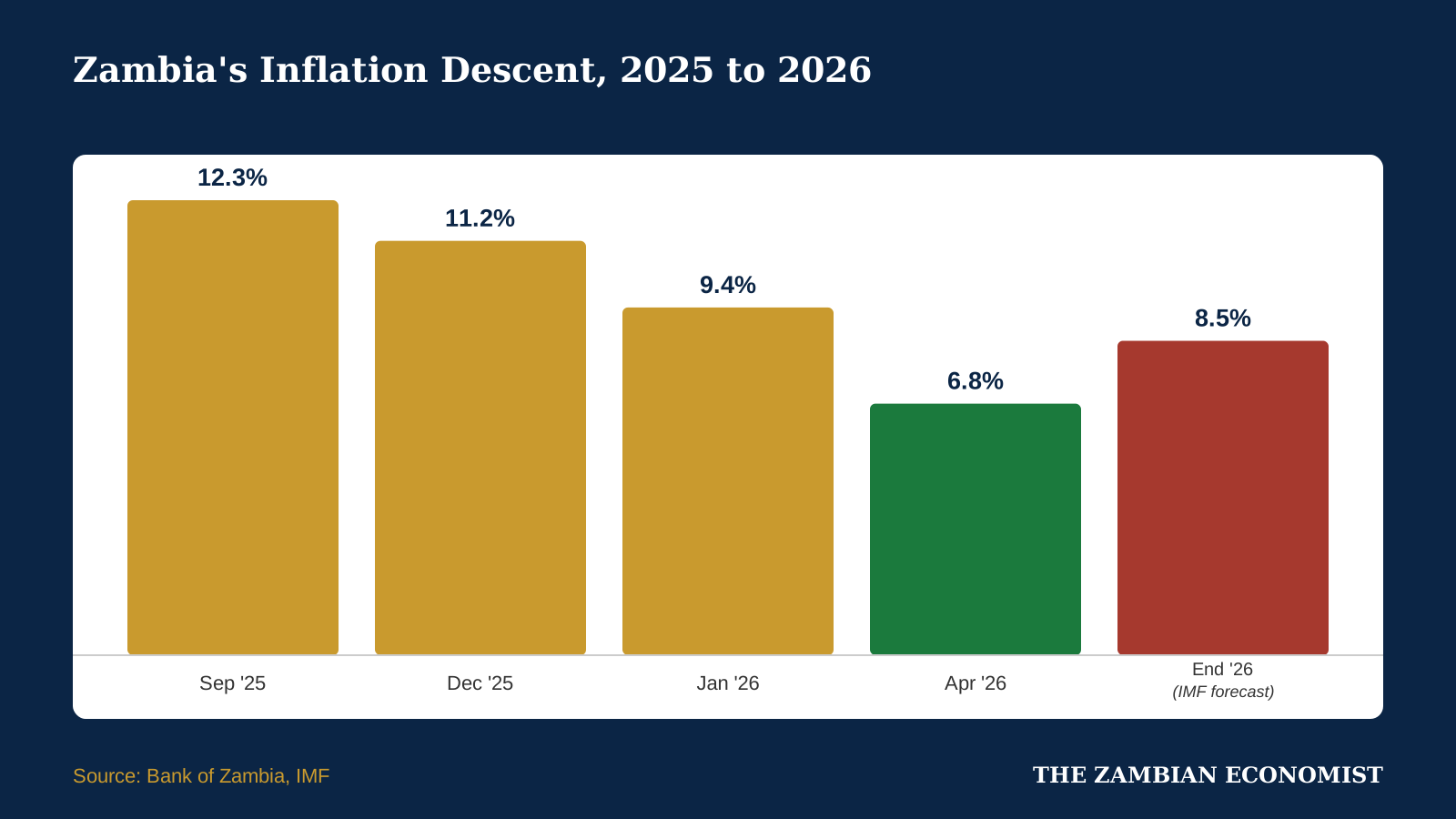
Strip away the graphics and the economic record is not ambiguous, though it is not simple either. Debt restructuring agreements now cover roughly 94% of the restructuring perimeter, and the African Development Bank records public debt falling to 87.6% of GDP in 2025 from 101% in 2024. Inflation has fallen sharply, from 12.3% in September 2025 to 6.8% in April 2026, back inside the Bank of Zambia’s 6 to 8% target band. The IMF nonetheless projects it rising to about 8.5% by the end of 2026 as fuel prices offset a stronger kwacha. Disinflation is not the same as falling prices; the cost of living is still above where it was, simply rising more slowly.
Growth tells a mixed story worth reporting honestly. The AfDB revised 2025 growth down to 3.8% from an initial 5.2% estimate. First quarter 2026 growth hit 7.7%, an over one year high, driven largely by agriculture after good rainfall, while copper production fell to an over one year low in the same quarter. The IMF has trimmed its full year 2026 projection to 4.3%. A recovery led by rainfall is a recovery hostage to weather.
Reserves have risen to about $6.4 billion, covering 4.4 months of imports, and the current account deficit narrowed to 1.0% of GDP in 2025 from 4.4% in 2024. The figure that should matter most to both campaigns is a fiscal one: the primary surplus reached 3.1% of GDP in 2025, and the IMF now projects it falling to just 1.1% in 2026, down from the 3.8% envisaged at the previous programme review. The consolidation that produced the stabilisation is loosening in an election year. That is the envelope every rally promise between now and Thursday has to fit inside.
Two Answers, One Shrinking Envelope
The two campaigns are not disputing these figures so much as disputing what they mean. Our full head-to-head comparison covers the candidates in depth. In short: Hichilema is asking to be judged on the turnaround itself, with a second term proposing to spend the resulting fiscal space on delivery. Mundubile, whose BBC interview put his economic vision on the international stage, is arguing the turnaround has not reached ordinary households, and has campaigned on fertiliser allocations, road rehabilitation, restored student meal allowances and youth wealth creation pledges, delivered largely through rallies rather than a single costed document.
That absence of costing is the fair criticism of the challenger, and it is analytically serious given where the primary surplus is headed. It is equally fair to press the incumbent on what carries growth once the rains are no longer doing the work copper used to do. Our piece on whether Zambia can afford its competing manifestos sets out that arithmetic in full. Neither campaign has fully answered its own hardest question. That, and not a fabricated pie chart, is the real story of this election.
A Standard for the Final Week
More graphics will circulate before Thursday, favouring one side or the other. Treat them identically. Before sharing any poll, look for the sampling frame, the fieldwork dates, the number of respondents, the margin of error, the undecided share and the name of the person who ran it. If any one is missing, do not share it. If the margin of error and the sample size contradict each other, the document is fabricated, and the only responsible response is to say so. This publication will report polling when polling exists, with its methodology attached, and will not publish a number it cannot source. In the final week of a national election, a projection dressed as a survey is not analysis. It is interference wearing analysis as a costume.
Sources: Electoral Commission of Zambia; International Monetary Fund staff assessments, 2026; African Development Bank, African Economic Outlook 2026; Bank of Zambia Monetary Policy Committee statements; International Foundation for Electoral Systems. Figures cited are as reported by the named institutions at the dates indicated and are subject to revision.