
By Zambian Economist Analyst
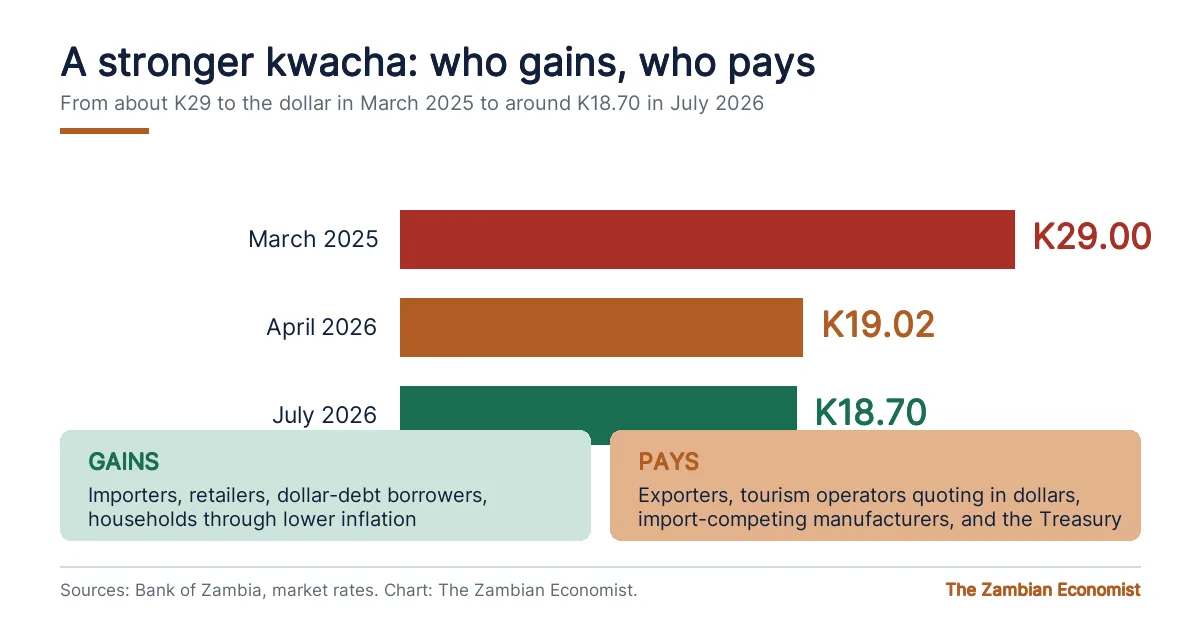
The kwacha has been trading around K18.70 to the dollar, having appreciated roughly 20% since January and more than 30% over twelve months. In March 2025 it touched K29 to the dollar. That is one of the sharpest currency recoveries on the continent.
The public reaction has been close to unanimous: this is good news.
It mostly is. But “the kwacha is strong” and “the economy is doing well” are not the same sentence, and treating them as one leads businesses and policymakers into avoidable mistakes. A currency is a price. When a price moves, somebody gains and somebody pays.
Here is who.
Who gains from a strong kwacha
Importers and retailers. The most direct beneficiaries. A container that cost K27 million to land at last year’s rate costs roughly K18.7 million at today’s. That is not a marginal improvement; it is a different business.
Anyone servicing dollar debt from kwacha income. A company with a US$500,000 facility was budgeting K13.5 million a year in principal at K27. At K18.70 it is K9.35 million. Nothing about the loan changed. The kwacha did.
Households. Cheaper imported goods, cheaper fuel inputs, and the single largest contributor, alongside a good harvest, to inflation falling to 6.5%.
The government’s external debt position. Dollar obligations are easier to meet when each dollar costs fewer kwacha.
Who pays
Exporters. This is the obvious one and it is genuinely painful. A Zambian firm exporting honey, gemstones, processed foods or services to the region earns dollars and pays wages, rent and electricity in kwacha. When the kwacha appreciates 20%, the dollar revenue is unchanged and the kwacha it converts into falls by a fifth. Costs did not fall by a fifth. That is the margin, gone.
Tourism. Operators in Livingstone and the national parks quote in dollars because their customers arrive with dollars. Their staff, fuel, food and licences are kwacha costs. The same squeeze applies, and it is worse because tourism prices are usually set a season in advance.
Small manufacturers competing with imports. A strong kwacha makes imported finished goods cheaper too. A Zambian producer of furniture, plastics or packaging suddenly faces landed competition at prices that did not exist eighteen months ago. Import substitution, the thing every diversification strategy calls for, gets harder precisely when the currency is strong.
And, less obviously, the Treasury.
The revenue problem nobody puts on a poster
This is the part that deserves careful attention, because it runs against intuition.
Mineral royalties, one of the largest single sources of government revenue in Zambia, are calculated on the dollar value of copper. But government spends in kwacha: salaries, CDF, drugs, roads, debt service on domestic paper.
So the kwacha value of royalty revenue depends on four things: how much copper is produced, the dollar price it sells at, the exchange rate, and how effectively the tax is collected.
Hold production and price constant, and appreciate the currency by 20%. Kwacha royalty revenue falls by roughly 20%.
The same tonne. The same dollar price. Materially fewer kwacha in the Treasury.
This creates a loop worth understanding:
- Currency strength compresses kwacha revenue from dollar-linked taxes
- A revenue gap increases reliance on domestic borrowing
- Domestic issuance absorbs bank liquidity and crowds out private credit
- Tighter liquidity feeds back into rates and the exchange rate
Which is why a Ministry of Finance official can look at a strengthening kwacha with more ambivalence than a newspaper headline allows. Currency strength improves the inflation optics and weakens the fiscal base at the same time.
Both are true. Serious analysis has to hold them together.
So is a strong kwacha good or bad?
Neither, on its own. What matters is why it is strong and how long it stays there.
Appreciation driven by rising productivity, export diversification and genuine investment inflows is durable and healthy. Appreciation driven by a commodity price is a loan from the cycle, repayable on demand.
Zambia’s current strength is overwhelmingly the second kind. The kwacha is up because copper is near record levels and debt restructuring has improved sentiment. Those are real, and they are also reversible. We set out the mechanism in copper and the kwacha.
The country has seen the reverse film before. In March 2025 the kwacha was at K29. Nobody who lived through that repricing needs reminding how fast it happened.
What to do about it
If you import: take the benefit, but do not build a permanent cost structure on a temporary rate. Assume the rate you use for a three-year lease or a fixed long-term contract should be weaker than today’s spot.
If you export: review pricing now rather than at year end. If your volumes justify it, ask your bank about forward cover, the point is not to speculate but to make your margin predictable. Where contracts allow, negotiate currency-adjustment clauses rather than fixed dollar prices.
If you compete with imports: your window is narrower than it was. Compete on lead time, service, credit terms and after-sales, not on landed price, which you will lose.
If you hold dollar debt: this is a good moment to reduce principal, not to add leverage.
A warning: the temptation during currency strength is to borrow in dollars because it looks cheap in kwacha terms. That is precisely the trade that destroyed balance sheets across Zambia between 2022 and 2024. The exchange rate that makes the loan look affordable is the same one that can make it unaffordable.
A strong currency is a good problem. It is still a problem.
The right posture for a Zambian business in mid-2026 is to bank the benefit where it exists, avoid building fixed commitments on a commodity-driven exchange rate, and remember that the kwacha’s strength is currently on loan from the copper market.
Nothing in this article constitutes investment or financial advice. Figures current as at 28 July 2026. Part of our Zambia Economy 2026 series.
Primary sources: Bank of Zambia
See also: a strong kwacha and the price of medicine.
Related reading: Zambia’s Current Account Surplus: The Quiet Good News Story