Key takeaways
- President Hakainde Hichilema has secured a second term with roughly 61% of the vote, giving investors the policy continuity they had priced in and removing the single biggest source of uncertainty hanging over Zambia’s markets this year.
- Zambia’s 2033 dollar bond and its world-beating kwacha-denominated local bonds are set to test whether continuity converts into a fresh IMF programme, since the previous $1.7 billion arrangement expired in January.
- Copper remains the story that matters most to outside investors. Government targets of 3 million tonnes a year by 2031, from roughly 890,000 tonnes in 2025, will now be judged against a second term rather than a first.
- Cooperating partners from Washington to Beijing to Brussels have a stake in the outcome, since Zambia sits at the centre of the global race for critical minerals.
- The business community gets clarity on tax, local content and regulatory direction, but still faces a currency that has been volatile since 2022 and a population still waiting to feel the recovery in daily life.
- The next real test is delivery: a new IMF programme, the September copper export duty decision, and whether growth this term reaches households as well as balance sheets.
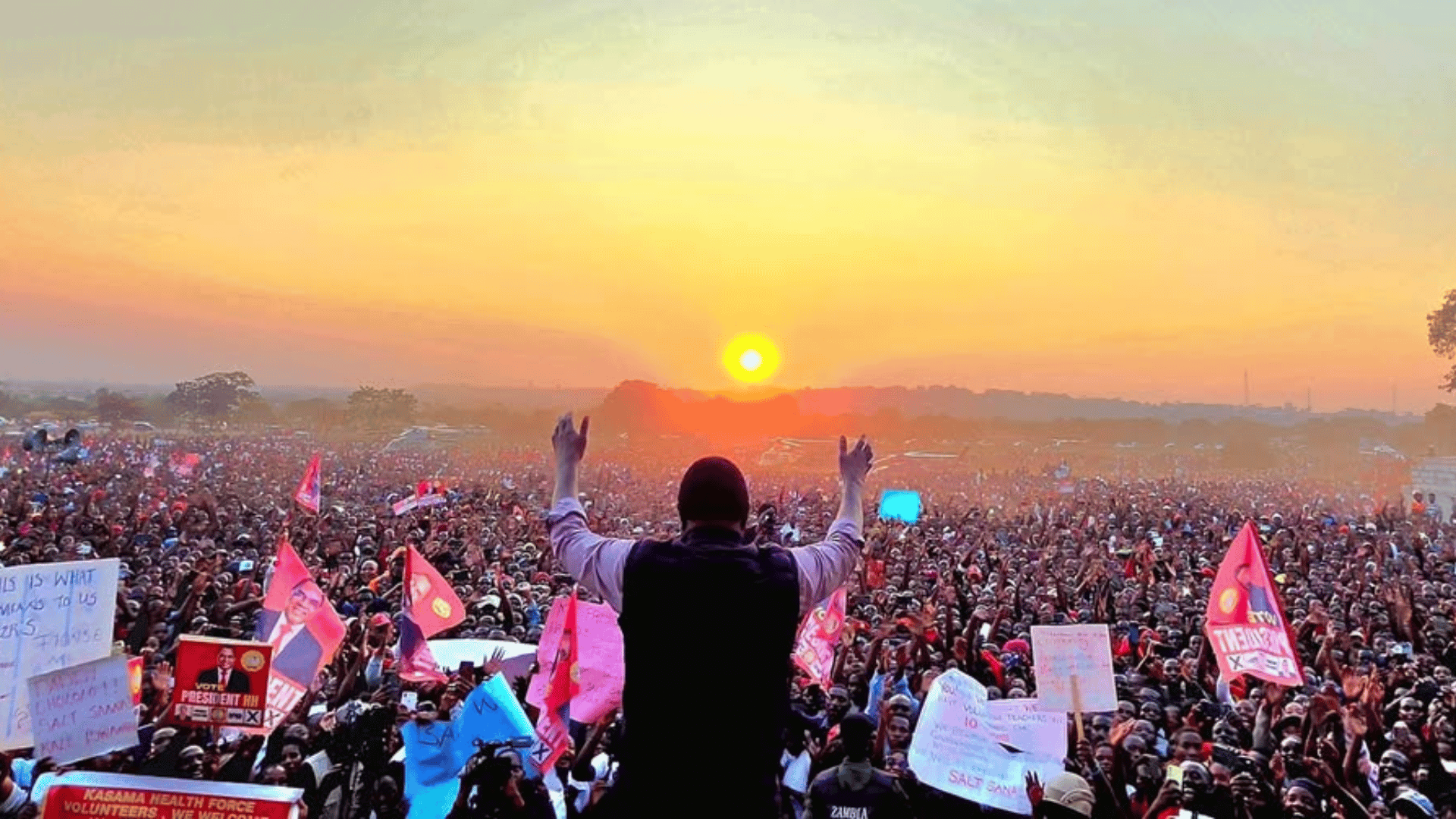
Zambia’s electorate has answered the only question that mattered to markets, cooperating partners and the business community that spent the past year, and in some cases the past five, watching Lusaka closely: is Hakainde Hichilema staying. The Electoral Commission of Zambia declared the president the winner of the 13 August poll with about 61.5% of the vote against Brian Mundubile’s 38.5%, delivering a second five-year term without the need for a runoff.
For a country that spent 2020 as the first African nation to default on its sovereign debt during the pandemic, that outcome carries weight far beyond its borders. Zambia’s re-election result has already moved through trading desks in London and Johannesburg, through the corridors of the IMF in Washington, and through boardrooms in Toronto and Beijing where decisions about the next decade of Zambian copper investment are made. This is what continuity actually buys a country, and what it now has to deliver.
Markets read continuity as a green light, not a guarantee
Investors had positioned for this outcome well before ballots were counted. Zambia’s kwacha-denominated local bonds delivered a 36% dollar return so far this year, the best of any emerging market Bloomberg tracks, comfortably ahead of the 1.35% return on the wider emerging local debt index. Citigroup had already flagged that a decisive Hichilema win would likely extend that rally rather than end it.
The reaction to the actual result has been notably calm rather than euphoric, which in itself is a signal. Zambia’s 2033 dollar bond, the country’s only international bond since the 2023 debt restructuring, traded at 97.72 cents on the dollar in the days around the declaration, broadly unchanged even against a weaker backdrop for African debt more generally. Markets, in other words, had already done the pricing. What they are watching for now is follow-through.
That follow-through has a name: a new International Monetary Fund programme. Zambia’s previous $1.7 billion arrangement expired in January, and Finance Minister Situmbeko Musokotwane has said the government intends to seek a successor programme by year-end, now that the political uncertainty of the election is behind it. Musokotwane has also been candid that a return to international bond markets remains premature while the government works to keep debt service manageable. For a country that took years to complete a restructuring involving creditors from China, France, the United Kingdom and the United States, with the IMF’s backing as a condition of participation, that caution is deliberate rather than timid.
The kwacha itself tells the more complicated part of the story. It was the world’s best-performing currency against the dollar in the opening months of Hichilema’s first term, surging more than 18% between January and September 2022, and again ranked among Africa’s best performers through 2025. But it has also depreciated sharply over the intervening years, and the currency’s path illustrates a wider truth about this presidency: macroeconomic credibility has been rebuilt, but it remains sensitive to drought, copper prices and global risk appetite in ways no single election result can fully insulate against.
Copper is still the country’s real diplomatic currency
If there is one sector where the re-election result carries the most direct international weight, it is mining. Zambia produced a record 890,346 tonnes of copper in 2025, an 8% increase on the previous year, driven by a genuine turnaround at Konkola Copper Mines, where output surged after years of underperformance, alongside gains at Mopani and Kansanshi. The government’s stated ambition, more than triple that figure to 3 million tonnes a year by 2031, remains one of the most ambitious production targets on the continent.
That target now belongs to a second Hichilema term, and the projects behind it are already in motion. First Quantum Minerals has expanded its Kansanshi operation through a $1.25 billion Sulphide-3 project. Barrick Gold continues to develop Lumwana. Vedanta has committed $1.3 billion to revive Konkola following the resolution of a long ownership dispute. KoBold Metals, backed by American investors, is advancing its Mingomba project as a next-generation copper development. Chinese firms including Sinomine, whose $600 million Kitumba project in Mumbwa is moving into production, remain deeply embedded in the sector alongside these Western and Indian players.
This mixture of ownership is precisely why Zambia’s copper has become a genuine subject of great-power interest. Washington has moved to secure direct access to Zambian copper and cobalt through vehicles such as the US Trade and Development Agency’s grant to Metalex Africa, explicitly framed around reducing dependence on Chinese-controlled processing. Beijing, meanwhile, remains Zambia’s largest infrastructure financier and a major mining investor in its own right. Neither side holds outright control of the sector, and that balance, uncomfortable as it can be to manage, has become part of Zambia’s leverage rather than its liability. A change in government would have reopened every one of those relationships to renegotiation. Continuity keeps them on track.
The nearest real test of execution comes on 30 September, when a 10% export duty on copper concentrates is due to take effect, intended to push processing and value addition onshore rather than exporting raw ore. Whether that policy accelerates smelting capacity or simply strains an electricity system still recovering from the 2023 to 2024 drought, when load shedding reached as much as 23 hours a day in places, will say a great deal about how well industrial policy and infrastructure planning have been sequenced in this second term.
What cooperating partners are watching for
For Zambia’s cooperating partners, the re-election result is less a surprise than a checkpoint. The IMF’s interest is straightforward: whether the fiscal discipline that underpinned the 2023 restructuring holds up now that campaign spending pressures have passed and a second programme is under negotiation. The World Bank and African Development Bank, both active financiers of Zambia’s energy and infrastructure programmes, will be looking for the same thing, continuity in reform commitments rather than a post-election loosening of the fiscal position.
The United States and the European Union have their own strategic interest, tied closely to critical minerals and to Zambia’s standing as one of the more credible democracies in the region. Chatham House has noted that Zambia’s general election carries international significance well beyond what the country’s landlocked geography or modest economic size would suggest, precisely because of its position at the centre of the critical minerals competition, debt diplomacy and shifting regional alliances. The events surrounding the vote count, including a brief nationwide suspension of counting after reports of violence and ballot theft in some districts, and the Law Association of Zambia’s public challenge to the legality of that suspension, will be read by these partners as a test of institutional resilience under pressure rather than a reason to disengage. How the government handles the aftermath, including opposition allegations around election-night arrests, will shape the tone of that partnership as much as the vote count itself did.
China’s interest is more commercial than political, rooted in its creditor position from the debt restructuring and its mining and infrastructure investments, but no less consequential. Continuity in Lusaka means continuity in repayment terms and in the pipeline of Chinese-backed projects, including logistics investments tied to critical minerals corridors that compete directly with Western-backed alternatives such as the Lobito Corridor.
The business community gets clarity, not certainty
For Zambia’s business community, the practical value of this result is predictability. Companies that had delayed investment decisions pending the outcome now have a clearer basis for planning around tax policy, the local content requirements that took effect on 1 January 2026 requiring mines to source a growing share of goods and services from Zambian-owned businesses, and the government’s broader industrialisation agenda.
That clarity does not remove the operating challenges that have defined the past two years. Businesses across sectors, particularly small and medium enterprises, continue to navigate a currency that has been volatile since 2022, financing costs that remain elevated, and an electricity system still rebuilding reserve margins after the drought. The government’s own messaging around this election, doubling the size of the economy, creating more jobs, expanding opportunities for households, is itself an acknowledgment that the macroeconomic recovery of the first term has not yet been widely felt on the ground. Critics have been equally direct that poverty and hunger remain widespread despite the headline numbers.
Sectors beyond mining stand to gain from the stability a settled election provides. Agriculture, still recovering from drought-driven shocks to output and food prices, benefits from continuity in support programmes and irrigation investment. Financial services, which have absorbed much of the volatility in the kwacha and in government securities, gain a calmer environment in which to price risk. Construction and engineering firms watching the outcome of local content enforcement will be looking for the second term to translate policy intent into enforced practice.
Economic diplomacy: Zambia’s bigger opportunity
Beyond the immediate market and sector reaction, the re-election result hands Zambia something more durable if it is used well: a second term to consolidate its position as a credible economic diplomacy actor in a region and a mineral market that increasingly rewards predictability. Having become the first African country to complete a post-pandemic sovereign default and restructuring, with creditors as diverse as China, France, the United Kingdom and the United States all brought to the same table, Zambia has a case study in creditor coordination that few other developing economies can match. That reputation, built through years of painstaking negotiation rather than a single election cycle, is now Hichilema’s to build on rather than to rebuild.
The government’s own framing at international forums, from Davos to the Mining Indaba in Cape Town, has leaned into this positioning deliberately, presenting Zambia’s full mineral base, not copper alone, but cobalt, manganese, lithium and emeralds, as a platform for partnership rather than extraction. Whether that framing converts into deeper regional integration through COMESA and SADC, more diversified export markets, and stronger positioning in the conversation about African trade access, will depend on execution over the next five years rather than on the margin of victory in this one.
The test ahead
Hichilema’s first term was defined by stabilisation: restoring debt sustainability, rebuilding relationships with international lenders, and steadying a currency and an economy that had been in genuine distress. His second term, on the evidence of both his own campaign messaging and the questions now being asked by investors, cooperating partners and Zambian voters alike, will be judged on growth that reaches further than the balance sheet. The 3-million-tonne copper target, the outcome of a new IMF programme, the September export duty decision, and whether household incomes finally catch up with the macroeconomic story, will together determine whether this re-election is remembered as the moment Zambia’s recovery became a genuine expansion, or as a mandate that arrived before the harder work was done.
Related coverage
- Zambia Holds Its Breath: What the Wait for a Presidential Declaration Means for Business
- ECZ Lifts Vote-Count Suspension as Zambia’s Election Stays Unsettled Between Rival Claims
- LAZ Challenges Legality of ECZ’s Nationwide Vote-Counting Suspension
- ECZ Suspends Vote Counting Nationwide After Reports of Violence and Ballot Theft
- Zambia’s Post-Election Rally Is Economically Sound
- The SME Credit Gap: Why Zambian Small Businesses Still Can’t Borrow Affordably
- Inside Statutory Instrument 68: Zambia’s New Local-Content Rules for Miners
- IBA Warns Broadcasters Against Speculative Election Results
- Emoluments Commission Congratulates President-Elect
- Why Zambia Cannot Afford Militias: The Economics of Hichilema’s Warning
WARNING! All rights reserved. This material and all other digital content on this website may not be reproduced, published, broadcast, rewritten, or redistributed, in whole or in part, without the prior express permission of The Zambian Economist. Where permission is granted, the content must be clearly credited to “The Zambian Economist,” with “www.zambianeconomist.com” prominently displayed.
WhatsApp: +260775574228 | Email: info@zambianeconomist.com
© 2026 The Zambian Economist.
Work With The Zambian Economist
Related: Angolau2019s Lourenço Congratulates Hichilema, Hails Zambiau2019s Democratic Maturity
Related: El Nino Warning: Zambia Told to Fix Its Power Gap Before the Drought Bites