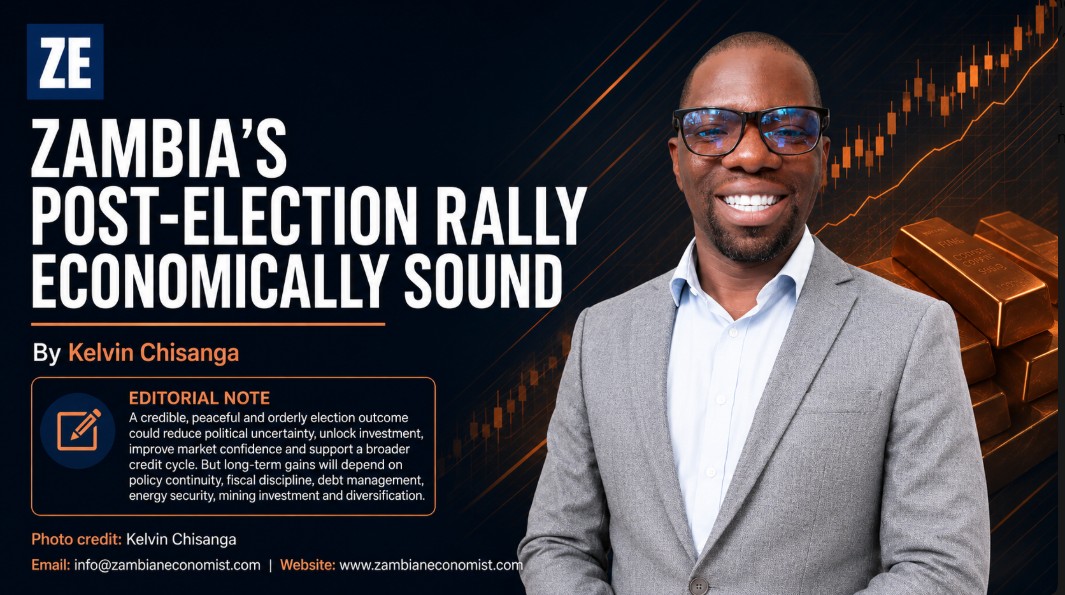
By Kelvin Chisanga
Zambia could be entering a strong post-election confidence rally. Whether that rally holds will depend on what happens once the ballots are fully counted.
The immediate economic benefit of a credible, peaceful and orderly election outcome is the reduction of political uncertainty and the risk premium that uncertainty attaches to investment decisions. Zambia entered the vote carrying exactly this kind of temporary risk premium, with investors, lenders and businesses holding back while they waited for clarity on the political outcome and the direction of policy.
Investors who took a wait-and-see approach through the campaign period can now begin releasing capital held back for mining, agriculture, energy, manufacturing, construction, tourism and ICT. Financial markets tend to respond in a similar way, through stronger demand for government securities, firmer business confidence and greater stability in the kwacha.
A Liquidity Boost Already in the System
Even before the vote took place, the Bank of Zambia had already moved to ease credit conditions. Governor Denny Kalyalya announced at the 98th Agricultural and Commercial Show that the statutory reserve ratio on kwacha deposits would fall by five percentage points, from 26 per cent to 21 per cent, effective 3 August 2026, while the ratio on foreign currency deposits was left unchanged. The central bank framed the move as an effort to inject liquidity into the banking sector and support lending to businesses and households.
| Measure | Before | After |
|---|---|---|
| Statutory reserve ratio, kwacha deposits | 26% | 21% |
| Effective date | 3 August 2026 | |
| Monetary Policy Rate | 13.25% (unchanged since May 2026) | |
The mechanic is straightforward. A bank that previously had to hold K26 in reserve for every K100 of kwacha deposits now only has to hold K21, freeing an additional K5 out of every K100 for lending. Applied across the banking sector, that reduction represents a meaningful amount of new lending capacity entering the system at the same time political uncertainty is starting to clear.
From Liquidity to a Credit Cycle
If banks channel the released liquidity into productive lending rather than government paper alone, the post-election period could stimulate a broader credit cycle: more financing reaching small and medium enterprises, agriculture and private investment rather than sitting parked in low-risk instruments.
That outcome is not automatic. Commentary following the reserve ratio cut has cautioned that more liquidity in the banking system does not by itself translate into more credit reaching businesses and households; banks still assess borrowers on creditworthiness, and businesses still need viable projects to present. The reserve ratio cut removes one constraint on lending. It does not remove the others.
An election victory alone cannot create sustainable growth.
The Real Test Comes After the Count
The real test of Zambia’s post-election economy will be policy continuity, fiscal discipline, debt management, energy security, mining investment and economic diversification. These are the areas investors watching Zambia’s fiscal trajectory and the cost of election-season commitments will be tracking in the months ahead, regardless of which party forms the next government.
None of these tests are new. They are the same fundamentals that determined whether Zambia’s debt restructuring, inflation gains and reserve accumulation of the past two years translated into a durable recovery rather than a temporary stabilisation. A change in political mood does not change the underlying requirement: spend within means, keep borrowing sustainable, keep the lights on, and keep the mining pipeline moving.
What to Watch: Business, Investor and Policy Signals
- Businesses should watch whether commercial lending rates actually move in response to the reserve ratio cut, and whether financing reaches productive sectors rather than remaining concentrated in consumption credit and government paper.
- Investors should watch demand at government security auctions, kwacha stability against the dollar, and whether capital held back during the campaign period is released into mining, agriculture, energy, manufacturing, construction, tourism and ICT as expected.
- Policymakers should watch whether the credibility gains of the past two years, on inflation, reserves and debt restructuring, are protected rather than spent down to fund post-election commitments.
Zambia’s biggest post-election opportunity is to convert political certainty into economic certainty, economic certainty into investment, and investment into jobs, productivity and inclusive growth.
Article by Kelvin Chisanga.
Related reading
- Zambia Faces a Temporary Political Risk Premium
- What the Bank of Zambia Policy Rate Means for Your Loan
- Life After the IMF: What a New Programme Could Mean for Zambia
- Opinion: Zambia’s Election Is a Major Economic Event
Related: Lusaka’s Great East Road Falls Silent as Zambians Head to the Polls
Related: Vincent Mwale Wins Chipangali West as an Independent
Related reading: Zambia’s Growth-Household Income Gap: The Economic Question Behind the 2026 Election
Related: Sunday Chanda Concedes Kanchibiya Seat, Defends His Bill 7 Vote in Farewell Statement
Related: Zambia Holds Its Breath: What the Wait for a Presidential Declaration Means for Business
Related coverage
Related coverage
WARNING! All rights reserved. This material and all other digital content on this website may not be reproduced, published, broadcast, rewritten, or redistributed, in whole or in part, without the prior express permission of The Zambian Economist. Where permission is granted, the content must be clearly credited to “The Zambian Economist,” with “www.zambianeconomist.com” prominently displayed.
WhatsApp: +260775574228 | Email: info@zambianeconomist.com
© 2026 The Zambian Economist.
Work With The Zambian Economist
For the latest on this story, see ECZ Lifts Vote-Count Suspension as Zambia’s Election Stays Unsettled Between Rival Claims.
Related: Hichilema’s Second Term: What It Means for Zambia’s Economy, Markets and Diplomacy
Related: Beyond the Ballot, Zambia Turns the Page to Economic Delivery