Zambia, Angola and the Democratic Republic of Congo met in Lusaka today to move the Lobito Corridor from signed commitments to money on the ground. The World Bank says there are US$28 billion in private investment opportunities along the route. Whether they materialise depends on what happens after the railway is built.
KEY TAKEAWAYS
- President Hakainde Hichilema opened the Second Lobito Corridor Coordination Meeting at the InterContinental Hotel in Lusaka on 5 October 2026, co-convened by the Government of Zambia and the World Bank Group.
- World Bank Managing Director of Operations Anna Bjerde said IFC diagnostics have identified 118 anchor investment opportunities worth over US$28 billion in mining, energy, agribusiness, logistics and forestry.
- The agenda covers a joint trade facilitation roadmap, corridor master plans, Lobito Atlantic Railway operations and investment milestones for the next 6 to 24 months.
- Zambia’s planned new rail link to the Angolan line, roughly 550 km on the Zambian side, is backed by a US$255 million African Development Bank loan approved in August.
- The commercial test remains freight volume: the greenfield line needs 2.5 to 3 million tonnes a year to pay its way, against about 1 million tonnes committed as of April.
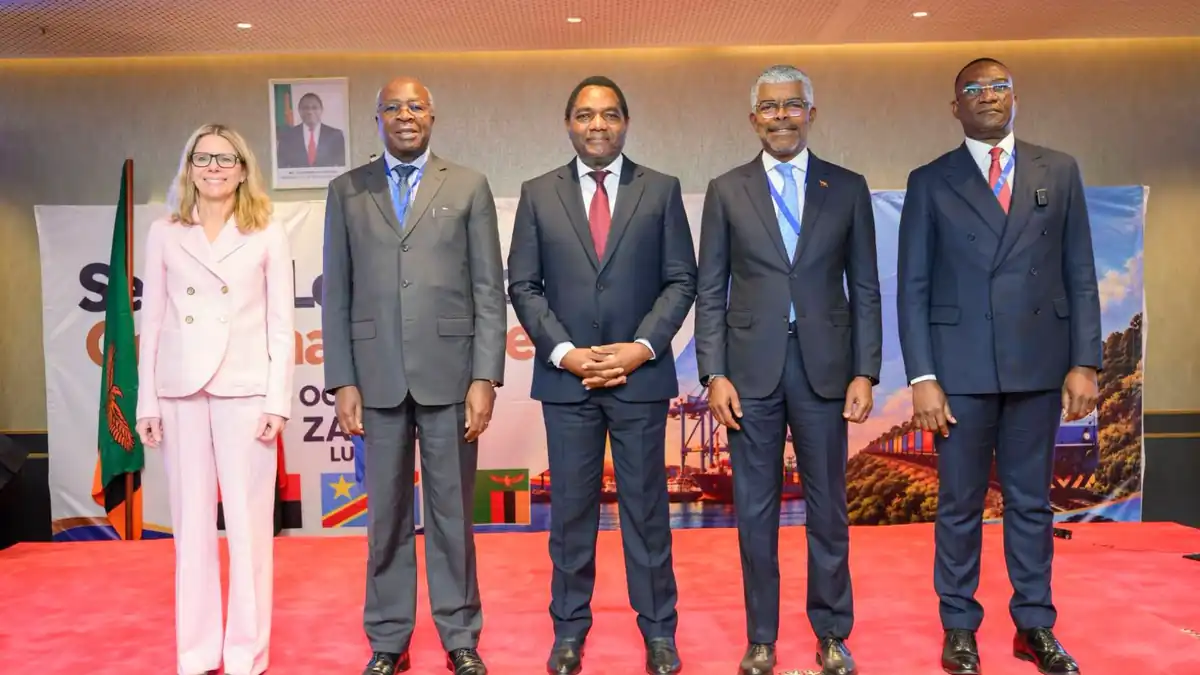
President Hakainde Hichilema opened the Second Lobito Corridor Coordination Meeting at the InterContinental Hotel in Lusaka on Monday, bringing together ministers and officials from Angola and the Democratic Republic of Congo, the World Bank Group and other development partners. The two-day meeting is meant to agree what each country and financier does next on the corridor that links the Copperbelt to Angola’s Atlantic port of Lobito.
“Our shared goal is to turn commitments into investment, stronger regional trade and jobs by improving connectivity and lowering transport costs,” the President said in a statement after the opening. “Zambia remains committed to ensuring this partnership delivers tangible benefits for our people and advances the Grow Zambia Agenda.”
Who is in the room
The meeting is co-organised by the Ministry of Finance and National Planning and the World Bank Group. Anna Bjerde, the Bank’s Managing Director of Operations, is attending. Angola’s delegation is led by Transport Minister Ricardo D’Abreu and includes Ivan dos Santos, Secretary of State for Public Investment, Amadeu Nunes, Executive Secretary of the Lobito Corridor Transit Transport Facilitation Agency (LCTTFA), and Angola’s Ambassador to Zambia, Albino Malungo, according to Angolan state news agency ANGOP via allAfrica.
The first coordination meeting was held in Luanda and opened by Angolan President João Lourenço. There, the three governments and partners including the African Development Bank, the Africa Finance Corporation, the European Union, the European Investment Bank and the World Bank agreed four steps: a corridor development master plan, a shared definition of what an “economic corridor” means across borders, a joint investment platform, and trade facilitation and border reforms. The Lusaka meeting is where those commitments get timelines.
What is on the table
According to the Treasury’s own announcement, delegates will work through a joint trade facilitation roadmap, regional development master plans, an operations update on the Lobito Atlantic Railway, the LCTTFA work programme, priority road and rail investments including feeder networks, cross-border infrastructure needs, and the financing gaps and technical assistance still outstanding. The stated aim is a list of implementation milestones for the next 6 to 24 months.
“Our aspiration is ultimately to ensure that regional cooperation and infrastructure translate into increased investment, production and trade,” the Ministry of Finance and National Planning said ahead of the meeting.
The US$28 billion question
The number that will travel furthest from Lusaka came from Bjerde. She told delegates that diagnostic work by the International Finance Corporation, the Bank’s private sector arm, had identified 118 anchor investment opportunities worth more than US$28 billion across mining, energy, agribusiness, logistics and forestry, Zambia Monitor reported.
She paired it with a warning. “If we coordinate only on rail, we will have built a very expensive conveyor belt,” Bjerde said. Her point was that rail alone moves ore to a port. Jobs come from what grows around the line: power for mines and processing plants, water, skills, secondary towns and businesses that can sell into the corridor.
Finance Minister Situmbeko Musokotwane made a similar case from the Zambian side, saying higher production would require investment in roads, warehouses and other logistics so that goods can move efficiently. That fits the export-led direction he set out on ZNBC last month, which we covered here.
Where Zambia’s piece of the corridor stands
The Angolan section already runs from Lobito to the DRC border, operated under concession by the Lobito Atlantic Railway, whose expansion is supported by a guarantee from the World Bank’s Multilateral Investment Guarantee Agency (MIGA). Zambia’s task is the missing link: a new line from the North-Western Province to join the Angolan network.
In August, the African Development Bank approved a US$255 million loan and a US$10 million grant to support Zambia’s part of the project, according to the Bank’s announcement. The package covers roughly 550 km of new railway in Zambia and upgrades to 105 km of the Mwinilunga to Jimbe road, and projects about 500 permanent jobs and 5,000 temporary construction jobs. The Bank has indicated later phases could take its support towards US$500 million.
The wider greenfield project, more than 1,300 km and costed at about US$6.6 billion, has drawn commitments of around US$500 million from the Africa Finance Corporation, US$320 million from Italy and US$200 million from the Development Bank of Southern Africa, Business Report said in April. Contractor selection was then expected in July or August, with early works pencilled in for late 2026 or early 2027. The European Union, separately, said in November 2025 that it had mobilised €2 billion for the corridor under its Global Gateway strategy.
Why it matters for Zambia
Zambia is landlocked, and most of its copper leaves by road through Dar es Salaam, Durban or Walvis Bay. Long truck routes add cost to every tonne exported and every bag of fertiliser imported. A working rail route to the Atlantic offers a shorter path to European and American buyers and competition between corridors, which tends to lower freight rates.
That matters more as the country chases its target of 3 million tonnes of copper a year. More output only pays if it can be moved cheaply. We have argued before that the copper target needs an economy built around it, and the Lobito debate is the same argument in transport form.
There is a hard number behind the optimism. Business Report, citing project sponsors, said the greenfield line needs 2.5 to 3 million tonnes of freight a year to be commercially viable, while firm commitments stood at about 1 million tonnes in April. Closing that gap depends on mines, farms and traders choosing to ship west, which is why the agenda in Lusaka leans so heavily on border procedures, feeder roads and private investment rather than track alone.
What to watch
- Contract awards. Whether an engineering, procurement and construction contractor for the Zambian section is named, and when works start.
- Freight commitments. Any new offtake or haulage agreements that move committed volumes closer to the 2.5 million tonne threshold.
- Border reforms. Concrete steps on single-window clearance and transit procedures across the three countries.
- The investment platform. How the US$28 billion pipeline is packaged for investors, and how much of it involves Zambian firms rather than only foreign sponsors.
The communiqué expected at the close of the meeting should show whether Lusaka produced dates and owners for each of these, or another round of commitments.
Sources
- Times of Zambia: HH to grace Lobito Corridor indaba
- Zambia Monitor: Lobito corridor offers $28 billion investment opportunities, World Bank
- allAfrica/ANGOP: Angola participates in Lobito Corridor coordination meeting in Zambia
- Ministry of Finance and National Planning: Angola, DRC and Zambia agree on concrete steps to accelerate the Lobito Corridor
- allAfrica/AfDB: US$255m loan and US$10m grant to advance the Lobito Economic Corridor
- Business Report: Lobito Corridor project advances to construction bidding phase
- Anadolu Agency: EU mobilises $2.3B for corridor linking Zambia, Angola, DR Congo
Does your business move goods to or from the Copperbelt? List it in the Zambian Economist Business Directory or submit an analysis.
Related: Hichilema Takes the Grow Zambia Pitch to Abu Dhabi as UAE Ties Shift From Diplomacy to Deals.
Related: Zambia’s Copper Engine: From 890,000 Tonnes to a 3-Million-Tonne Ambition.
Related: Beyond Copper: How Economic Diplomacy Can Drive Zambia’s Diversification.
WARNING! All rights reserved. This material and all other digital content on this website may not be reproduced, published, broadcast, rewritten, or redistributed, in whole or in part, without the prior express permission of The Zambian Economist. Where permission is granted, the content must be clearly credited to “The Zambian Economist,” with “www.zambianeconomist.com” prominently displayed.
WhatsApp: +260775574228 | Email: info@zambianeconomist.com
© 2026 The Zambian Economist.