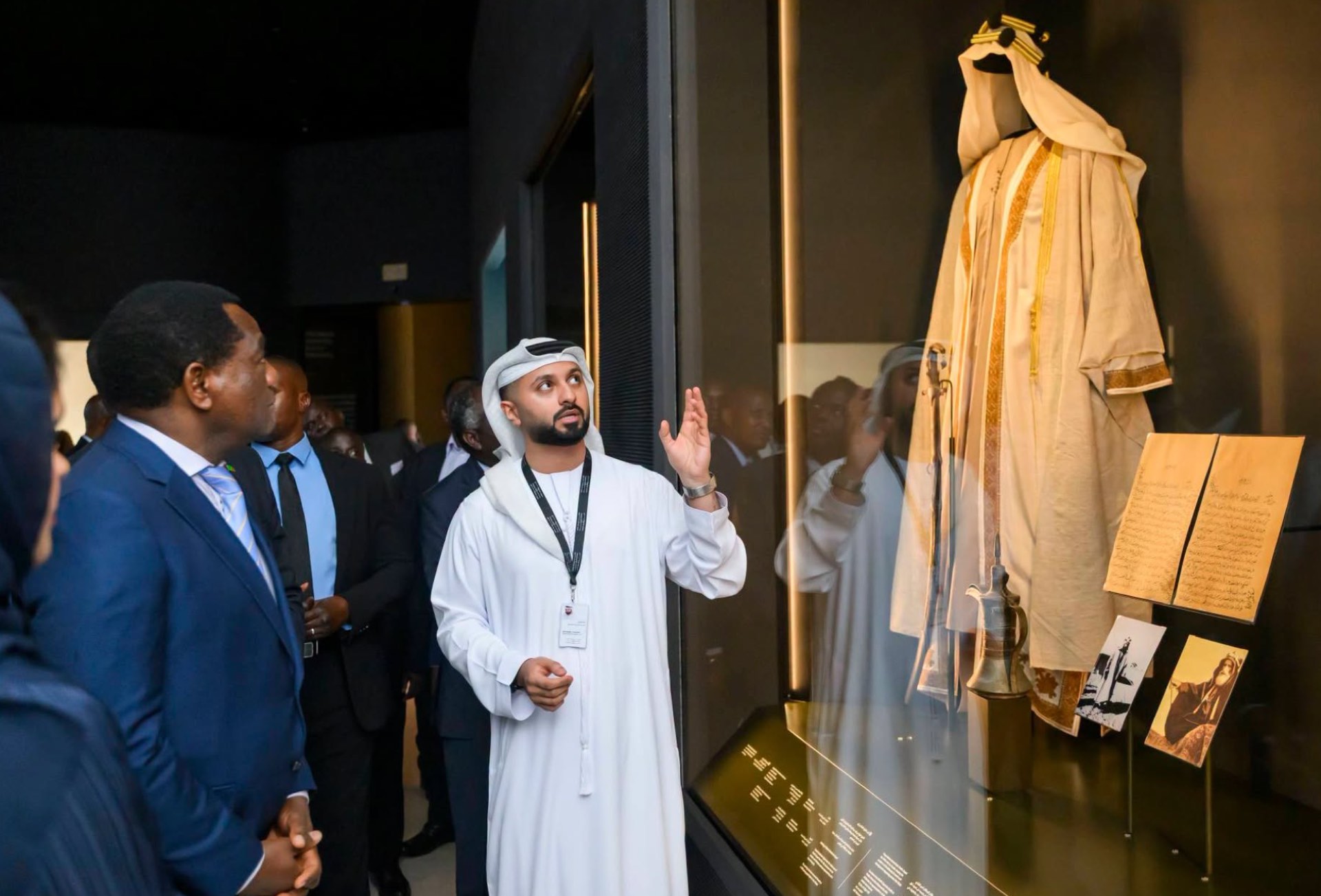
LUSAKA President Hakainde Hichilema closed his working visit to the United Arab Emirates not at a signing ceremony or an investment forum, but at a museum. Before leaving Abu Dhabi, the President toured the Zayed National Museum, the country’s national museum, to, in his words, appreciate the traditions and culture of the Emirati people.
Key Takeaways
- President Hakainde Hichilema ended his working visit to the UAE with a tour of the Zayed National Museum in Abu Dhabi, the UAE’s national museum.
- The museum honours the late Sheikh Zayed bin Sultan Al Nahyan, the Founding Father of the UAE, and traces the country’s development from desert emirates to a diversified economy.
- In his own words, the President said the UAE’s progress “demonstrates what a nation can achieve through hard work and unity.”
- The subtext for Zambia: economic transformation and cultural identity are not competing goals, and the UAE is a working example.
- Zambia and the UAE have been deepening trade and investment ties, and the visit signals Lusaka’s interest in Gulf capital for infrastructure, agriculture and energy.
It was a deliberate choice of venue. The museum honours the legacy of the late Sheikh Zayed bin Sultan Al Nahyan, the Founding Father of the UAE, and offers a full account of how a federation formed in 1971 built itself into one of the world’s most diversified economies. As the President noted, the UAE’s journey “remains steeped in the culture and traditional values of its people.”
His concluding message was blunt: “The UAE’s progress demonstrates what a nation can achieve through hard work and unity.”
What the Zayed National Museum Actually Tells You
The museum, located in the Saadiyat Cultural District, is named after the ruler who unified seven emirates into one state. Its galleries walk visitors through the country’s transformation, from pearl diving and date farming to oil, and then beyond oil into logistics, finance, tourism and renewable energy.
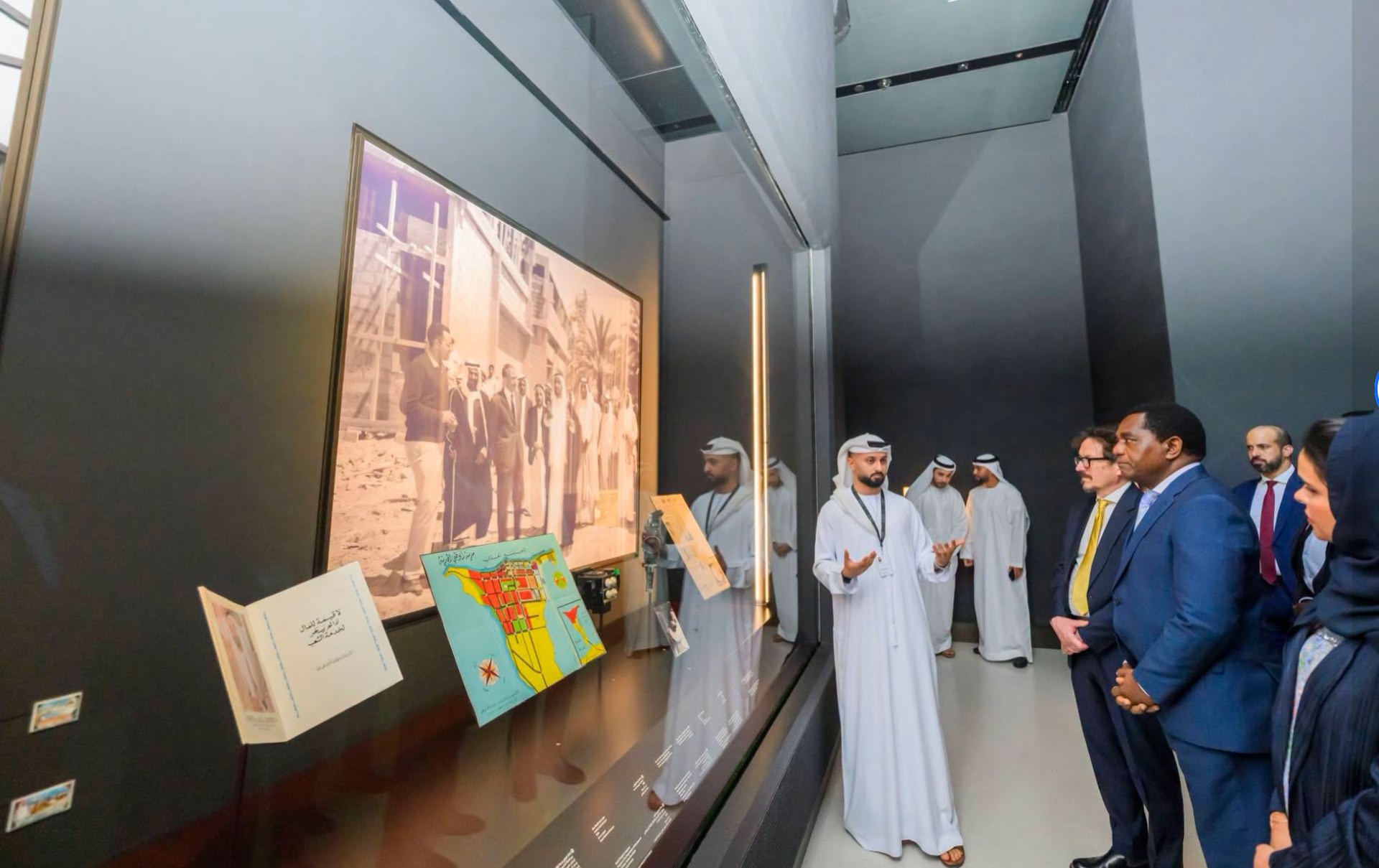
The story the museum tells is a familiar one to any Zambian who has sat through a national development plan. A resource-dependent economy. A leadership that insisted on diversification. Debates about how much of the windfall to spend now and how much to save. The difference is that the UAE executed, and it did so while keeping its national identity front and centre in its capital city.
Why a Museum Visit Matters for Policy
Presidents signal priorities through what they choose to see. A tour of a national museum at the end of an investment-focused working visit says something specific: that the President sees economic transformation and cultural preservation as part of the same project, not separate files for separate ministries.
It also fits a pattern. The UAE has become one of the most courted sources of capital for African economies, pouring billions into ports, energy and agriculture across the continent. Zambia, which has hosted Emirati delegations and signed cooperation agreements covering investment and trade, wants a share of that flow. Understanding how the UAE presents its own development story is part of understanding what Gulf investors look for in a partner: stability, a clear national strategy and a state that finishes what it starts.
The Zambian Parallel, and the Hard Part
Zambia’s own development story has the same opening chapter. A single commodity, copper, has carried the economy since independence, just as oil carried the emirates. The Eighth National Development Plan and Vision 2030 both call for diversification into agriculture, manufacturing and tourism.
The harder chapters are the ones the UAE wrote and Zambia has not. The UAE converted resource revenue into world-class infrastructure, a national airline that connects it to every continent, and sovereign wealth funds that outlasted the oil price cycles. Zambia’s attempts at the same, from the mining windfall debates to the restructuring of external debt completed in 2024, show how much harder this is to do when the resource earnings are thinner and the debt burden heavier.
The museum the President walked through exists because a country that had money also chose to spend some of it on telling its own story. Zambia’s Livingstone Museum, the oldest in the country, has waited decades for that level of attention.
What This Means for Business
For Zambian businesses, the deepening relationship with the UAE is practical, not symbolic. Gulf investment funds are actively looking at African agriculture, energy and logistics, sectors where Zambia has unmet demand and underused assets. Firms positioned in those value chains, and those able to meet the documentation and governance standards Gulf partners expect, are the natural first beneficiaries.
What This Means for Investors
Investors watching Zambia read a visit like this as a signal of where the government is courting capital. The UAE model also carries a reminder: the emirates built investor confidence by delivering projects on schedule and keeping policy predictable. Every delayed mine permit or reversed tariff in Zambia carries a cost that is invisible on the day but compounds over a decade.
What This Means for Policy
The President’s message about hard work and unity is easy to quote and harder to legislate. But the UAE’s experience offers one transferable lesson: economic transformation succeeded there alongside, not instead of, a deliberate investment in national identity and institutions. Zambia’s diversification agenda would be stronger with the same pairing, a cultural sector funded as infrastructure, not decoration.
Conclusion
President Hichilema left Abu Dhabi with a message that fits the moment Zambia is in. The UAE built prosperity in half a century without becoming someone else to do it. The question the visit leaves behind is whether Zambia can pair its own diversification push with the same confidence in its story, its institutions and its people.
Photos: Credit President Hakainde Hichilema’s Official Facebook Page.
By The Zambian Economist Analyst
WARNING! All rights reserved. This material and all other digital content on this website may not be reproduced, published, broadcast, rewritten, or redistributed, in whole or in part, without the prior express permission of The Zambian Economist. Where permission is granted, the content must be clearly credited to “The Zambian Economist,” with “www.zambianeconomist.com” prominently displayed.
WhatsApp: +260775574228 | Email: info@zambianeconomist.com © 2026 The Zambian Economist.
Work With The Zambian Economist: Advertise With Us | List With Us | Submit an Article
Related: Hichilema Returns From Abu Dhabi as Musokotwane Sets the Real Test for US$2.14bn UAE Deals.