
The Electoral Commission declared Hakainde Hichilema re-elected on Tuesday with 60.49% of the vote. The runner-up promised a court challenge, congratulations arrived from Washington to New Delhi, and the kwacha and Zambia’s only dollar bond finished the week almost exactly where they began. Our review of 18 to 22 August, and of what the week did and did not settle.
Key takeaways
- The Electoral Commission declared Hakainde Hichilema re-elected on 18 August with 2,965,326 votes, or 60.49%, against 37.87% for Brian Mundubile. Turnout reached 57.23%, about thirteen points above 2021, and the UPND took 160 of 278 National Assembly seats.
- Mundubile said on 19 August he would ask the Constitutional Court to overturn the result, alleging vote fraud. He has seven days from the declaration to file, and the court fourteen days to hear the petition.
- Markets treated the outcome as continuity. Zambia’s 2033 dollar bond held near 97.7 cents and the kwacha traded around K18.9 to the dollar, the territory it has kept for weeks.
- The second term starts with inflation at 6.5%, the lowest since February 2018, first-quarter growth of 7.7% and a policy rate of 13.25% ahead of a 30 September decision.
- The next fortnight brings the petition deadline on 25 August, a swearing-in reported for 1 September and a fuel price review due at the start of September.
Zambia spent the week after its election finding out what a win actually buys. The answer, by Friday evening, was a court case in the post, a mailbox of congratulations and a market that had barely moved.
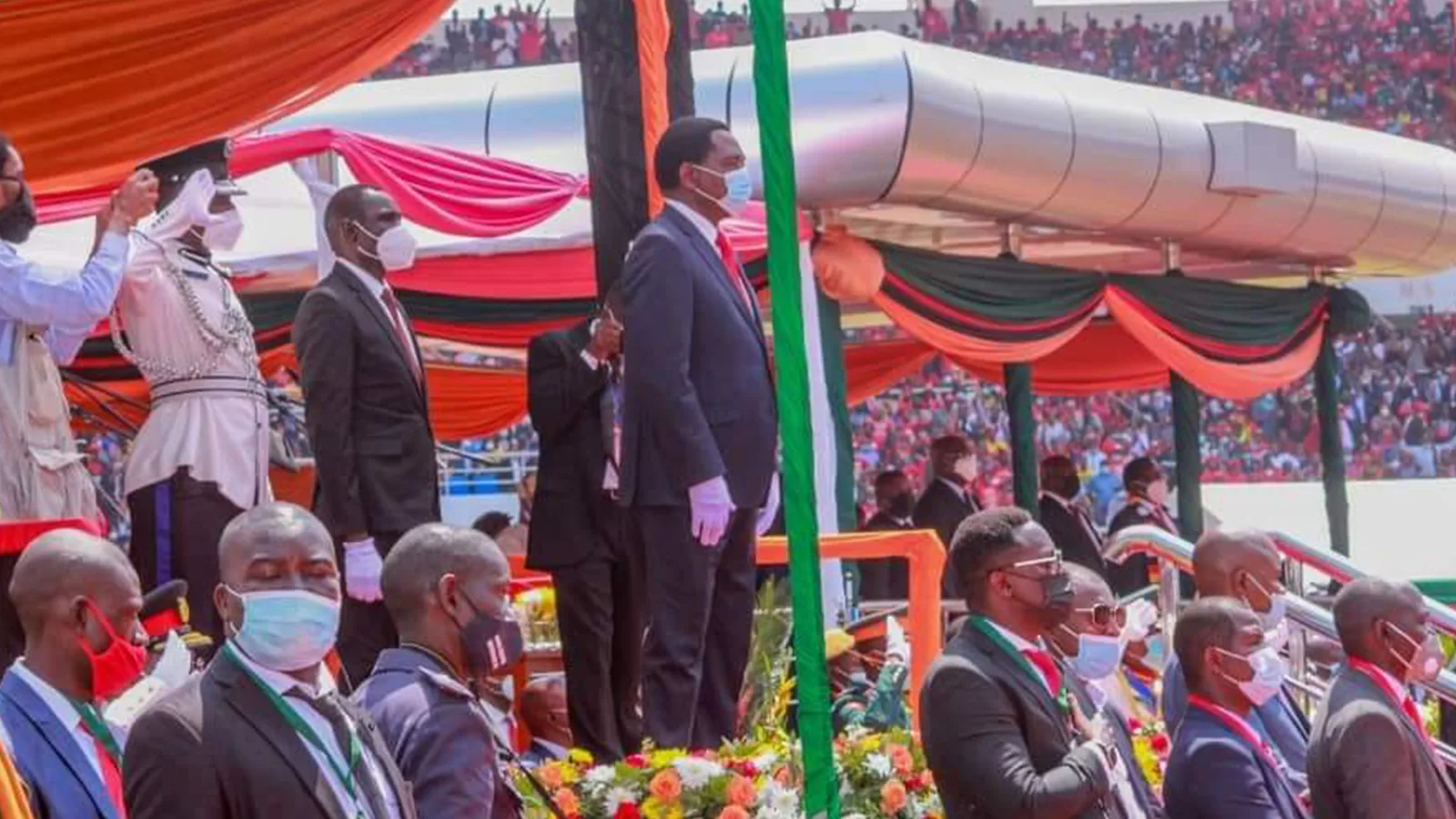
The Electoral Commission declared President Hakainde Hichilema re-elected on Tuesday 18 August, ending a count that had briefly been suspended nationwide after reports of violence and ballot theft. He is the first sitting Zambian president to win a second term since Levy Mwanawasa in 2006. The final tally gave him 2,965,326 votes, or 60.49%, against 37.87% for Brian Mundubile of the National Reconciliation Party for Unity and Prosperity. Turnout reached 57.23%, about thirteen points above 2021, and the President’s United Party for National Development took 160 of 278 seats in a National Assembly elected for the first time with 40 proportional-representation seats added for women, youth and candidates with disabilities. Our election results dashboard carries the full breakdown.
The week that followed the declaration was quieter than the one before it, and that is the story. This review draws on the Electoral Commission, the Bank of Zambia, the Zambia Statistics Agency, the Energy Regulation Board, Reuters, Bloomberg and market pricing to take stock of what changed between Monday and Saturday, and what did not.
What the declaration settled, and what it did not
Politics, for five years. Economics, rather less. The European Union’s observer mission called the election competitive and the count transparent while judging the broader playing field uneven, a verdict that will feed the opposition’s case and do little to unsettle investors who had already decided the outcome was investable.
The grievances that carried Mundubile to 37.87% did not disappear on Tuesday. That share sits within a point of the 38.71% Edgar Lungu managed in 2021, but on a much larger turnout. The protest vote did not shrink. It lost, again, and it now has a parliamentary rump and a court process through which to argue, as our election economics hub has tracked all year.
Congratulations set the tone for the transition. Washington’s message, delivered within two days, signalled continuity in Zambia’s biggest investment relationship. India’s Narendra Modi pledged to strengthen ties, and Kinshasa, the Litunga of the Lozi and Senior Chief Mweemba added theirs. The read from money desks was straightforward: the partners who fund Zambia’s mines, mills and meters intend to keep doing so.
The seven-day clock on the challenge
On Wednesday 19 August Mundubile announced he would ask the Constitutional Court to overturn the result, alleging vote fraud. Reuters reported the announcement; Al Jazeera quoted his campaign saying it had documented “serious irregularities” around the vote.
The constitution gives a losing presidential candidate seven days from the declaration to file, which puts the deadline at Tuesday 25 August, and gives the court fourteen days to hear the petition once it lands. Recent precedent matters here. In 2021 the same court dismissed Edgar Lungu’s petition against his own defeat on procedural grounds, without ruling on the substance. Earlier this year, a full bench threw out Mundubile’s attempt to bar Hichilema from the ballot altogether. A petition is a volatility window, in other words, not obviously a route to overturning 60.49%.
The state is behaving as if the result will stand. Reports in Lusaka point to a swearing-in on Tuesday 1 September, two weeks to the day after the declaration. In 2021 the winner took office while the petition against him was still live, and that remains the working precedent.
Markets had voted before the court opened
The sovereign bond market’s verdict arrived within hours. Zambia’s 2033 dollar bond, its sole international bond, was bid at 97.72 cents after the declaration, broadly unchanged on the day. Investors quoted by Reuters framed the result as continuity and said what they want next is growth.
The currency told the same story with a shrug. The kwacha had firmed to about K18.88 during the count, changed hands at K18.97 on Friday 21 August, up less than half a percent on the day, and has traded in a narrow band for weeks. That calm sits on top of a remarkable run: a gain of about 25% against the dollar in 2025, another 14.8% in the first quarter of this year by Governor Denny Kalyalya’s accounting, and a January that Bloomberg called world-beating before corporate demand for dollars ended the streak. Kwacha government bonds have returned roughly 36% in dollar terms this year, Citi reckons, among the best in emerging markets, and the bank expects the rally to extend on the certainty the result delivered.
A market that does not move is a market that has already priced the outcome, and the reading is double-edged. Zambia gets no re-rating from the election because the re-rating, from default to a B- rating and bond prices in the high nineties, already happened on the first term’s watch. What is left to price is execution. Our fuller assessment of the outlook the second term inherits sets that out.
The scoreboard the second term starts from
The growth news came too late for the campaign but not for the transition. The statistics agency now puts first-quarter growth at 7.7%, against 4.5% in the same quarter of 2025, with agriculture, forestry and fishing contributing 21.7% of the expansion after two drought-scarred seasons. The economy produced K191 billion of output at current prices in the quarter, against K153 billion a year earlier. A Reuters poll of twelve economists sees 6.5% growth for the full year. For a country that managed just 3.8% in 2025, below every official forecast of a year ago, the first quarter is the first hard evidence that 2026 is different.
| Indicator | Latest reading | Detail |
|---|---|---|
| Annual inflation | 6.5% (July) | Lowest since February 2018; unchanged from June (ZamStats) |
| Policy rate | 13.25% | Three cuts since November 2025; next decision 30 September (Bank of Zambia) |
| GDP growth | 7.7% (Q1) | Up from 4.5% a year earlier; agriculture drove a fifth of it |
| Copper output | 447,181 tonnes (H1) | Up 0.45% year on year, with the LME price above $14,000 a tonne |
| Kwacha | K18.97 to the dollar (21 Aug) | Up 14.8% in Q1 after a gain of about 25% in 2025 |
| Petrol pump price | K25.29 a litre | Cut from K26.15 on 1 August; September review due (ERB) |
| Sovereign rating | B- (Fitch), CCC+ (S&P) | Fitch stable outlook, November 2025; S&P affirmed in June |
Two tensions sit inside that scoreboard. Copper is trading above $14,000 a tonne, near record highs, yet the mines produced 447,181 tonnes in the first half, up just 0.45% on the year. Prices are doing the work volumes have not. And inflation, at 6.5% for a second month, sits inside the Bank of Zambia’s 6 to 8% band while the policy rate stands at 13.25%, a real margin near seven percentage points. That gap frames the 30 September rate decision, the first of the new term.
The court’s other ruling emptied an audit office
On Friday the Constitutional Court removed the Auditor-General from office, holding that Mwambwa had passed the constitutional age limit for the post. The ruling came from the same institution that will hear the election petition, in the same week.
In public-money terms this matters more than the news cycle suggested. The Auditor-General audits every ministry, province and spending agency, and hands Parliament the reports on which the Public Accounts Committee works. The office now falls vacant at the exact moment a new parliament convenes and the 2027 budget cycle begins. Whoever fills it inherits the audit backlog of an election year. The vacancy is the sort of detail voters skip and treasuries regret, which is why our Auditor General Explained coverage keeps watch on the office.
Also in governance this week: Sean Tembo retired from active politics after ten years leading the Patriots for Economic Progress, removing from the incoming parliament one of its most numerate opposition voices.
The investment pitch did not wait for the lawyers
Whatever the courts do with the petition, the sales effort carried on. On Friday, Zambian officials pitched South African business leaders at a Johannesburg chamber forum, pressing the case for investment across mining, energy and agriculture. A day earlier, the Zambia-Finland partnership was recast as an investment programme, moving from aid to enterprise.
Two operational realities will test every pitch. Electricity is the first. ZESCO’s load-shedding schedules were updated as recently as Sunday 16 August, and commercial centres in Lusaka and the Copperbelt still face rotating outages, after eight-hour daily rotations were announced for those areas in July. The government had promised relief by this month. The calendars say otherwise.
Fuel is the second. The Energy Regulation Board cut pump prices on 1 August, petrol to K25.29 a litre from K26.15, on the back of international prices falling from about $105.82 to $96.92 a barrel. The next review falls due at the start of September, and the finance minister flagged the war in the Middle East in July as a risk to that run of falling prices.
Business, investor and policy readings
For business
Plan on policy continuity. The tax and mining frameworks that shaped the past three years carry into the new term, and the appointments that follow the swearing-in will tell you how much of the economic team does too. The binding constraint is power, not politics, and firms that budgeted for load-shedding through the third quarter were right to. Watch the September fuel review and the restart of public procurement after 1 September.
For investors
The sovereign bond near 98 cents pays for stability already delivered, so the pricing left in it is execution risk. Three dates carry the story: the 30 September rate decision, where a real rate near seven points gives the Bank of Zambia room to cut into a cleared calendar; the year-end target for a successor IMF arrangement, which the finance minister confirmed in July after the first programme disbursed about $1.7 billion; and copper volumes, which have yet to match copper prices. A court petition is a volatility window, not, on the evidence so far, a repricing event.
For policymakers
The result is simultaneously a mandate for the macro programme and a warning about its distribution. Thirty-seven-point-nine percent on a bigger turnout is a large protest vote, assembled from the cost of living, and it will not disperse on its own. Filling the Auditor-General’s post quickly, and landing the successor IMF arrangement anchored on mining, energy and agriculture, would signal that the second term intends to govern rather than only to win.
What to watch in the next fortnight
- Tuesday 25 August: deadline for the election petition to be filed.
- Within fourteen days of filing: the Constitutional Court’s hearing window.
- Tuesday 1 September: the reported swearing-in date.
- Early September: the ERB’s monthly fuel review, the first after the election.
- Tuesday 30 September: the Bank of Zambia’s next policy rate decision.
- Fourth quarter: talks toward a successor IMF arrangement, targeted for year-end, and drafting of the 2027 budget.
The bottom line
The week removed the question that has hung over Zambian assets all year and replaced it with the question that has hung over the economy for a decade. Who governs is settled. What governing delivers is not. Markets have already paid for the first answer. The second one they will want to see.
Sources
- Electoral Commission of Zambia results, as compiled in The Zambian Economist election dashboard, declared 18 August 2026
- Reuters, Zambian opposition leader to try to overturn election result, 19 August 2026
- Al Jazeera, Zambia’s Hichilema wins second term as president, 18 August 2026
- Reuters via CNBC Africa, Hichilema win gives investors continuity, now they want growth, August 2026
- Zambia Statistics Agency, Economy expands by 7.7 percent, Q1 2026
- Zambia Statistics Agency, Year-on-year inflation rate for July 2026 at 6.5 percent
- Bank of Zambia, Monetary Policy Committee Statement, May 2026
- Energy Regulation Board, August 2026 petroleum pump prices, 1 August 2026
- News Diggers, Copper output rises to 447,181 in H1 2026, 1 August 2026
- Reuters, Zambia hopes to agree new IMF programme by year-end, finance minister says, 16 July 2026
- Fitch Ratings, Fitch Upgrades Zambia to ‘B-‘; Outlook Stable, 28 November 2025
- S&P Global Ratings, Zambia Foreign Currency ‘CCC+/C’ Ratings Affirmed, 8 June 2026
- Bloomberg, Zambian Kwacha Ends World-Beating Run on Corporate Dollar Demand, 13 January 2026
- Trading Economics, US dollar to Zambian kwacha data, 21 August 2026
- State House, President Hakainde Hichilema secures second term, August 2026
- Times of Zambia, ZESCO load-shedding schedule, July 2026; Mwebantu, schedule update, 16 August 2026
WARNING! All rights reserved. This material and all other digital content on this website may not be reproduced, published, broadcast, rewritten, or redistributed, in whole or in part, without the prior express permission of The Zambian Economist. Where permission is granted, the content must be clearly credited to “The Zambian Economist,” with “www.zambianeconomist.com” prominently displayed.
WhatsApp: +260775574228 | Email: info@zambianeconomist.com © 2026 The Zambian Economist.