Key takeaways
- President Hichilema, speaking after his 18 August re-election, warned Zambians against allowing the country to degenerate into one that condones gun culture and militias, and asked supporters to celebrate responsibly, without hurting anyone or damaging property.
- The warning follows the 13 August Kabulonga raid in which security forces seized high-grade military weapons. Six people, including an NRPUP spokesman, are charged and in custody, and presidential candidate Brian Mundubile was named at the scene. NRPUP denies any wrongdoing.
- Zambia’s post-default rehabilitation, its IMF programme and a copper pipeline led by Barrick, First Quantum and KoBold all rest on the state’s control of force. Militia narratives feed straight into sovereign risk.
- Mozambique shows the ceiling: TotalEnergies’ US$20 billion LNG project has sat frozen since 2021 after an insurgency took hold of Cabo Delgado.
- Due process in the insurrection cases is itself an investor signal. Open courts will protect Zambia’s country risk profile as much as the raid did.
Zambia’s election produced two stories this month. The first was a landslide. The Electoral Commission of Zambia declared President Hakainde Hichilema the winner early on 18 August with more than 2.9 million valid votes, enough to avoid a run-off. With 192 of 226 constituencies counted, he led Brian Mundubile of the New Republic Party for Unity and Prosperity by 2,430,702 votes to 1,461,457.
The second story got less celebration. On 13 August, the day polls closed, security forces raided a premises in Kabulonga, one of Lusaka’s wealthier suburbs. Secretary to the Cabinet Patrick Kangwa told ZNBC the occupants had been under surveillance for years and were found with high-grade military weapons, ammunition and materials he described as intended for armed insurrection, some of it linked to foreign nationals and illegal training camps. The occupants fired on officers. Six people, including NRPUP spokesman George Chisanga, are in custody and charged. Mundubile was named as present at the scene. His party denies any wrongdoing.
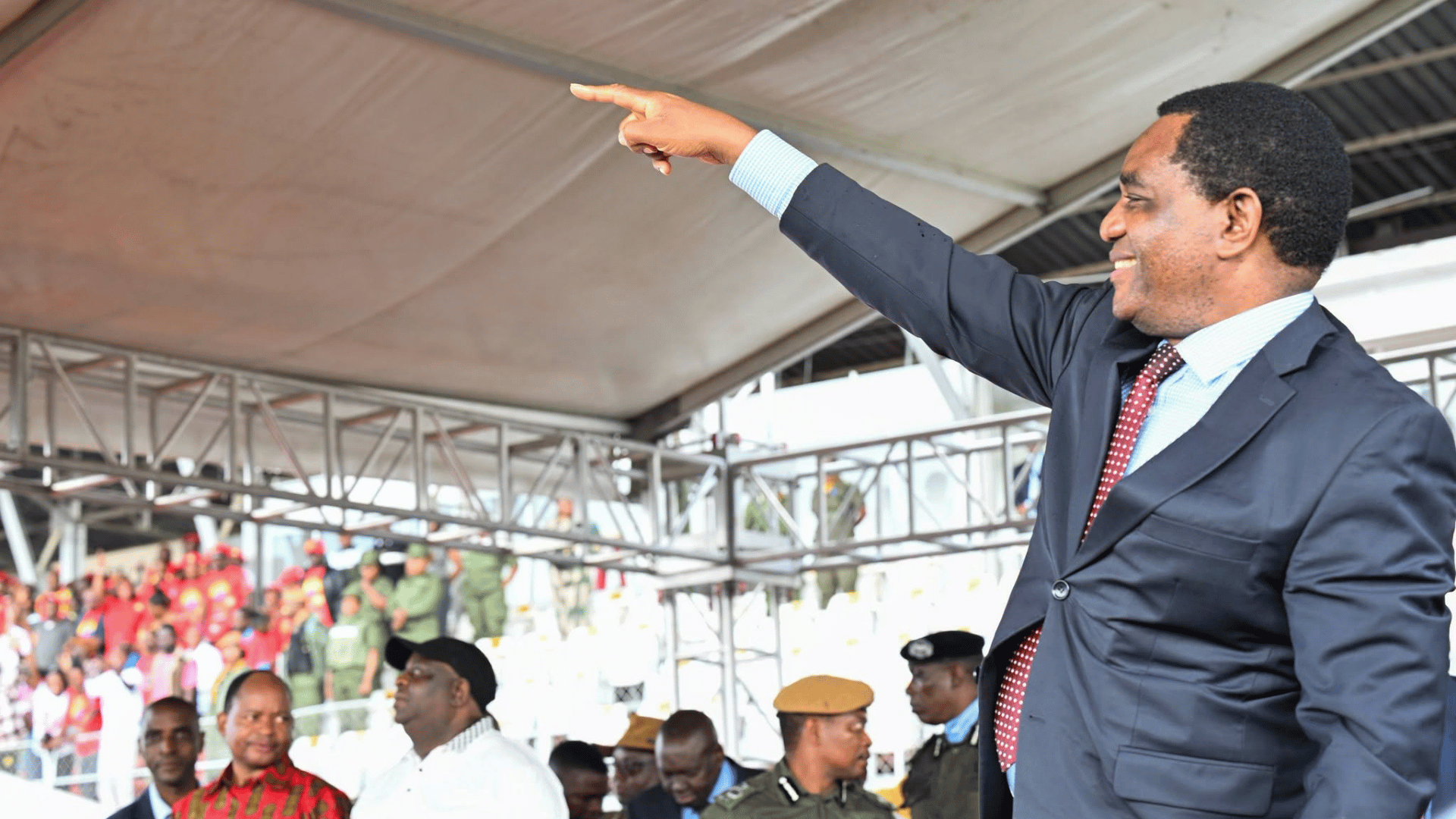
Speaking after the declaration, in remarks reported by the Zambia Daily Mail, the President said citizens should not allow the country to degenerate into one that condones gun culture and militias. You cannot use militias to seek public office, he said, adding that those celebrating his re-election should do so responsibly, without hurting anyone or damaging property.
As politics, the warning lines up with the constitution. As economics, it is exactly right. Militia politics is not a moral problem Zambia’s growth can absorb later. It is a running cost the country cannot pay, and the bill is already itemised in the way lenders, insurers and mining boards price the country.
What the state’s monopoly on force is worth
Max Weber’s old definition of a state is the body that holds the monopoly on the legitimate use of force within its borders. Investors use blunter language: can the government protect the asset, and will it honour the contract? When the answer starts to wobble, everything built on top of it reprices.
Zambia has recent experience of what an orderly state is worth on international markets. It defaulted on its external debt in November 2020 and spent four years repairing the balance sheet: a US$1.3 billion Extended Credit Facility from the IMF approved in August 2022, and a restructuring of about US$3 billion of Eurobonds completed in March 2024, with an 18 per cent haircut and maturities stretched into the 2050s. The kwacha steadied as the Bank of Zambia and the Ministry of Finance worked through the programme. None of that recovery was priced off copper geology alone. It was priced off a state that controls its territory, obeys its own courts and changes government by ballot.
Armed men preparing insurrection in the capital are a direct attack on that assumption. That is why the Kabulonga raid, small in itself, travels further than its casualty count. Markets do not wait for convictions to adjust. They price the accusation.
The copper pipeline prices stability too
The investments courted for the second term are themselves bets on an orderly Zambia. Barrick has committed about US$2 billion to turn Lumwana into a super pit. First Quantum is carrying out its S3 expansion at Kansanshi. KoBold Metals’ Ming Ming deposit in Chililabombwe has been ranked by its backers among the biggest copper finds of the decade. Zambia produced roughly 820,000 tonnes of copper in 2024 against a government target of 3 million tonnes by 2031. On top of the mines sit the US- and EU-backed Lobito Corridor, which routes copper to the Atlantic through Angola, and the 2024 agreement with a Chinese consortium to revive the Tazara railway.
Projects of that scale are underwritten by decade-long assumptions about law and order. A final investment decision reads like a legal document for a reason: the capital must survive five election cycles, not one. Insurgency talk in a campaign season does not merely embarrass the country. It enters the risk annex of every feasibility study on the Copperbelt.
The bill arrives fast
Mozambique ran the experiment for its neighbours. Insurgents took hold of Cabo Delgado from 2017. TotalEnergies declared force majeure on its US$20 billion LNG project in April 2021, days after an attack on Palma, and thousands of jobs and billions in planned revenue went with it. Restart talks are still dragging on years later. One armed group froze more foreign investment in a month than most bad policies manage in a decade.
The table below shows the cheaper channels through which militia risk reaches an economy long before any shot is fired at a mine.
| Channel | What it touches | What to watch |
|---|---|---|
| Sovereign credit | IMF programme reviews and the price of the restructured Eurobonds | Fund mission statements and ratings commentary |
| Currency | Kwacha budgeting for importers, miners and households | Interbank volatility around hearings and headlines |
| Mining investment | Phasing of Lumwana, Kansanshi and Ming Ming spending | Company guidance and final investment decisions |
| Insurance | Political violence cover for shops, fleets and warehouses | Renewal terms quoted to retailers and logistics firms |
| Tourism | Livingstone bookings, conferences and travel advisories | US and UK embassy security alerts |
| Informal trade | Trading days at Soweto and City markets | Security deployments through the celebration period |
One bad night in the markets
The President’s call for responsible celebration deserves to be read as an economic instruction. In the months around the 2016 elections, markets and shops were looted and burnt in Lusaka’s townships, and the government of the day threatened a state of emergency. Traders at Soweto and City markets carry stock bought on credit, and most hold no political violence cover. A single night of disorder can erase a year of margins for hundreds of small firms, and the treasury picks up the bill for deployments, repairs and lost revenue on the other side. Peaceful celebration is not a courtesy the winners owe the losers. It is working capital protection for the informal economy that employs most Zambians.
Due process is part of the product
There is a caveat, and external investors will watch it as closely as the charges. The six people in custody have been charged, and their families and lawyers are to be given access, according to Mr Kangwa. NRPUP denies the allegations, and Mr Mundubile’s own status has been the subject of conflicting reports since election day. If these cases proceed in open court, with counsel and evidence, the state will have strengthened the very asset it is defending. If they drift toward victor’s justice, the risk premium will come back through the courtroom door, because contract enforcement and criminal process are read as one system by the people who price sovereign debt.
Zambia has already seen how quickly Western capitals reach for targeted measures when governance worries them. Washington announced visa restrictions on unnamed Zambian officials over corruption in December 2024. An insurrection case prosecuted cleanly costs the country nothing. A messy one costs it at the next bond auction.
What this means for business, investors and policy
- Business: log any trading disruption now, dates, locations and losses, in case insurance or compensation claims follow; time foreign payments away from court dates and headlines; get political violence renewal terms early; hospitality operators should watch embassy advisories and prepare cancellation terms.
- Investors: the election removed one uncertainty, the result, and replaced it with another, the prosecution, so watch the courts rather than the press conferences. The copper pipeline’s fundamentals are untouched; what moves is the risk premium on its timetable. IMF reviews and restructured Eurobond prices are the cleanest real-time gauge of how external investors price Zambian institutions.
- Policy: disarm party security wings of every colour, including the winners’, or the next election’s militia will claim a precedent; publish the charges and let the courts carry the case; keep policing visible around markets through the celebration period, where disorder does its worst damage in hours.
The arithmetic of the warning
Ballots price policies. Guns price risk. President Hichilema’s warning was aimed at politicians, but its logic is financial: the cheapest asset Zambia owns is a state that answers to voters alone. The country spent four years buying back its credibility at a discount. Militias, whether training in a Kabulonga yard or sitting inside a party structure, sell that credibility short. You cannot use militias to seek public office is a constitutional point first. On the arithmetic, it is also an investment thesis.
Related coverage
- Zambia Holds Its Breath: What the Wait for a Presidential Declaration Means for Business
- Hichilema’s Second Term Must Turn Economic Stability Into Shared Prosperity
- Zambia’s Growth-Household Income Gap: The Economic Question Behind the 2026 Election
- More from our Election 2026 Economics coverage
WARNING! All rights reserved. This material and all other digital content on this website may not be reproduced, published, broadcast, rewritten, or redistributed, in whole or in part, without the prior express permission of The Zambian Economist. Where permission is granted, the content must be clearly credited to “The Zambian Economist,” with “www.zambianeconomist.com” prominently displayed.
WhatsApp: +260775574228 | Email: info@zambianeconomist.com
© 2026 The Zambian Economist.