
Zambia and Suriname have opened a new phase of economic diplomacy, identifying trade, agriculture, energy, mining, investment and education as priorities after Ambassador Sitali Dennis Alibuzwi presented his credentials in Paramaribo.
Key takeaways
- Lieutenant General Sitali Dennis Alibuzwi (Rtd) has been accredited as Zambia’s non-resident ambassador to Suriname.
- Suriname’s government says the credential ceremony took place on 20 August 2026; Zambia’s embassy issued its statement on 21 August.
- The two governments identified trade, agriculture, energy, mining, manufacturing, tourism, investment, culture and education as possible areas of cooperation.
- Alibuzwi presented Zambia’s policy continuity, currency stability and the Lobito Corridor as part of its investment case.
- No trade agreement, investment value or specific commercial project was announced at the ceremony.
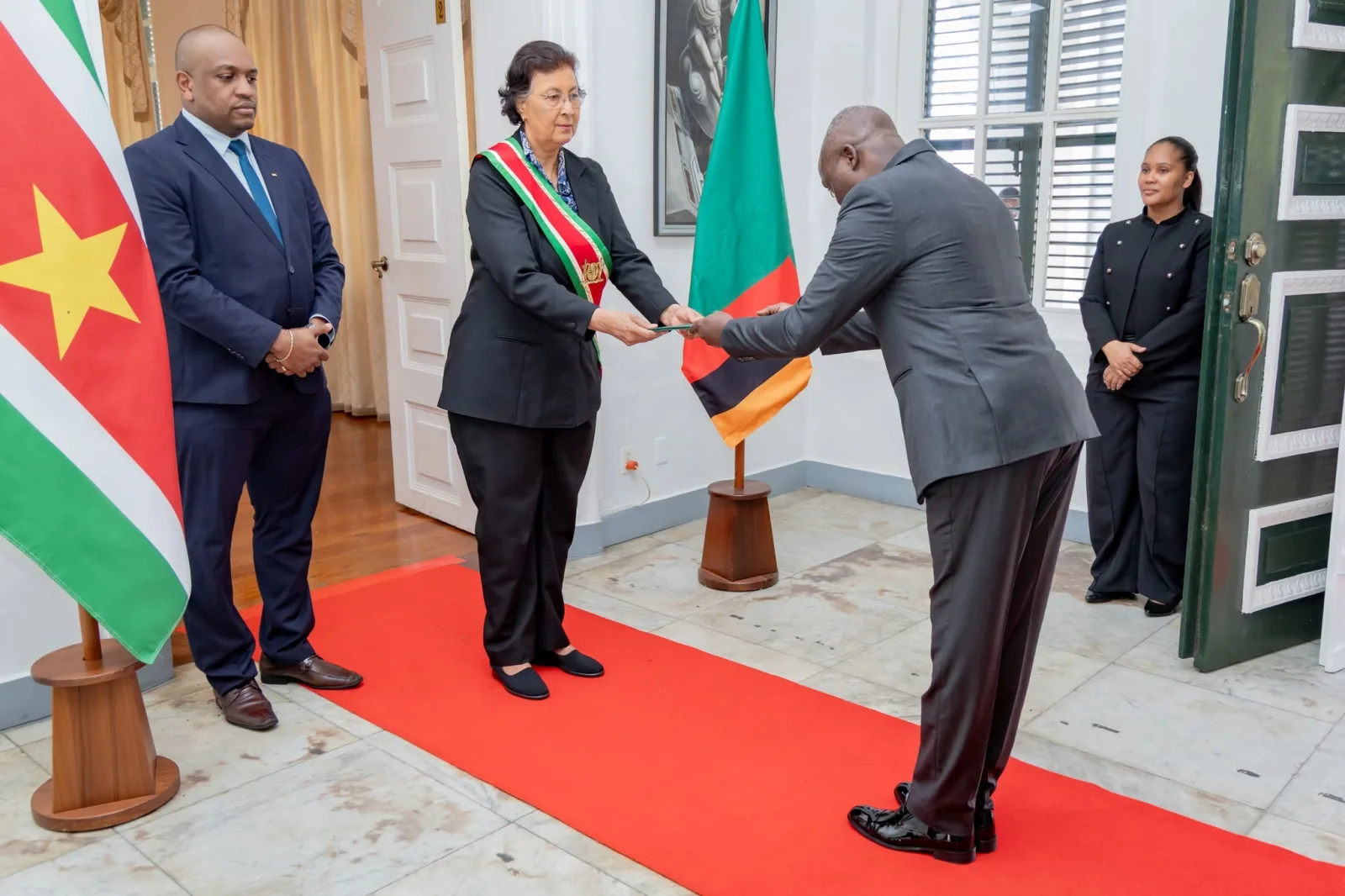
Zambia and Suriname have committed to expanding bilateral relations after Lieutenant General Sitali Dennis Alibuzwi (Rtd) formally presented his credentials as Zambia’s Non-Resident Ambassador Extraordinary and Plenipotentiary to Suriname.
The accreditation gives Zambia a formal diplomatic channel for pursuing commercial and institutional links with the South American country. The immediate task is to convert a broad list of sectors into specific projects, investment contacts and government-to-government agreements.
Alibuzwi presents credentials in Paramaribo
Alibuzwi presented his Letters of Credence to President Jennifer Geerlings-Simons at the Presidential Palace in Paramaribo. Suriname’s government records the ceremony as taking place on Thursday, 20 August 2026. The Zambian embassy statement announcing the accreditation was dated 21 August.
Suriname’s Minister of Foreign Affairs, International Business and International Cooperation, Melvin Bouva, attended the ceremony. Alibuzwi is based in Brasília and will represent Zambia in Suriname on a non-resident basis.
Economic sectors move to the centre of the relationship
Alibuzwi conveyed President Hakainde Hichilema’s interest in cooperation across energy, mining, agriculture, manufacturing and tourism. President Geerlings-Simons identified trade, agriculture, investment, culture and education as areas in which Suriname wants stronger engagement.
The overlap is clearest in agriculture and investment. Both governments can now ask their investment agencies and business associations to identify companies, technical exchanges and projects that match those priorities.
The list remains an agenda rather than a commercial agreement. Neither government announced a trade target, investment value, timetable or named project during the credential ceremony.
Zambia makes its investment case
Alibuzwi argued that Hichilema’s re-election supports policy continuity, investor confidence and macroeconomic stability. He also pointed to the recent stability of the kwacha against the United States dollar.
These claims form part of Zambia’s pitch to potential partners. Investors will still test them against exchange-rate movements, electricity supply, regulatory predictability and the cost of moving goods before committing capital.
Why the Lobito Corridor entered the discussion
The ambassador presented the Lobito Corridor as evidence of Zambia’s improving regional connectivity. The route is intended to link Zambia and the Democratic Republic of Congo to Angola’s Atlantic coast, giving mining and other exporters another channel to international markets.
For Surinamese companies, the corridor may strengthen Zambia’s case as a gateway into Southern and Central African value chains. It does not, by itself, create a direct Zambia-Suriname shipping route, and no logistics agreement between the two countries was announced.
What Suriname wants from wider international partnerships
Suriname’s government says it wants to be seen as a strategic and reliable partner that implements international commitments. It is also seeking economic diversification alongside the expansion of its oil and gas sector, with agriculture, tourism, renewable energy and infrastructure among its wider priorities.
That policy creates room for Zambia to present experience and opportunities in mining, agriculture and regional trade. Suriname, in turn, can offer Zambia a relationship in a resource-rich South American market with its own links to the Caribbean.
What happens after the credential ceremony?
Alibuzwi is expected to meet Surinamese ministries, investment authorities and business representatives in Paramaribo. Those engagements should determine whether the initial sector list produces memoranda, technical cooperation, investment missions or direct business partnerships.
The useful measure will be execution. Diplomatic credentials create access, but businesses need named counterparts, clear regulations, market information and projects with financing. Until those details emerge, the Zambia-Suriname initiative should be treated as a promising opening rather than a completed economic partnership.
Related coverage
- Repositioning Zambia in the Global Economy Through Economic Diplomacy
- From Aid to Enterprise: The Zambia-Finland Partnership Enters Its Investment Years
- Why the World Is Watching Zambia’s Copper
- Economic Diplomacy and Zambia in the Global Economy
WARNING! All rights reserved. This material and all other digital content on this website may not be reproduced, published, broadcast, rewritten, or redistributed, in whole or in part, without the prior express permission of The Zambian Economist. Where permission is granted, the content must be clearly credited to “The Zambian Economist,” with “www.zambianeconomist.com” prominently displayed.
WhatsApp: +260775574228 | Email: info@zambianeconomist.com
© 2026 The Zambian Economist.