A study of tourism stakeholders finds uneven crisis planning and weak coordination. Giving institutions clear responsibilities could matter as much as asking lodges to prepare.
KEY TAKEAWAYS
- The study reports documented crisis plans among 23% of domestic private operators, compared with 67% of government institutions in the research.
- Early warning systems scored 2.52 out of five, the lowest of seven governance measures.
- The authors propose a National Tourism Crisis Coordination Centre, supported by proportionate planning requirements and finance for preparedness.
- These are findings from selected respondents, not a national census. The reported overall governance test did not reach statistical significance at the 5% level.
Zambia’s tourism crisis preparedness depends on whether public agencies and businesses can act together. A lodge’s evacuation procedure can protect its guests, but it cannot organise destination-wide warnings or decide which institution leads a response.
That is the institutional problem examined in research my colleagues Norman Kachamba, Chaste Nsama and I published in the African Scientific Annual Review. It complements the Zambia Crisis Management and Resilience Model discussed in my previous article, examining the governance arrangements needed to make preparedness work.
Who takes charge when a tourism crisis hits?
The study describes responsibilities spread across tourism authorities, disaster management bodies, provincial offices and industry associations. Each has part of the job. The difficulty is establishing who coordinates those parts, with what authority and what budget.
Interview evidence points to unclear responsibilities, limited enforcement capacity and spending priorities that favour immediate operations over preparedness. Those findings are the researchers’ assessment of the institutions examined, rather than a fresh audit of every agency’s current arrangements.
The economic consequence is practical. If operators receive inconsistent information, they may make different decisions about guest safety, cancellations or reopening. For a small tourism business, disruption can mean lost bookings while wages and supplier bills still fall due. The study does not calculate those losses in kwacha.
What the crisis-plan figures show
The research reports a sharp difference between organisation types. Documented plans were more common among government institutions and international operators than among domestic businesses or community organisations.
| Organisation type | Reported formal crisis-plan rate |
|---|---|
| Government institutions | 67% |
| International tourism operators | 54% |
| Domestic private operators | 23% |
| Community-based tourism organisations | 12% |
Source: Ernest, Kachamba and Nsama (2026), Table 2. Rates describe the organisations represented in the study; subgroup counts are not provided in the table.
A written plan is a starting point. Its existence alone does not show that staff know their roles, emergency contacts work or an evacuation has been rehearsed. Conversely, an operator without a formal document may have some informal arrangements. Policy should test practical readiness as well as paperwork.
Early warnings are the weakest link
Among seven governance measures, the availability and functionality of early warning systems received the lowest average score, 2.52 on a five-point scale. Inter-agency coordination followed at 2.63. Alignment with international frameworks scored highest, at 3.24.
That pattern suggests a gap between familiarity with recognised standards and the ability to put them into daily operation. Respondents also identified demand for assistance: 97.8% endorsed real-time crisis information and early warnings, and the same proportion endorsed financial support for preparedness investment. Technical assistance for writing plans received 89% support.
For a camp in Kafue or South Luangwa, information must arrive in a form staff can use. The paper recommends accessible mobile communication infrastructure, with the Zambia Tourism Agency administering the platform. A useful operational test would be whether an alert reaches the responsible person and tells that person what action to take.
How strong is the evidence?
The study describes a mixed-methods sample of 137 stakeholders across Livingstone, Lusaka, South Luangwa National Park and Kafue National Park. It combines questionnaires, interviews and policy-document analysis, using purposive selection to include people with relevant experience.
The quantitative governance analysis reports 46 respondents. Its overall average of 2.88 sits below the neutral midpoint of three, but the paper’s reported p-value of 0.066 does not meet the conventional 0.05 threshold. It should not be presented as a statistically conclusive finding that national governance is inadequate.
There are further limits. The methodology lists 16 interview participants alongside questionnaire groups that already total 137, without clearly explaining overlap. Organisation-level denominators are also absent from the crisis-plan table. The findings identify concerns worth investigating and addressing; they do not establish precise national rates or prove that a particular reform will work.
What would a coordination centre actually do?
The proposed National Tourism Crisis Coordination Centre would need a defined statutory mandate, staff and a funded operating role. Its purpose would be to coordinate institutions that already have responsibilities, rather than leave operators to work out the chain of command during an emergency.
Establishing another office would have little value if it added an approval stage without improving response. Government would need to specify who issues warnings, who authorises sector-wide action and how responsibilities connect to the Disaster Management and Mitigation Unit. Joint exercises would reveal whether that arrangement works before a real crisis tests it.
The paper also recommends integrating tourism representatives into national disaster coordination committees and including tourism enterprises in simulation exercises. These are proposals, not announcements that a centre or new regulatory regime has been established.
What this means for businesses and investors
For domestic operators, mandatory planning would be more workable if requirements reflected business size and risk. A small guesthouse needs an accessible template and practical help. Larger operators can reasonably be expected to maintain more detailed systems. The study recommends graded requirements backed by inspections.
Finance matters too. The authors propose a Tourism Crisis Resilience Fund, supported by government, development partners and sector contributions, including assistance with insurance for smaller enterprises and community organisations. Funding sources, eligibility rules and oversight would have to be settled before businesses could rely on it.
Investors can already ask specific questions: has the business tested its plan, identified a response leader and checked how it receives official warnings? Those questions turn resilience from a broad promise into something that can be examined during due diligence.
The next policy step should be a clear allocation of responsibilities, supported by a costed implementation plan. Tourism businesses need to know whom to call, which instruction to follow and what help they can expect when normal operations stop.
Explore our Business & Economy coverage and Leadership & Governance analysis. Related: Lusaka’s tourism investment pitch in Busan. Find sector businesses in the Business Directory or browse Events.
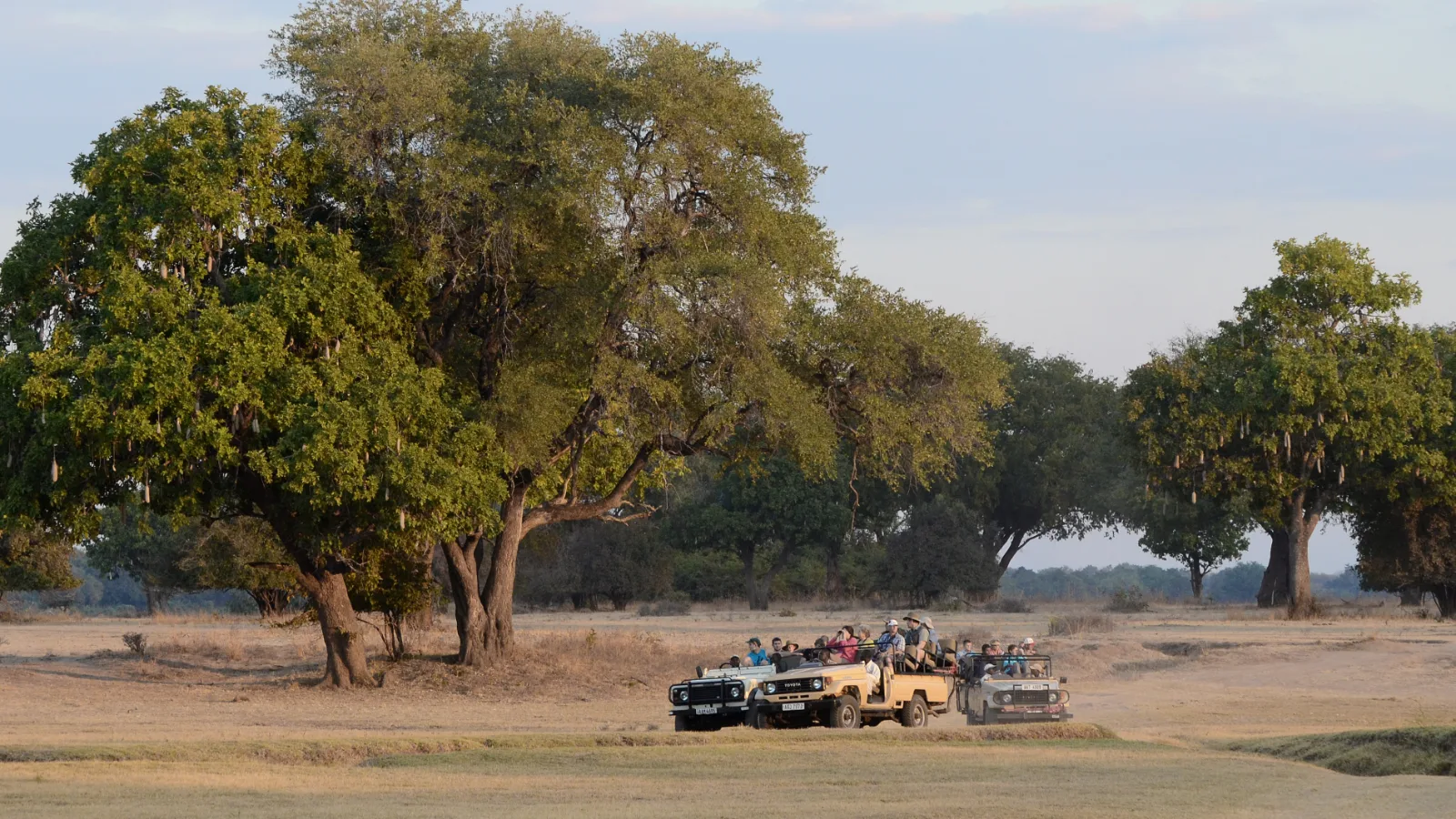
Photograph: “Jeep fleet”, safari vehicles in South Luangwa National Park, by Geoff Gallice / Wikimedia Commons, CC BY 2.0. Cropped and converted to WebP. Illustrative photograph, taken in 2011; it does not document the research or an emergency.

Dr Bruce Ernest is a researcher at the University of Zambia. This article draws on research co-authored with Norman Kachamba and Chaste Nsama: “Institutional frameworks and crisis governance in Zambia’s tourism industry: An empirical assessment of policy capacity and structural challenges”, African Scientific Annual Review, 3(1), 60–66 (2026). Read the original study. See also his previous article.
WARNING! All rights reserved. This material and all other digital content on this website may not be reproduced, published, broadcast, rewritten, or redistributed, in whole or in part, without the prior express permission of The Zambian Economist. Where permission is granted, the content must be clearly credited to “The Zambian Economist,” with “www.zambianeconomist.com” prominently displayed.
WhatsApp: +260775574228 | Email: info@zambianeconomist.com
© 2026 The Zambian Economist.
The photograph retains its separate Creative Commons licence.